
The Nasdaq's 3.54% Drop: What Investors Should Fear and What They Should Embrace
The Nasdaq Composite's 3.54% drop in October 2025 has sent shockwaves through global markets, marking one of the most significant corrections since the AI-driven rally of 2024. While short-term volatility often triggers panic, this downturn presents a nuanced opportunity for long-term investors. By dissecting the root causes of the decline and aligning strategies with macroeconomic realities, investors can transform uncertainty into a catalyst for growth.
What Investors Should Fear
The drop was fueled by a confluence of factors, each amplifying market fragility. Political uncertainty loomed large as polls tightened ahead of the 2025 election, with investors bracing for potential shifts in trade, fiscal, and regulatory policies. Nasdaq's October review underscores how such uncertainty erodes confidence, prompting profit-taking and risk-off behavior (Nasdaq's October review).
Simultaneously, mixed economic signals created a volatile backdrop. While the September jobs report exceeded expectations, job openings data softened, and inflationary pressures lingered near the Federal Reserve's 2% target. This duality left investors grappling with divergent narratives about the economy's trajectory, the Nasdaq review noted. Compounding this, a bond market selloff pushed Treasury yields higher across the curve, signaling a flight to safety and dampening equity valuations, as that review observed.
Perhaps most critical was the AI bubble fears narrative. After a year of speculative fervor around artificial intelligence, investors began re-evaluating "growth at all costs" strategies. A Financial Content analysis notes that the Nasdaq's record intraday high of 23,062.62 on October 9 was swiftly followed by a sharp correction as profit-taking and skepticism about AI's long-term profitability took hold (Financial Content analysis).
What Investors Should Embrace
While these risks are valid, the drop also creates a buying opportunity for disciplined investors. The Nasdaq's 20% surge in the first half of 2024 was driven by tech giants like Microsoft, Apple, and Nvidia, which remain fundamentally strong despite short-term overcorrections, as a Fool article observed (Fool article). A 3.54% decline in a high-growth index often represents a temporary setback rather than a collapse, particularly when earnings and innovation pipelines remain robust.
Moreover, volatility itself is a feature, not a bug, for long-term growth. Historically, periods of sharp correction have been followed by rebounds as markets realign with fundamentals. For instance, that Nasdaq review highlights how turbulent months often precede strategic entry points for investors who prioritize resilience over timing. Diversification across sectors and geographies can further mitigate risk while capitalizing on undervalued assets.
A strategic rebalancing of portfolios is also warranted. As the Federal Reserve's stance on interest rates remains pivotal, investors should prioritize companies with strong cash flows and pricing power-traits that buffer against rate hikes, a financeworld analysis suggests (financeworld analysis). For example, tech firms with recurring revenue models (e.g., cloud services) are better positioned to weather macroeconomic headwinds than speculative plays.
Conclusion
The Nasdaq's 3.54% drop in October 2025 is a reminder that markets are inherently cyclical. While political uncertainty, economic mixed signals, and AI skepticism warrant caution, they also create fertile ground for long-term growth. By focusing on fundamentals, diversification, and strategic rebalancing, investors can turn volatility into a stepping stone for outperforming the market. As history shows, those who embrace uncertainty with a clear-eyed perspective often emerge with the greatest rewards.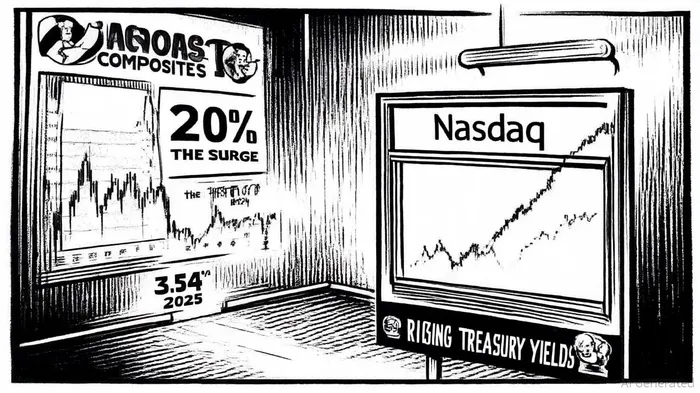







Comentarios
Aún no hay comentarios