
The Nasdaq-100 Tech Shuffle: Identifying the True Winners of the AI-Driven Investment Cycle
The Nasdaq-100 has long been a barometer of technological innovation, but in 2025, its trajectory is being reshaped by artificial intelligence (AI). With the Magnificent 7 companies alone allocating $380 billion to AI infrastructure-a 54% year-over-year surge-investors are scrambling to identify which firms are not just riding the AI wave but anchoring it. The stakes are high: while 65% of enterprises now use generative AI regularly, a MIT study reveals that 95% of companies have yet to see meaningful profit and loss impacts from AI adoption. This gap between investment and returns underscores the need for a discerning approach to stock selection.
The Hyperscalers: Building the AI Infrastructure of Tomorrow
Microsoft, AmazonAMZN--, Alphabet, and MetaMETA-- dominate the AI infrastructure landscape, with their combined 2025 capital expenditures projected to reach $400 billion by 2026. Microsoft's Azure division, for instance, reported 33% year-over-year revenue growth, with AI contributing 16 percentage points of that expansion. 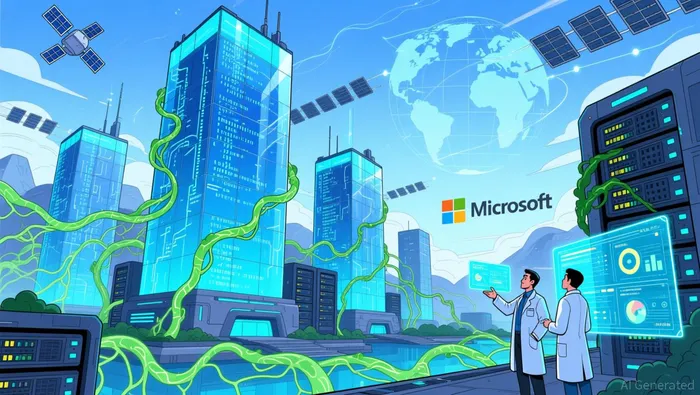 Alphabet's Google Cloud also saw a 34% revenue jump to $15.2 billion, driven by AI infrastructure and generative AI solutions. These firms are not merely investing in AI; they are embedding it into their core operations, creating flywheels of data, compute, and customer lock-in.
Amazon and Meta are equally aggressive. Meta's $72 billion full-year capex guidance for 2025 reflects its commitment to AI-driven ad platforms and metaverse initiatives according to financial reports. Amazon, through AWS, continues to lead in enterprise AI solutions, leveraging its cloud dominance to capture a 8.82% market share in the AI sector.
Independent AI Model Developers: The New Power Players
Beyond the hyperscalers, standalone AI model developers like OpenAI and Anthropic are rewriting the rules of monetization. OpenAI's annualized revenue skyrocketed from $200 million in early 2023 to $13 billion by August 2025, fueled by consumer demand for ChatGPT. Anthropic mirrored this trajectory, with revenue surging from $87 million in early 2024 to $7 billion by late 2025. These figures highlight a critical shift: AI is no longer a cost center but a revenue engine.
However, profitability remains a concern. Goldman Sachs' Eric Sheridan warns that only a few tech firms earn excess returns on their cost of capital, raising questions about the sustainability of current investment levels. MicrosoftMSFT-- and Palantir Technologies, with gross margins of 68.76% and 69.85% respectively, demonstrate that profitability is achievable. In contrast, companies like C3.ai, despite growing revenue, struggle to turn a profit, signaling the need for caution.
Market Share Dynamics: NVIDIA's GPU Dominance and the Cloud Giants
NVIDIA's leadership in AI hardware is unparalleled. With a $4.40 trillion market cap and 15.75% of the AI sector, its GPUs power the training and inference workloads of nearly every major player according to market analysis. This dominance is unlikely to wane, given the insatiable demand for AI compute. Meanwhile, Microsoft and Alphabet hold 12.87% and 13.50% of the AI sector, respectively, leveraging their cloud platforms to cement long-term market share.
The broader AI market is also consolidating. U.S.-based AI companies captured 64% of global venture capital spending in H1 2025, a trend that favors Nasdaq-100 constituents with deep pockets and global reach.
Strategic Stock Selection: Balancing Growth and Profitability
For investors, the key lies in balancing AI-driven growth with financial discipline. Microsoft and NVIDIA exemplify this balance: Microsoft's Azure backlog and NVIDIA's GPU demand suggest durable growth, while their strong margins indicate operational efficiency. Conversely, firms like C3.ai, despite AI-driven revenue growth, require closer scrutiny due to their lack of profitability.
Independent AI developers like OpenAI and Anthropic present high-risk, high-reward opportunities. Their explosive revenue growth is undeniable, but their reliance on consumer adoption and venture capital funding introduces volatility. Similarly, Elon Musk's xAI, with annualized revenue rising from $100 million to $500 million in 2025, shows promise but lacks the infrastructure moats of the hyperscalers.
Conclusion: Navigating the AI Investment Cycle
The Nasdaq-100's AI-driven reshuffle is in full swing, but not all participants are created equal. The true winners-Microsoft, NVIDIA, and the leading hyperscalers-are those that combine aggressive AI investment with sustainable profitability. As the sector matures, investors must prioritize companies that demonstrate not just AI adoption, but AI-led monetization. In a market where 95% of AI investments have yet to yield significant returns, the ability to convert AI into profit will separate the leaders from the laggards.





Comentarios
Aún no hay comentarios