
Myanmar's Military-Backed Election and Its Implications for Global Resource Investors
The critical minerals sector in Myanmar has emerged as a focal point in the global race for rare earth elements (REEs), particularly heavy rare earth elements (HREEs) like dysprosium and terbium, which are indispensable for electric vehicles, wind turbines, and advanced defense systems. However, the sector's potential is shadowed by the political instability following the 2021 military coup and the contested 2025 election, which has reshaped governance, regulatory frameworks, and foreign investment dynamics. For global investors, the interplay of geopolitical risks, environmental degradation, and shifting power balances in Kachin and Shan states presents a complex landscape of both challenges and opportunities.
Geopolitical Risks: Fractured Governance and Ethnic Conflict
The military-backed election in December 2025, held under a draconian electoral law, has further entrenched the Tatmadaw's control over resource governance, despite losing territorial dominance in key mining regions. The Kachin Independence Army (KIA), now a de facto governing body in Kachin State, seized critical mining hubs like Pangwa and Chipwi by late 2024, disrupting rare earth shipments to China and leveraging the resource as a diplomatic tool. This shift has fragmented authority, with non-state actors like the KIA imposing taxes and regulating trade, while the military regime retains legal but contested control over national policy.
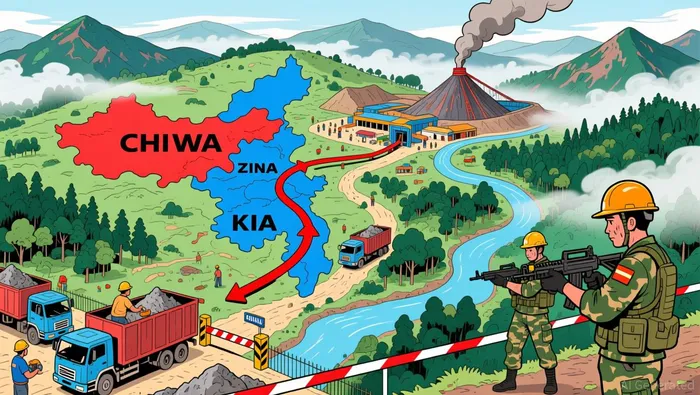
China's response to the KIA's control was swift: border closures and a temporary halt to rare earth imports until a fixed-price agreement of 35,000 yuan per metric ton was established in April 2025. This arrangement underscores China's strategic reliance on Myanmar's HREEs, which supplied 50–60% of global demand in 2023. However, the KIA's role as a gatekeeper has introduced volatility into supply chains, with global prices for terbium oxide spiking due to disrupted flows. For foreign investors, the lack of stable governance and the risk of expropriation or sanctions under U.S. and OECD frameworks remain significant barriers.
Economic Implications: Export Booms and Environmental Costs
Myanmar's rare earth exports surged post-2021, with USD 3.6 billion in shipments to China between 2021 and 2024-84% of the total value from 2017 to 2024. The 2023 export value alone reached USD 1.4 billion, the highest annual figure on record. Yet, this growth has come at a steep environmental and social cost. Unregulated mining in Kachin State has led to deforestation, groundwater contamination, and toxic runoff, with local communities reporting respiratory and skin diseases and declining agricultural productivity.
The military regime's 2016 Investment Law and 2018 Companies Law, which restrict foreign ownership in critical sectors, further complicate investment. Stricter import licensing and foreign currency controls have forced many foreign firms to suspend operations or exit the market. Meanwhile, the KIA's taxation of mining activities has reduced China's imports, creating a ripple effect on global markets and prompting alternative players like India to explore partnerships. India Rare Earths Limited (IREL) visited Kachin in late 2024, but logistical and processing challenges limit its ability to scale operations.
Opportunities Amidst Instability: Strategic Alliances and Global Demand
Despite the risks, Myanmar's critical minerals sector holds strategic allure. The U.S. and India have shown interest in diversifying supply chains away from China, with the Trump administration exploring partnerships with the KIA and Tatmadaw in 2025. India's limited domestic HREE reserves make access to Myanmar's deposits vital for reducing reliance on Chinese processing. However, these efforts face hurdles, including underdeveloped infrastructure and the KIA's dominance in upstream extraction.
The global push for clean energy technologies also positions Myanmar as a key player. HREEs are critical for permanent magnets in wind turbines and electric vehicles, and Myanmar's deposits are expected to remain significant through 2030. Yet, the sector's long-term viability hinges on addressing environmental degradation and stabilizing governance. The military's 2025 investment incentives, which expanded opportunities in renewable energy and infrastructure, signal an attempt to attract foreign capital, though their credibility is undermined by ongoing conflict and sanctions.
Conclusion: Navigating a High-Risk, High-Stakes Landscape
For global investors, Myanmar's critical minerals sector embodies a paradox: immense strategic value amid profound instability. The military-backed election has consolidated power in the Tatmadaw while ethnic armed groups like the KIA assert control over resource-rich regions. This fragmented governance, coupled with environmental and regulatory risks, demands a cautious approach. While alternative partners like India and the U.S. seek to exploit Myanmar's deposits, the lack of transparent frameworks and the dominance of Chinese processing infrastructure ensure that Beijing remains the dominant player.
Investors must weigh the potential rewards of accessing HREEs against the realities of geopolitical volatility, environmental harm, and reputational risks. As the global demand for clean energy technologies grows, Myanmar's role in the rare earth supply chain will remain pivotal-but only if stakeholders can navigate the complex interplay of conflict, corruption, and climate.







Comentarios
Aún no hay comentarios