
MVB Financial (MVBF) Earnings Miss and Analyst Downgrades: A Growing Risk for Long-Term Investors?
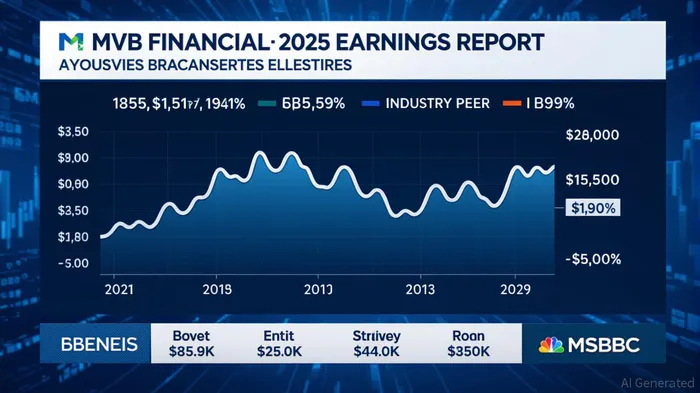
The recent earnings report from MVB FinancialMVBF-- (MVBF) has raised significant concerns for long-term investors. The company's Q2 2025 results—a 42% miss on earnings per share (EPS) and a 6.06% revenue shortfall—highlight a troubling divergence from both analyst expectations and broader industry trends. While the banking sector, particularly the Banks - Northeast subindustry, has shown resilience in 2025, MVB Financial's performance underscores structural challenges that could amplify risks for its shareholders.
A Stark Earnings Disappointment
MVB Financial reported Q2 2025 EPS of $0.15, far below the Zacks Consensus Estimate of $0.31, marking a 51.61% earnings surprise. This miss was compounded by a revenue decline to $33.73 million, which fell short of the $35.33 million forecast. The company attributed the shortfall to timing issues in loan growth, where provisioning occurred without corresponding interest income. While pre-tax, pre-provision income rose 3.5% and noninterest income grew 13.4%, these gains were insufficient to offset the drag on profitability.
The earnings miss has already triggered a 14.1% year-to-date stock price decline, despite the broader market's 8.6% gain. Technical indicators, including a MACD Death Cross and KDJ Death Cross on the 15-minute chart, suggest further downward pressure. Analysts have downgraded EPS forecasts for 2025, cutting the estimate from $1.21 to $1.05—a 13.2% reduction—while revenue is projected to contract at an annualized rate of 3.4% by year-end. This contrasts sharply with the industry's 7.6% annual revenue growth forecast.
Industry Peers Outperform
MVB Financial's struggles are amplified when compared to its peers. For instance, Northeast Bank, a key competitor in the Northeast banking sector, reported Q4 2024 net income of $15.1 million (up 24.8% year-over-year) and a 9.55% annual loan growth rate. Its National Lending Division achieved a 9.37% loan yield, significantly higher than MVB Financial's net interest margin of 3.66%.
Capital metrics also favor peers. Northeast Bank's Tier 1 leverage ratio of 12.3% and Total Risk-Based Capital Ratio of 14.8% reflect robust capitalization, while MVB Financial's Zacks Rank #3 (Hold) suggests a neutral outlook. The broader Banks - Northeast industry ranks in the top 15% of Zacks industries, yet MVB Financial's underperformance—despite a 3.5% deposit growth and 8.5% deposit increase—indicates operational inefficiencies.
Leadership Changes and Strategic Uncertainty
The departure of CFO Don Robinson and CEO Larry Mazza's return to President adds another layer of risk. Leadership transitions during periods of financial stress can disrupt strategic clarity, particularly when earnings volatility persists. While MVB Financial has repurchased $6.4 million in shares, this action may not offset the reputational damage from repeated earnings misses.
Investment Implications
For long-term investors, the key question is whether MVB Financial can reverse its trajectory. The company's upcoming Q3 2025 earnings report (expected October 30, 2025) will be critical. Analysts project $0.39 EPS and $37.7 million in revenue, but these figures must be viewed skeptically given the current trajectory.
Investors should also monitor the company's ability to align with industry benchmarks. For example, Northeast Bank's 16.6% return on average equity (ROAE) versus MVB Financial's 2.0% ROAA highlights a stark efficiency gap. If MVB Financial cannot improve its capital utilization or address loan timing issues, its Zacks Rank may deteriorate further.
Conclusion
MVB Financial's earnings miss and deteriorating forecasts signal a growing risk for long-term investors. While the company has shown pockets of strength—such as deposit growth and a Zacks Rank #3—it remains out of sync with industry peers. The combination of weak revenue growth, leadership uncertainty, and technical indicators pointing to a potential downtrend warrants caution. Investors should prioritize monitoring the October earnings call and consider hedging exposure until the company demonstrates a clear path to aligning with sector performance. In a market where resilience is key, MVB Financial's current trajectory may not justify long-term optimism.





Comentarios
Aún no hay comentarios