
Can Mutuum Finance (MUTM) Outperform Shiba Inu and Capture DeFi's Next Big Opportunity?
In the ever-evolving DeFi landscape, contrarian investors are increasingly prioritizing tokenomics-driven narratives over hype. Two projects-Mutuum Finance (MUTM) and Shiba InuSHIB-- (SHIB)-stand at a crossroads of potential, but their trajectories diverge sharply in design and execution. This analysis examines whether MUTM's structured tokenomics and utility-first approach can outperform SHIB's speculative deflationary model, positioning it as a prime candidate for DeFi's next big opportunity.
Tokenomics: Utility vs. Speculation
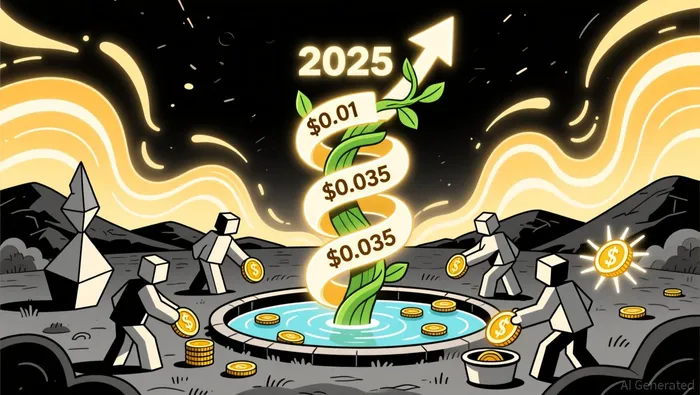
Mutuum Finance's tokenomics are engineered for active utility and sustainable growth. With a capped supply of 4 billion tokens, MUTM's presale has already raised $19.3 million, selling 820 million tokens (20.5% of total supply) across 18,600 holders according to the press release. The token's price has surged 250% from $0.01 to $0.035 since early 2025, driven by a phase-based appreciation model that increases the price by 20% in each subsequent presale stage. Crucially, MUTM's value is tied to real protocol activity: lenders depositing assets receive mtTokens, which appreciate as borrowers repay interest, creating a yield mechanism directly linked to usage.
In contrast, Shiba Inu (SHIB) relies on a passive deflationary model with a staggering 589 trillion circulating tokens. While SHIBSHIB-- burns tokens via Shibarium gas fees and community initiatives, its massive supply dilutes the impact of these burns. For instance, even after burning 410 trillion tokens, SHIB's weekly burn rate in December 2025 dropped by 96.96%, halting its deflationary momentum. Analysts argue that SHIB's price targets-such as $0.000018 by 2028-depend on Shibarium's ability to attract developers, a structural challenge given its sub-$1 million TVL.
Deflationary Mechanisms: Active Buybacks vs. Passive Burns
MUTM's deflationary strategy is dynamic and revenue-driven. A portion of protocol revenue from borrowing fees is allocated to open-market buybacks, with purchased tokens redistributed to mtToken stakers. This "buy-and-distribute" model not only reduces circulating supply but also incentivizes long-term participation, creating a flywheel effect. As usage grows, so does the intensity of buybacks, compounding value for stakeholders.
SHIB's deflationary mechanism, however, is static and supply-dependent. While its burn rate spiked by 10,728% in early 2026, this volatility underscores the fragility of its model. With a circulating supply of 589 trillion tokens, even massive burns (e.g., 173 million SHIB in a single day) have minimal price impact. Moreover, SHIB's utility remains limited to speculative trading and NFTs, lacking the yield-generating infrastructure that MUTM offers.
Utility and Roadmap: DeFi's Next Frontier
MUTM's roadmap is anchored in real-world utility. The Q4 2025 V1 launch will introduce liquidity pools, automated liquidations, and mtToken mechanics, with plans to expand to layer-2 networks and launch a USD-pegged stablecoin. These features address scalability and transaction costs, critical pain points for DeFi adoption. Additionally, the project's dual-lending framework (P2C and P2P) diversifies risk and broadens accessibility.
SHIB's ecosystem, meanwhile, remains speculative and fragmented. While ShibaSwap and Shiboshis NFTs add novelty, they lack the composability and yield mechanisms that drive DeFi growth. Shibarium's low TVL and limited developer activity suggest a lack of traction in building a sustainable ecosystem.
Market Performance: Momentum vs. Fundamentals
MUTM's presale has demonstrated sustained demand, with 99% of Phase 6 tokens sold and a 250% price increase since early 2025. The token's capped supply and utility-driven design position it for further appreciation as the V1 launch nears. Analysts project a 4x–6x price increase if the protocol executes its roadmap successfully.
SHIB's price action, however, is highly volatile and speculative. Despite a 9.66% surge following a 2026 burn spike, its $0.000008–$0.000009 range reflects limited demand. With a $5.9 billion market cap, SHIB's growth hinges on Shibarium's adoption-a "dead end" without massive, sustained deflationary pressure according to market analysis.
Conclusion: Contrarian DeFi Investing in Action
For contrarian investors, MUTM represents a tokenomics-driven opportunity with structured utility, active deflationary mechanisms, and a clear roadmap. Its yield-generating mtTokens, buy-and-distribute model, and focus on scalability align with DeFi's next phase of innovation. SHIB, by contrast, remains a speculative asset with a deflationary model that struggles to counteract its astronomical supply.
While both projects face risks-such as regulatory scrutiny and market volatility-MUTM's fundamentals suggest it is better positioned to capture DeFi's next big opportunity. As the V1 launch approaches, the coming months will test whether MUTM can deliver on its promise of utility-backed growth.






Comentarios
Aún no hay comentarios