
Mustang Energy Corp.'s Strategic Move into Saskatchewan's Surprise Creek Drilling Project: Assessing Competitive Positioning in Canada's Critical Minerals Landscape
Mustang Energy Corp. is making waves in Canada's critical minerals sector with its upcoming drilling campaign at the Surprise Creek Uranium-Copper Project in Saskatchewan. While the project is not part of the oil sands sector—traditionally dominated by heavy crude producers like Cenovus Energy or Suncor Energy—the company's strategic pivot into uranium and copper positions it to capitalize on a rapidly evolving energy transition landscape. This analysis evaluates Mustang's competitive positioning and growth potential, contextualizing its move within the broader dynamics of Canada's underpenetrated critical minerals market.
Strategic Rationale: Uranium-Copper Synergy in a High-Demand Sector
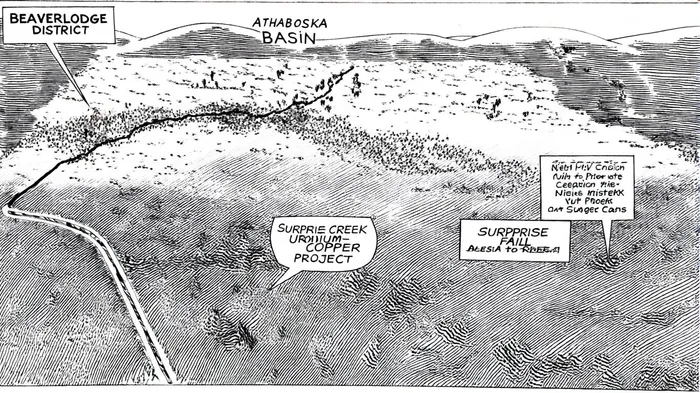
Mustang's Surprise Creek project, located 25 km northwest of the historic Beaverlodge Uranium District, leverages Saskatchewan's reputation as a global hub for high-grade uranium deposits. The Athabasca Basin, home to over 80% of the world's known uranium resources, provides a geological advantage that few oil sands players can match [1]. By targeting uranium and copper—a combination critical for both nuclear energy and renewable technologies—Mustang aligns with dual-use demand drivers.
Historical drilling results, including 2.1 meters of 4.37% U3O8 and 9.1 meters of 2.07% Cu, underscore the project's potential to deliver economically viable grades [1]. These figures compare favorably to industry benchmarks, particularly in a market where uranium prices have surged by over 150% since 2022 due to geopolitical tensions and renewed nuclear energy investments [1].
Competitive Positioning: Niche Expertise vs. Oil Sands Giants
While oil sands firms focus on hydrocarbon extraction, Mustang's specialization in uranium-copper exploration offers a distinct edge in the critical minerals race. The company's partnership with Thunderbird Resources Ltd., granting an 80% interest in Surprise Creek, reduces capital intensity and de-risks exploration costs—a stark contrast to the high CAPEX models of oil sands operations [1].
Moreover, Mustang's proximity to the Athabasca Basin provides logistical and infrastructural advantages. The region's established supply chains, skilled labor pool, and regulatory familiarity with uranium projects lower barriers to entry compared to greenfield oil sands ventures, which often face environmental and community opposition [1].
Growth Potential: Energy Transition Tailwinds and Market Gaps
The global energy transition is creating a structural imbalance in critical mineral supply. Uranium demand is projected to grow by 5% annually through 2030, driven by nuclear power's role in decarbonization [1]. Similarly, copper—a key component of electric vehicles and grid infrastructure—is expected to see a 6% CAGR in demand. Mustang's dual focus positions it to benefit from both trends, outpacing oil sands peers whose revenue streams remain vulnerable to fossil fuel price volatility.
However, the company must navigate challenges. Uranium exploration is capital-intensive, and while Surprise Creek's historical data is promising, new drilling results will be critical to validate resource estimates. Additionally, the project's success hinges on maintaining stable uranium prices, which remain sensitive to geopolitical shifts and policy changes in nuclear energy adoption.
Conclusion: A Strategic Bet on the Future of Energy
Mustang Energy Corp.'s Surprise Creek initiative represents a calculated bet on the energy transition's critical minerals needs. While the project does not directly compete with oil sands operations, its focus on uranium and copper aligns with long-term demand drivers that oil sands firms cannot easily replicate. By leveraging Saskatchewan's geological endowment and strategic partnerships, Mustang is well-positioned to carve out a niche in a sector poised for growth. Investors should monitor the September 2025 drilling results closely, as they could redefine the company's trajectory in Canada's evolving energy landscape.







Comentarios
Aún no hay comentarios