
Municipal Bonds for Affordable Housing: Balancing Yield Potential and Risk in a Low-Interest Rate Era
Municipal Bonds for Affordable Housing: Balancing Yield Potential and Risk in a Low-Interest Rate Era
In the current low-interest rate environment, municipal bonds have emerged as a compelling vehicle for financing affordable housing projects, offering a unique blend of yield stability and risk mitigation. As of mid-2025, the Bloomberg Municipal Bond Index yielded 4%, a multiyear high driven by tax-exempt incentives and robust credit fundamentals, according to the Breckinridge mid-year outlook. This performance underscores their appeal for investors in higher tax brackets, where the after-tax advantage of municipals can rival or exceed taxable alternatives, as noted in the Schwab mid-year outlook. However, the interplay of macroeconomic dynamics and sector-specific risks demands a nuanced assessment of risk-adjusted returns.
Yield Trends and Structural Advantages
The municipal bond market has experienced a surge in issuance, with $256 billion in new issues through June 2025-a 16% year-over-year increase and a 49% rise above the five-year average, according to the New York Life mid-year update. This growth is fueled by infrastructure needs, including water and sewer systems, and the preservation of the tax-exempt status of municipals despite earlier-year concerns about potential reforms, per the MunicipalBonds mid-2025 outlook. For affordable housing, the pairing of tax-exempt bonds with 4% low-income housing tax credits (LIHTCs) has streamlined development, enabling developers to meet stringent bond tests like the 95% of Proceeds Requirement, as explained in an MN Advisors guide.
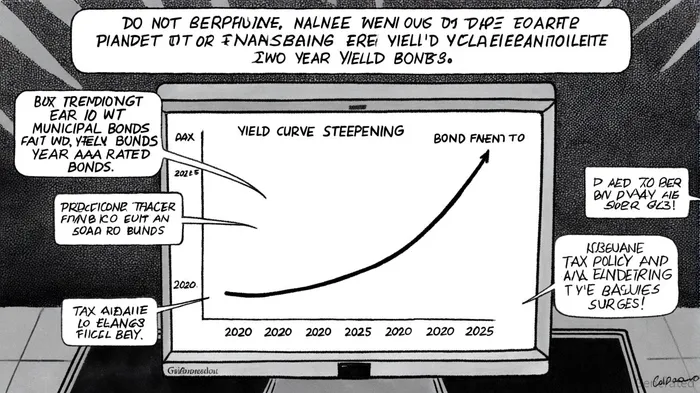
Yield curves have steepened, with a 60-basis-point spread between two-year and 10-year AAA-rated municipals, offering enhanced compensation for duration risk (the Breckinridge mid-year outlook). This steepening reflects investor demand for longer-dated instruments amid economic uncertainty and trade policy shifts (the New York Life mid-year update). Meanwhile, the yield-to-worst (YTW) of the Bloomberg Municipal Bond Index reached 3.96% in mid-2025, outpacing 95% of historical readings over the past decade (the Schwab mid-year outlook). Such metrics highlight the sector's resilience, even as broader fixed-income markets grapple with inflationary pressures.
Risk Metrics and Mitigation Strategies
While the tax-exempt status and strong credit quality (72% of bonds rated AAA/Aaa or AA/Aa) bolster confidence (the Breckinridge mid-year outlook), investors must navigate several risks:
Interest Rate Risk: Longer-duration bonds face price volatility if rates rise. A 10-year bond could lose 10% in value with a 1% rate hike, according to an Accounting Insights analysis. However, the Federal Reserve's cautious approach to tightening and the tax-equivalent yield advantage (e.g., a 4% municipal bond translating to 7.3% after-tax for a 39.6% bracket investor, per the Schwab mid-year outlook) temper this risk.
Credit Risk: Jurisdictions with robust tax bases, such as Texas and Florida, exhibit stronger fundamentals, whereas states like Illinois face pension liabilities. Investors should prioritize debt service coverage ratios and reserve fund levels (see Accounting Insights analysis).
Liquidity Constraints: Affordable housing bonds often trade in lower volumes, complicating execution. The MSRB's statistical summaries provide critical liquidity data, enabling investors to avoid overexposure to illiquid issues (Accounting Insights analysis).
Call Risk: Callable bonds may be refinanced if rates decline further. Diversifying across non-callable and long-duration issues can mitigate this risk (Accounting Insights analysis).
Risk-Adjusted Returns and Long-Term Stability
The municipal bond market's risk-adjusted returns remain favorable, particularly for high-grade bonds. Default rates are historically low, and credit fundamentals for A- and AA-rated issues are stable (the New York Life mid-year update). For affordable housing, alignment with federal and state grant programs enhances fiscal resilience, though Medicaid cuts and shifting federal funding pose potential headwinds (the Breckinridge mid-year outlook).
Investors should adopt a strategic approach:
- Duration Management: Balance long-dated bonds with shorter maturities to hedge against rate volatility.
- Credit Diversification: Allocate across geographies and sectors to avoid concentration risks.
- Tax-Efficient Structuring: Leverage LIHTCs and tax-exempt bonds to maximize after-tax returns.
Conclusion
Municipal bonds for affordable housing present a compelling case in the current low-interest rate environment, combining elevated yields with strong credit profiles. While risks such as interest rate sensitivity and liquidity constraints persist, disciplined portfolio construction can enhance risk-adjusted returns. As issuance is projected to exceed $500 billion in 2025 (the New York Life mid-year update), the sector offers both income generation and long-term stability-provided investors navigate its complexities with care.







Comentarios
Aún no hay comentarios