
Multi-Asset Income Strategies in a Volatile Rate Environment
The Federal Reserve's cautious approach to interest rates—holding steady at 4.25%-4.5% since early 2024 while hinting at potential cuts by year-end—has left investors navigating a precarious balancing act. With inflation lingering above 2%, GDP growth sluggish at 1.4%, and trade policy risks clouding the outlook, the search for reliable income streams requires more than passive exposure to traditional assets. The answer lies in multi-asset strategies that blend sector diversification, active management, and risk mitigation tools, as demonstrated by recent ETF innovations and the evolving role of crypto in traditional finance.
The Fed's Hesitant Hand: A Catalyst for Active Management
The Fed's “data-dependent” stance—evident in its repeated pauses since January 2024—reflects uncertainty about inflation's persistence and the economy's resilience. While the dot plot projections suggest two rate cuts by late 2025 (), volatility remains high. This environment favors investors who can dynamically adjust exposure to interest rate-sensitive assets like bonds while seeking yield elsewhere.
Active ETFs like the Horizon Flexible Income ETF (FLXN) and Vanguard Government Securities Active ETF (VGVT) exemplify this approach. FLXN combines high-yield bonds with tactical credit allocations and put spread overlays, which hedge against equity declines, while VGVT actively manages government-backed securities to navigate yield fluctuations. Both strategies prioritize income stability amid shifting rates.
Sector Diversification: Beyond Bonds and Equities
Income seekers must expand beyond the traditional 60/40 portfolio. ETFs like the Allspring Ultra Short Municipal ETF (AUSM) and Pacer US Cash Cows Bond ETF (MILK) highlight the shift toward multi-asset diversification:
- AUSM focuses on short-duration municipal bonds, offering tax-exempt income with low duration risk.
- MILK targets corporate bonds from companies with high free cash flow, prioritizing yield over credit ratings, thus diversifying beyond investment-grade mandates.
Meanwhile, Kurv Gold Enhanced Income ETF (KGLD) merges gold exposure with dynamic portfolio shifts, capitalizing on the metal's inverse correlation to rates. Such strategies reduce reliance on any single asset class, a critical defense in a volatile rate environment.
The Crypto Dimension: A Double-Edged Sword
DeFi yield products and crypto ETFs have introduced new income opportunities but with unique risks. Calamos' structured products—such as the CBOY and CBXY ETFs—offer BitcoinBTC-- exposure with downside buffers (e.g., 100% or 90% loss protection over a year). These appeal to risk-averse investors seeking crypto's potential upside without total exposure to its volatility.
However, crypto's inherent instability—Bitcoin's daily swings often exceed 5%—and regulatory uncertainty limit its role in core portfolios. Institutions remain hesitant, with only 350+ firms engaging directly as of early 2025. For most investors, crypto should represent a niche allocation, if any, to avoid overconcentration in high-risk assets.
Risk Mitigation: Buffers and Hedged Strategies
The rise of buffer ETFs underscores the demand for active risk management. Products like the PGIM S&P500 Max Buffer ETF (PMJA) and AllianzIM 6 Month Buffer10 Allocation ETF (SPBX) combine equity exposure with options-based hedging. For instance, PMJA caps losses at 10% over a year while allowing upside participation, making it a viable alternative to traditional dividend stocks.
Similarly, NestYield's EGGY ETF focuses on income generation through hedged equity exposure, while Calamos' CPSY offers S&P 500 returns up to a 10% cap with full loss protection. These tools allow investors to participate in growth markets without excessive downside risk, a critical feature as the Fed's cuts remain conditional.
Investment Recommendations
- Core Allocation:
- VGVT and FLXN for active bond management.
- AUSM for tax-advantaged municipal income.
MILK to tap high-cash-flow corporate bonds.
Commodity Exposure:
KGLD to hedge against rate uncertainty.
Equity Buffer Strategies:
PMJA or SPBX to balance equity upside with loss limits.
Crypto Caution:
- Allocate <5% to structured products like CBOY only if risk tolerance permits.
Conclusion
In an era of Fed hesitation and sector-specific volatility, multi-asset income strategies are not just advantageous—they are essential. By combining active management, cross-sector diversification, and risk-mitigating tools like buffer ETFs, investors can secure resilient income streams without overexposure to any single asset class. While crypto's yield products offer tantalizing opportunities, they remain a speculative complement to a portfolio anchored in proven, low-volatility assets.
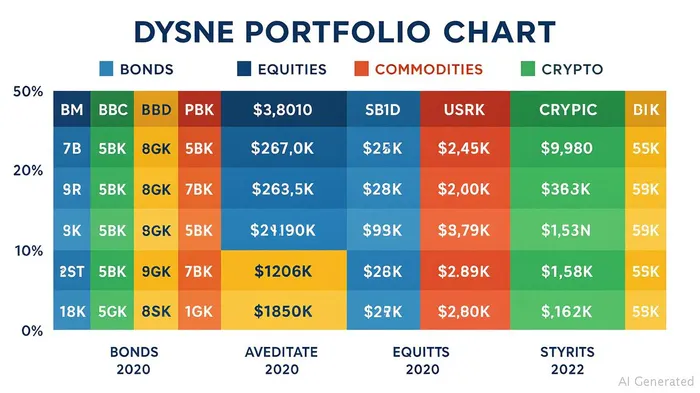
The path forward demands vigilance, flexibility, and a refusal to rely on outdated assumptions. In a volatile rate environment, the best income strategies are those that adapt—and that starts with diversifying beyond the obvious.







Comentarios
Aún no hay comentarios