
Mueller Industries and the Strategic Gains from U.S. Tariff Policies
Mueller Industries, a leading U.S. manufacturer of semi-finished copper products, has emerged as a standout performer in an era of escalating trade tensions and shifting global supply chains. The company's strategic positioning in essential markets—water infrastructure, HVAC/R, and electrical transmission—has allowed it to capitalize on U.S. tariff policies introduced since 2023, which have reshaped industrial manufacturing dynamics. As geopolitical trade dynamics drive reshoring and supply chain resilience, Mueller's financial and operational adaptability underscore its potential for long-term value creation.
Tariffs as a Catalyst for Domestic Manufacturing
The Trump administration's aggressive tariff policies, including a 50% duty on copper imports and sector-specific levies on steel and aluminum, have created a favorable environment for domestic producers like Mueller IndustriesMLI--. According to a report by KPMG, over 40% of industrial manufacturing (IM) executives reported margin declines due to tariffs, yet companies with localized production capabilities have gained competitive advantages[1]. Mueller's CEO, Greg Christopher, noted that the firm's reliance on U.S. manufacturing mitigates direct tariff exposure while enabling price adjustments to offset rising raw material costs[2]. This duality—leveraging trade protections while maintaining operational flexibility—has driven record financial results.
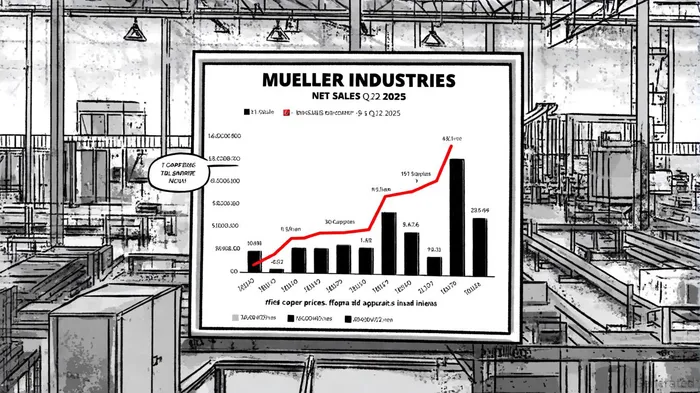
In Q2 2025, Mueller reported net sales of $1.14 billion, surpassing analyst estimates, and net income of $245.9 million, a 50.5% year-over-year increase[3]. A $36.3 million insurance gain from a 2023 tornado further bolstered earnings, but even excluding this, diluted EPS rose to $2.22, reflecting core operational strength[3]. The company's operating income surged to $304.2 million, driven by higher copper prices and strategic acquisitions such as Nehring and EPC[4]. These gains highlight Mueller's ability to navigate a volatile trade landscape by aligning with U.S. policy priorities.
Geopolitical Dynamics and Strategic Adaptation
The broader geopolitical context—marked by U.S.-China trade tensions, friendshoring initiatives, and decoupling from traditional supply chains—has amplified demand for domestic manufacturing. As noted in a McKinsey analysis, global trade relationships are shifting toward partners like Mexico and Vietnam, while tariffs have spurred reshoring efforts[5]. Mueller's focus on nonferrous metals and infrastructure-related products aligns with these trends, as demand for copper in electrical transmission and water systems remains resilient amid economic uncertainty.
The company's strategic acquisitions and investments in automation further reinforce its competitive edge. By expanding its global manufacturing footprint and enhancing supply chain visibility, Mueller has positioned itself to serve both domestic and international clients efficiently[6]. For instance, its recent integration of acquired businesses has contributed to an 8.4% projected annual revenue growth over the next two years[2]. This proactive approach contrasts with peers who have delayed capital investments due to tariff-related uncertainties[1].
Analyst Perspectives and Long-Term Outlook
Industry reports underscore the dual-edged nature of U.S. tariffs. While KPMG found that 57% of IM firms prioritized supply chain reconfiguration to mitigate risks[1], Mueller's localized production and pricing strategies have allowed it to thrive. PwC's analysis of tariff impacts highlights that 73% of executives view tariffs as a significant risk, yet Mueller's CEO remains optimistic about leveraging trade protections for long-term growth[7]. The company's $1.06 billion in cash reserves and a current ratio of 5.1 to 1 further strengthen its ability to withstand market volatility[3].
However, challenges persist. Raw material price swings and retaliatory measures from trade partners could test Mueller's margins. Yet, its focus on innovation—such as digital transformation and automation—positions it to maintain efficiency gains[6]. As J.P. Morgan notes, the effective U.S. tariff rate rose to 18–20% by mid-2025, creating a complex environment for global trade[8]. For Mueller, this complexity is a strategic opportunity, not a constraint.
Conclusion
Mueller Industries exemplifies how industrial manufacturing leaders can transform geopolitical trade dynamics into long-term value. By aligning with U.S. tariff policies, investing in domestic production, and adapting to supply chain shifts, the company has achieved exceptional financial performance while navigating macroeconomic headwinds. As tariffs continue to reshape global trade, Mueller's resilience and strategic foresight make it a compelling case study for investors seeking exposure to the reshoring trend.





Comentarios
Aún no hay comentarios