
MTY Food Group's Franchise Model Proves Resilient Amid 2025 Inflationary Pressures
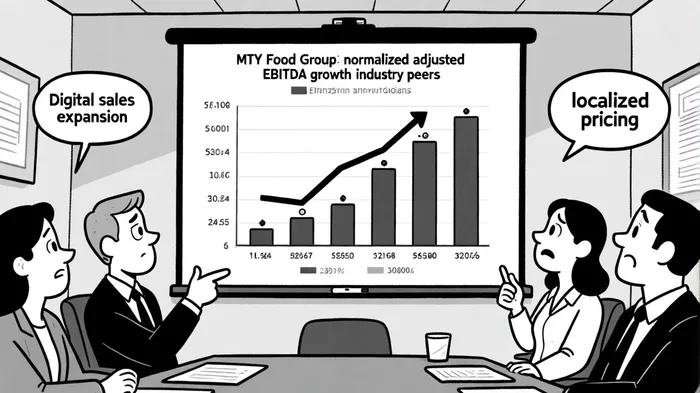
In a year marked by persistent inflation and economic volatility, MTY Food Group has emerged as a standout performer in the franchised restaurant sector. Despite a modest revenue miss in Q3 2025-reporting $296.99 million against an expected $298.1 million-the company's franchise model demonstrated resilience through strategic adaptations, including localized pricing, digital innovation, and supply chain optimization. These efforts translated into a 3% year-over-year increase in normalized adjusted EBITDA to $74 million, outpacing many industry peers struggling to balance rising costs with consumer demand, according to MTY's Q3 2025 results.
Navigating Inflation: MTY's Strategic Pillars
MTY's ability to maintain profitability amid inflationary headwinds stems from its asset-light franchise model and proactive operational adjustments. The company added 15 new locations in Q3 2025, expanding its global footprint to 7,061 units, a stark contrast to the 41 net closures in the same period of 2024, per the same Q3 release. This growth was driven by banners like Cold Stone Creamery and Wetzel's Pretzels, which leveraged seasonal demand and localized marketing to offset broader macroeconomic pressures.
A key differentiator has been MTY's focus on digital infrastructure. Digital sales grew by 1% year-over-year to $273.4 million in Q3 2025, reflecting investments in platforms that enhance convenience and value for price-sensitive consumers, as noted in the company's Q3 release. CEO Eric Lefebvre emphasized that digital tools not only drive incremental revenue but also provide data-driven insights to refine menu offerings and pricing strategies, as reported by Verdict Foodservice. For instance, the company's value-driven promotions-such as combo meals and loyalty incentives-have helped mitigate declines in same-store sales, which fell by 1.6% in Q3 but showed sequential improvement from a 1.9% drop in Q2, according to the Q3 release.
Supply Chain and Cost Management
MTY's supply chain resilience further underscores its competitive edge. By prioritizing domestic sourcing and strategic vendor partnerships, the company has reduced exposure to tariff-related risks and volatile global commodity prices, according to Retail Insider. This approach aligns with broader industry trends, as 66% of franchisors plan to adjust wages or efficiency measures to combat labor and input cost inflation (reported earlier by Verdict Foodservice). MTY's focus on scalable, limited-service formats-such as its fast-casual and quick-service banners-also allows for leaner operations, with smaller footprints and streamlined labor models that buffer against rising expenses, a dynamic discussed in Forbes.
Industry Comparisons and Long-Term Positioning
While MTY's Q3 results included a decline in cash flows from operations to $39 million (down from $66.4 million in Q3 2024), its EBITDA growth and unit expansion outperformed many competitors. For context, industry peers in the casual dining segment faced sharper declines in traffic, as middle-income consumers shifted to more affordable options, a trend noted in the Retail Insider coverage. MTY's diversified portfolio-spanning 57% U.S., 35% Canada, and 8% international locations-has allowed it to capitalize on regional strengths, such as Canada's 1.4% sales growth in Q2 2025, also reported by Retail Insider.
The company's share repurchase program-canceling 297,000 shares for C$12.6 million in Q2-also signals confidence in its long-term financial stability, as highlighted by Verdict Foodservice. Coupled with a pipeline of M&A opportunities and a focus on high-return investments, MTY is positioning itself to capitalize on a favorable private equity environment, where brands with repeatable growth models command premium valuations, as discussed in Forbes.
Conclusion: A Model for Franchise Resilience
MTY Food Group's Q3 2025 performance highlights the importance of agility in a high-inflation environment. By combining localized strategies, digital innovation, and disciplined cost management, the company has not only stabilized its operations but also laid the groundwork for sustained growth. As the industry faces ongoing challenges in labor, supply chains, and consumer spending, MTY's franchise model offers a blueprint for resilience-one that prioritizes franchisee support, scalable formats, and data-driven adaptability. For investors, this positions MTY as a compelling case study in navigating macroeconomic turbulence through strategic foresight.







Comentarios
Aún no hay comentarios