
MSTR's Exclusion from S&P 500: A Buying Opportunity or a Warning Signal?
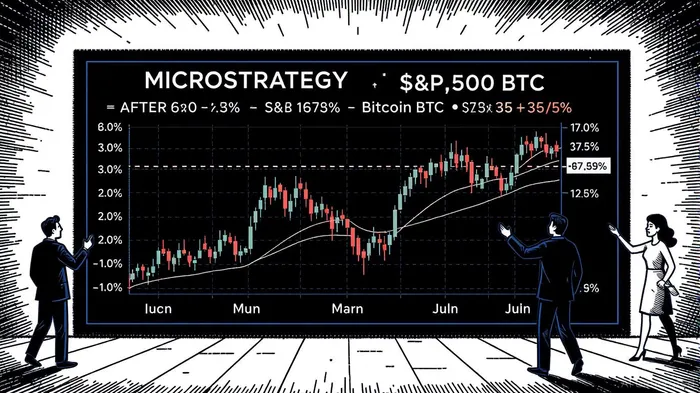
The recent exclusion of MicroStrategy (MSTR) from the S&P 500 has sparked a heated debate among investors and analysts. While the decision was officially attributed to "broader considerations" such as sector representation and BitcoinBTC-- exposure [1], the immediate market reaction—a 3% after-hours drop in MSTR’s stock price—underscores the symbolic weight of index inclusion. For investors navigating volatile, high-growth sectors, this event raises a critical question: Is MSTR’s exclusion a warning signal of systemic risks, or a contrarian buying opportunity in a market prone to overreaction?
The S&P 500’s "Secret Committee" and the Case of MSTR
The S&P 500’s composition is not purely algorithmic. A "secret committee" of S&P Global’s index team exercises discretion in balancing sector representation, market volatility, and alignment with traditional financial metrics [3]. In MSTR’s case, its heavy Bitcoin treasury—over 632,000 BTC—likely raised red flags. While the company meets inclusion criteria like market capitalization and liquidity, its exposure to a volatile asset class complicates its fit within the index’s risk framework [1]. This exclusion, however, is not unprecedented. Historically, companies removed from the S&P 500 have outperformed the index by over 5% annually in the five years post-exclusion, as markets often overcorrect [2].
Strategic Implications for High-Growth Sectors
For firms like MSTRMSTR--, operating in high-growth, volatile sectors, the S&P 500’s exclusion is a double-edged sword. On one hand, it denies access to passive inflows from index-tracking funds, which typically boost liquidity and price for newly added constituents [3]. On the other, it forces the company to rely on its intrinsic value proposition. MSTR’s leadership, including CEO Michael Saylor, has emphasized the company’s annualized returns—outperforming the S&P 500 over the past decade—despite the exclusion [3]. This resilience highlights a key principle in volatile sectors: long-term value often diverges from short-term index signals.
Contrarian Investing in a Polarized Market
Historical data supports a contrarian approach. For example, when Apartment Investment and Management (AIV) was replaced by TeslaTSLA-- in 2020, AIV outperformed Tesla by 80% in six months [2]. Similarly, MSTR’s exclusion could create a mispricing opportunity. The company’s Bitcoin treasury, now the largest corporate holding, positions it as a proxy for BTC in equities. As institutional adoption of Bitcoin grows—public companies collectively hold over 1 million BTC [1]—MSTR’s strategy may gain traction despite regulatory and macroeconomic headwinds.
Balancing Risk and Reward
Critics argue that MSTR’s Bitcoin-heavy balance sheet introduces systemic risks. Bitcoin’s price volatility, coupled with Fed policy uncertainty, could amplify downside risks [1]. However, diversification remains a cornerstone of strategic investing. While MSTR’s exclusion denies it passive inflows, investors can hedge by pairing it with defensive equities or low-volatility sectors like healthcare [2]. This approach mitigates the impact of macroeconomic shocks while capitalizing on MSTR’s potential as a high-conviction play.
Conclusion: A Nuanced Perspective
MSTR’s exclusion from the S&P 500 is neither a definitive warning nor a guaranteed buying opportunity. It reflects the index’s evolving criteria and the market’s ambivalence toward crypto-adjacent assets. For strategic investors, the key lies in balancing short-term volatility with long-term fundamentals. MSTR’s performance post-exclusion will hinge on its ability to sustain Bitcoin’s value proposition while addressing the S&P 500 committee’s concerns. In a landscape where 40% of the S&P 500’s weight is concentrated in just ten companies [1], the exclusion of a high-growth firm like MSTR may signal a broader shift toward diversification—a trend worth monitoring.
**Source:[1] MicroStrategy's S&P 500 Snub Weighs on MSTR Stock Amid Bitcoin Market Uncertainty [https://www.btcc.com/en-US/square/Bitcoin%20News/912915][2] 5 Stocks Kicked Off the S&P 500 That Have Outperformed [https://www.investopedia.com/stocks-kicked-off-sp-500-outperformed-8731496][3] Why $MSTR Missed the S&P 500: Index Committee Blocks Inclusion [https://blockchain.news/flashnews/why-mstr-missed-the-s-p-500-index-committee-blocks-inclusion]







Comentarios
Aún no hay comentarios