
MP Materials' Strategic Position in the Rare Earths Sector Amid Valuation Concerns: Assessing Margin of Safety and Long-Term Catalysts
The rare earths sector, a linchpin of modern technology and national security, has seen a surge in strategic investments and policy-driven demand. MP Materials Corp.MP-- (MP), the dominant rare earth producer in the Western Hemisphere, finds itself at a crossroads. While its stock has surged 230% in 2025 amid heightened geopolitical focus on supply chain resilience, recent insider selling and volatile price swings have raised questions about valuation合理性 and margin of safety. This analysis evaluates whether MP's strategic positioning-anchored by U.S. government support and vertical integration-justifies its current valuation or signals caution for investors.
Strategic Positioning: Government Partnerships and Vertical Integration
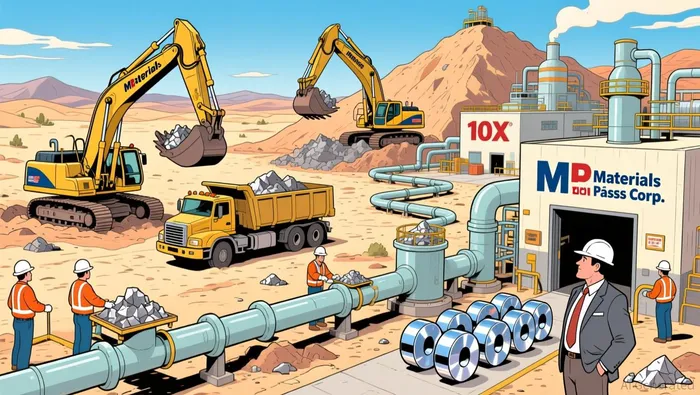
MP's most compelling catalyst is its transformational public-private partnership with the U.S. Department of Defense (DoD). Under a multibillion-dollar agreement, the DoD has committed a $400 million equity investment, acquiring a 15% stake in MP and becoming its largest shareholder. This funding will accelerate the construction of the "10X" magnet manufacturing facility, expected to operationalize by 2028 and expand U.S. magnet production capacity to 10,000 metric tons annually. Crucially, the DoD has also agreed to a 10-year price floor of $110 per kilogram for neodymium-praseodymium (NdPr) oxide and a 10-year offtake agreement covering 100% of the magnets produced at the new facility.
This vertical integration strategy-spanning mining, separation, refining, and magnet production- positions MP to reduce U.S. dependence on China for rare earth elements, a critical national security objective. The collaboration is further bolstered by $1.0 billion in commercial debt from JPMorgan Chase and Goldman Sachs and a $150 million loan from the DoD to expand MP's separation capabilities at Mountain Pass, California. Such strategic depth, combined with bipartisan political support, creates a durable moat against competitors and geopolitical risks.
Valuation Concerns: A Tale of Two Metrics
Despite these strategic advantages, MP's valuation metrics are troubling. As of January 2026, the company's enterprise value (EV) stands at $10.7 billion, with an EV/EBITDA ratio of -315.57 and a forward P/E ratio of 1,430. These figures starkly contrast with the Metals & Mining industry averages of 11.33 for EV/EBITDA and 24.27 for P/E according to industry data. The P/S ratio of 46x further underscores speculative expectations of future revenue growth, as the company's trailing twelve months EBITDA is -$35.3 million according to SEC filings. Analysts have flagged these metrics as indicative of overvaluation, particularly given MP's operational inefficiencies and unprofitable status.
However, MP's balance sheet offers a counterpoint. The company holds $1.94 billion in cash reserves as of September 2025, resulting in a net cash position of $917.9 million despite $1.02 billion in debt. This liquidity provides a margin of safety, enabling MP to manage debt obligations and fund strategic initiatives without immediate refinancing risks. Additionally, a 51% year-over-year increase in NdPr production and a projected return to profitability by Q4 2025, supported by long-term contracts, could strengthen its balance sheet over time.
Insider Selling and Investor Sentiment
Insider selling has been a persistent theme in 2025, with 13 open-market trades-exclusively sales-executed by executives over the past six months. Notably, CEO James H. Litinsky sold $40.1 million worth of shares, while CFO Ryan Corbett offloaded $2.29 million in late 2025 according to SEC filings. Such activity could signal skepticism about the stock's near-term prospects, particularly given its volatility. For instance, MP's shares dropped 14.23% in the recent quarter, and its 30-day price volatility has increased by 65% year-over-year according to market data.
Yet, insider selling must be contextualized. Executives may be diversifying personal portfolios rather than signaling corporate distress. Moreover, the DoD's $400 million investment and the 10X facility's construction timeline suggest long-term value creation, which may not align with short-term stock price fluctuations. Analysts have assigned MP a "Moderate Buy" rating, with a consensus price target of $78.91-27.3% above its current price of $61.98. This optimism hinges on the assumption that MP's strategic initiatives will translate into sustained profitability and market share gains.
Long-Term Catalysts and Risks
MP's long-term growth hinges on three factors:1. Execution of the 10X Facility: Delays in construction or cost overruns could undermine the DoD's offtake agreement and price floor guarantees.2. Global Rare Earth Demand: The transition to electric vehicles, renewable energy, and defense technologies will drive demand, but MP's ability to scale production and maintain cost efficiency will determine its market share.3. Geopolitical Dynamics: While the U.S. seeks to reduce reliance on China, trade tensions or regulatory shifts could disrupt MP's supply chain or pricing power.
For investors, the margin of safety lies in the company's liquidity, strategic partnerships, and the inelasticity of rare earth demand. However, the current valuation implies a high degree of confidence in MP's ability to execute its vertical integration and capitalize on policy tailwinds-a bet that may not be justified by its operational track record.
Conclusion: A High-Risk, High-Reward Proposition
MP Materials occupies a unique position in the rare earths sector, with unparalleled access to U.S. government support and a vertically integrated supply chain. These factors create a compelling long-term narrative for investors seeking exposure to the critical minerals boom. However, the company's valuation metrics-coupled with insider selling and operational losses-warrant caution. While the DoD's investment and 10X facility offer a margin of safety, they also raise the bar for execution. For now, MP appears to be a speculative play rather than a conservative investment, appealing to those who believe in the transformative potential of its strategic initiatives despite the risks.





Comentarios
Aún no hay comentarios