
MP Materials: A Geopolitical Gamble in a Stalled Rare Earth Revolution
The rare earth boom of 2025 has turned MP MaterialsMP-- (NYSE: MP) into a poster child for de-risking supply chains. Its stock has surged over 400% year-to-date, fueled by China's export restrictions, a $400 million DoD investment, and a $500 million Apple supply deal[1]. Yet beneath the headlines lies a fragile narrative: MP's success hinges on geopolitical tailwinds that may be waning and a U.S. rare earth infrastructure that remains underdeveloped. For investors, the question is whether MP can outlast the volatility of its environment or if it's merely a speculative play on a half-baked industrial revolution.
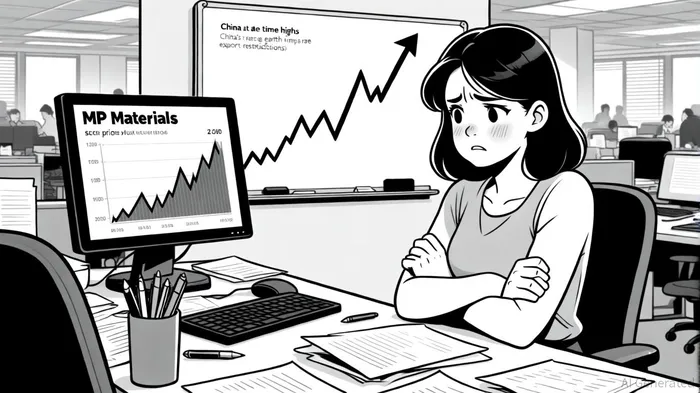
Geopolitical Tailwinds Fade as Trade War Optimism Crumbles
China's recent escalation of rare earth export controls-now restricting 12 of 17 rare earth elements and barring U.S. military-linked entities from accessing its supply chains-has been a tailwind for MP Materials[2]. The company's stock spiked 20% in a single day after Beijing's December 1 licensing rules[3], which added bureaucratic friction to shipments. However, this dynamic assumes a deteriorating U.S.-China relationship. If trade tensions ease-say, through a Trump-Xi détente or reduced semiconductor export controls-the urgency for U.S. rare earth independence could diminish.
According to a report by the Center for Strategic and International Studies (CSIS), China's export restrictions are not just about supply chain leverage but also about weaponizing its dominance in refining technologies[4]. While MP's vertical integration strategy (mine-to-magnet production) aims to bypass Chinese processing, its current operations still rely on global markets for heavy rare earths and downstream manufacturing. A shift in geopolitical priorities-such as a new administration prioritizing trade normalization-could erode demand for MP's services.
U.S. Rare Earth Infrastructure: Promises vs. Reality
The U.S. government has poured over $550 million into MP Materials, including a 10-year price floor for neodymium-praseodymium oxides and a $150 million loan for refining upgrades[5]. Yet these investments mask a broader truth: the U.S. rare earth sector remains a work in progress.
MP's "10x Factory" in California, critical to its magnet production ambitions, isn't expected to operate until 2028[6]. Meanwhile, competitors like Energy Fuels and USA Rare Earth are also racing to build processing capacity, but their combined output pales against China's 90% global refining dominance[7]. Data from the U.S. Geological Survey (USGS) shows that even with recent investments, the U.S. produces less than 5% of global rare earth oxides[8]. This gap means MP's long-term viability depends on sustained government subsidies and the assumption that private-sector partners like Apple will continue to fund its infrastructure.
Valuation Risks in a High-Stakes Game
MP's price-to-sales ratio exceeds 25 times industry averages[9], a multiple that assumes flawless execution of its ambitious plans. However, the company's Q1 2025 net loss of $22.6 million-driven by halted exports to China and capital-intensive downstream projects-highlights operational risks[10]. Analysts at Bloomberg warn that delays in the "10x Factory" or a drop in NdPr prices (due to oversupply in EV or renewable energy sectors) could trigger a valuation correction[11].
Moreover, the DoD's $110/kg price floor for NdPr oxides, while stabilizing, is a double-edged sword. It ensures short-term revenue but may discourage market-driven efficiency. If China relaxes its export curbs or if rare earth prices plummet due to technological substitutions (e.g., hydrogen-free magnets), MP's margins could shrink.
Conclusion: A Strategic Asset or a Policy-Driven Mirage?
MP Materials occupies a unique niche as the U.S.'s most advanced rare earth player. Its partnerships with the DoD and Apple, coupled with its vertical integration strategy, position it as a critical node in America's push for supply chain resilience. However, its success is inextricably tied to the persistence of geopolitical tensions and the acceleration of domestic infrastructure-a combination that remains uncertain.
For investors, the key risks are clear: waning trade war optimism, underperforming U.S. processing capabilities, and a valuation that assumes perfect execution. While MP's government backing provides a floor, it also underscores the sector's reliance on policy rather than organic market demand. In a world where geopolitical winds shift rapidly, MP Materials may prove to be either a visionary cornerstone of U.S. industrial policy or a cautionary tale of overhyped infrastructure bets.





Comentarios
Aún no hay comentarios