
Mounjaro's Disruptive Potential in India's Obesity Drug Market: A Strategic Investment Opportunity
Market Dynamics: A $326.6 Million Opportunity by 2030
India's obesity treatment market is on a meteoric trajectory. According to a Grand View Research India Obesity Treatment Market Size & Outlook, 2024-2030 report, the market generated $91.6 million in revenue in 2024 and is projected to grow at a compound annual growth rate (CAGR) of 25%, reaching $326.6 million by 2030. This expansion is fueled by a population exceeding 150 million individuals above the BMI threshold for pharmacotherapy, coupled with the rise of self-pay healthcare and urbanization-driven lifestyle shifts, as noted in a India strategic launchpad for next wave of obesity care article.
The GLP-1 receptor agonist segment, in particular, is outpacing global averages, with a projected CAGR of 34.3% from 2025 to 2030, according to an Obesity lab: India becomes ground zero for weight-loss... report. This is driven by blockbuster drugs like Mounjaro and Novo Nordisk's Wegovy (semaglutide), which have demonstrated clinical efficacy and commercial traction. However, the competitive landscape is evolving rapidly, with patent expirations and generic manufacturing capabilities poised to reshape access and pricing.
Mounjaro's Strategic Edge: Clinical Superiority and Market Timing
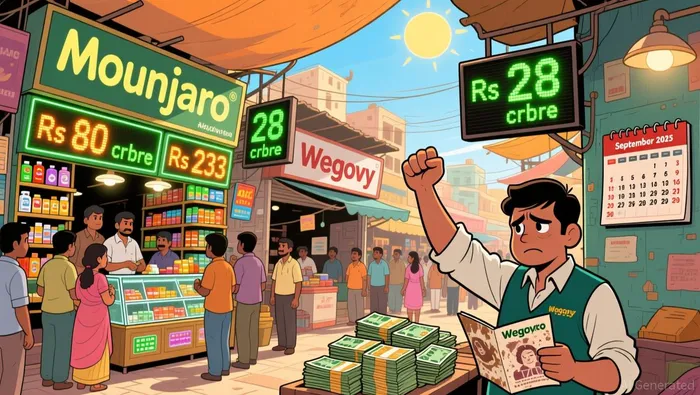
Eli Lilly's Mounjaro, launched in India in March 2025, has swiftly outpaced Novo Nordisk's Wegovy, which entered the market in June 2025. By September 2025, Mounjaro had achieved monthly sales of Rs 80 crore, making it the second-highest-selling pharmaceutical brand in the country after GSK's Augmentin, as noted in a How Eli Lilly's weight-loss drug Mounjaro gained early lead against Novo Nordisk's Wegovy in India report. Cumulative sales of Rs 233 crore contrast sharply with Wegovy's Rs 28 crore during the same period, as reported in the same source.
This dominance stems from Mounjaro's dual-action mechanism, which targets both GLP-1 and GIP pathways. Clinical trials, such as SURMOUNT-5, demonstrated an average weight loss of 20.9–22.8% for Mounjaro, compared to 13.7–15% for Wegovy, according to the How Eli Lilly's weight-loss drug Mounjaro gained early lead against Novo Nordisk's Wegovy in India article. Such efficacy, combined with Eli Lilly's aggressive market entry, has created a first-mover advantage. The company further expanded its reach by partnering with Cipla to market Mounjaro under the brand name Yurpeak, leveraging Cipla's distribution network to penetrate non-metro markets, as detailed in the same article.
Competitive Landscape: Patent Exclusivity and Future Challenges
While Mounjaro's early success is undeniable, the market is not without risks. Semaglutide, the active ingredient in Wegovy, currently holds a 50% market share in India, with a monthly trailing (MAT) revenue of Rs 428 crore, according to a Mounjaro slims-down competition to become India's ... report. However, Mounjaro's patent exclusivity and superior clinical outcomes provide a buffer against immediate generic competition. The impending launch of Eli Lilly's small-molecule pill, Orforglipron, further cements its long-term position, as reported in the same source.
That said, the Indian government's Production-Linked Incentive (PLI) scheme is accelerating generic manufacturing of GLP-1 APIs, with companies like Aurobindo and Dr. Reddy's investing heavily in production lines, as previously noted in the India strategic launchpad for next wave of obesity care article. While this could democratize access, it also threatens to erode margins for innovators. For now, though, Mounjaro's exclusivity and pricing (Rs 13,125–25,781 per month) position it as a premium but effective solution, as noted in the How Eli Lilly's weight-loss drug Mounjaro gained early lead against Novo Nordisk's Wegovy in India article.
Investment Thesis: Timing the High-Growth Window
For investors, the key question is whether Mounjaro's current valuation reflects its disruptive potential. Given the market's projected CAGR of 34.3% for GLP-1 drugs and Mounjaro's rapid adoption, the drug represents a high-conviction opportunity. Its ability to outperform Wegovy in both sales and clinical outcomes underscores its role as a market leader.
However, timing is critical. The window of exclusivity is narrowing, with semaglutide's patent in India expected to expire within 12 months of its launch, as noted in the India strategic launchpad for next wave of obesity care article. While this creates opportunities for generics, it also pressures innovators to maximize revenue before competition intensifies. Eli Lilly's $1 billion investment in Indian manufacturing and distribution infrastructure suggests a long-term commitment to sustaining Mounjaro's dominance, as reported in the Mounjaro slims-down competition to become India's ... article.
Conclusion: A Defining Moment in Obesity Care
India's obesity treatment market is at an inflection point, driven by unmet medical needs, regulatory support, and technological innovation. Mounjaro's rapid ascent reflects its ability to address these challenges while capturing a disproportionate share of a high-growth segment. For investors, the drug exemplifies the rewards of strategic market entry and clinical differentiation. Yet, the looming threat of generics and pricing pressures necessitates a balanced approach-leveraging Mounjaro's current momentum while hedging against future volatility.
In the evolving landscape of obesity care, Mounjaro's story is not just about a drug-it's about redefining access, efficacy, and profitability in one of the world's most dynamic markets.







Comentarios
Aún no hay comentarios