
Mortgage Rate Volatility and the Resilience of Mortgage-Backed Securities: A Fixed-Income Investment Analysis
The U.S. housing market has entered a new era of volatility, defined by sharp swings in mortgage rates and a recalibration of fixed-income investment strategies. From a peak of 7.79% in October 2023, 30-year fixed mortgage rates eased to 6.2% by September 2024, only to fluctuate around the mid-6% range in 2025 as the Federal Reserve navigated inflationary pressures and shifting economic signals, according to a CFPB data spotlight. This turbulence has reshaped housing affordability, with the average monthly payment on a $400,000 loan surging by over $1,200 since the early 2020s, as noted in that CFPB analysis. For investors, the ripple effects extend to mortgage-backed securities (MBS), a critical segment of the fixed-income market that now sits at a crossroads of opportunity and risk.
The MBS Yield Premium: A Double-Edged Sword
Mortgage-backed securities have long been prized for their relatively low credit risk and steady income streams. However, the current environment has amplified their appeal while introducing new complexities. As of July 2025, MBS yields stood at 5.11%, aligning with lower-rated investment-grade corporate bonds despite the latter's higher credit and interest rate risks, as described in an LPL Research note. This yield premium reflects the Federal Reserve's quantitative tightening (QT) strategy, which reduced its MBS holdings and left the market more exposed to supply-demand imbalances. The resulting spread between 10-year Treasuries and MBS widened to 250 basis points by early 2025, a historically abnormal level driven by reduced foreign demand and U.S. tariff policies, according to an MPA analysis.
This spread creates a paradox: while elevated MBS yields offer attractive returns, they also signal heightened uncertainty. For instance, the Fed's September 2025 rate cut-a "risk management cut" aimed at cushioning against economic slowdowns-failed to significantly compress mortgage rates, as that MPA analysis observed the spreads remained stubbornly wide. This suggests that investors must balance the allure of higher yields with the risks of prolonged volatility, particularly as prepayment expectations remain unpredictable.
Strategic Adjustments in a Shifting Landscape
Institutional investors have adapted to these dynamics by refining their MBS strategies. Brendan Doucette of GW&K notes that the buyer base has shifted from the Fed to money managers, who prioritize valuation-driven decisions over macroeconomic bets, according to a GW&K commentary. This has led to a preference for higher-coupon MBS pools, which offer lower prepayment risk and higher yield potential. Additionally, allocations to asset-backed securities (ABS) have increased, as their lower correlation to rate volatility provides diversification benefits-a point also raised in the GW&K commentary.
The market's resilience is further underscored by its scale. In the first half of 2025, U.S. MBS issuance totaled $1,192.4 billion, with agency MBS trading at an average daily volume of $345.1 billion, per a Bond Street analysis. These figures highlight the sector's liquidity and its role in the broader fixed-income ecosystem, where MBS account for over 25% of the Bloomberg US Aggregate Index, as discussed by GW&K. Yet, the non-agency segment, though smaller, is also gaining traction, with annual trading volumes reaching $1.7 billion, according to the Bond Street analysis.
Risk-Return Dynamics: MBS vs. Corporate Bonds
Historical comparisons between MBS and corporate bonds reveal distinct risk-return profiles. During the 2015–2025 period of rising rates, MBS demonstrated lower volatility than corporate bonds but also less upside in falling rate environments, according to a FasterCapital analysis. For example, Baa-rated corporate bonds historically outperformed MBS during rate hikes but underperformed during rate cuts due to their sensitivity to credit spreads, a divergence highlighted in that FasterCapital piece. This divergence underscores the importance of aligning MBS investments with macroeconomic expectations.
Prepayment risk remains a critical factor. As the Fed contemplates rate cuts, the threat of a refinancing wave looms large. If rates drop sharply, borrowers may refinance en masse, forcing investors to reinvest returned principal at lower yields, a dynamic noted in the Bond Street analysis. Conversely, a slower pace of rate cuts could extend repayment periods, enhancing returns but increasing duration risk. Tools like the ICE BofA MOVE Index and the ICE U.S. Residential Mortgage Rate Lock Index are now essential for tracking volatility and refinancing trends, as described by Bond Street.
The Road Ahead: Navigating Uncertainty
Looking forward, the National Association of Realtors (NAR) forecasts mortgage rates averaging 6.7% in the second half of 2025, with a potential decline below 6% by 2026, a projection reported in the CFPB data spotlight. While this trajectory could improve affordability, high home prices and limited inventory will likely temper demand. For MBS investors, the key will be balancing yield capture with prepayment hedging.
The potential privatization of Fannie Mae and Freddie Mac adds another layer of uncertainty. If the government guarantee is removed, MBS spreads could widen further, eroding their near-risk-free status, a risk discussed in the LPL Research note. However, the Fed's expected rate cuts and reduced volatility may offset this risk, making MBS an appealing option for income-focused portfolios.
Conclusion
Mortgage rate volatility has transformed the MBS landscape, creating both challenges and opportunities. While elevated yields and liquidity make MBS attractive, investors must remain vigilant about prepayment risks and policy shifts. By leveraging tools for real-time analysis and diversifying into higher-coupon pools or ABS, fixed-income investors can navigate this complex environment. As the Fed's policy path clarifies, the MBS market may yet offer a compelling avenue for balancing income generation with strategic risk management.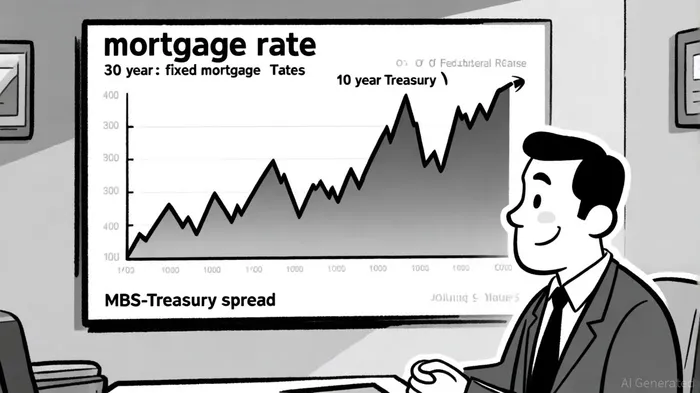







Comentarios
Aún no hay comentarios