
The Recent Mortgage Rate Drop and Its Impact on Housing Market Dynamics
The U.S. housing market in 2025 is navigating a paradox: a weak labor market is unexpectedly creating tailwinds for real estate and mortgage-backed securities (MBS) investors. While historically, economic downturns have signaled caution for homebuyers and sellers alike, the current environment—marked by declining mortgage rates and shifting Fed policy—has introduced a unique set of opportunities. This article dissects how labor market weakness is reshaping housing dynamics and outlines strategic entry points for investors.
Labor Market Weakness and the Mortgage Rate Conundrum
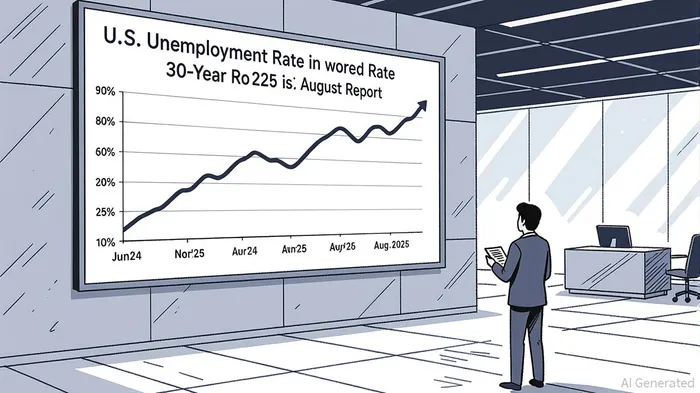
The August 2025 jobs report delivered a stark reality check: just 22,000 nonfarm payrolls added, with unemployment rising to 4.3%, the highest since October 2021. This data triggered a flight to safety in bond markets, driving the 10-year Treasury yield down to 4.09% and pushing the 30-year fixed mortgage rate to 6.55%, a 11-month low. The Federal Reserve's anticipated rate cuts—88.2% probability of a 25-basis-point reduction in September—have further cemented this trend.
The logic is straightforward: weaker labor markets reduce inflationary pressures, prompting central banks to lower borrowing costs. However, the ripple effects on housing demand are nuanced. While lower rates improve affordability—Redfin reports a median housing payment of $2,593, the lowest since January 2025—buyer activity remains subdued. Mortgage purchase applications dipped 6% in late August, and buyer traffic is down 8% year-over-year. This hesitancy reflects broader economic uncertainty, not just rate sensitivity.
Strategic Opportunities in Real Estate and MBS
Despite tepid demand, the current environment offers compelling opportunities for investors who can navigate the market's duality.
1. Undervalued Secondary Markets
The Sun Belt region, including cities like Las Vegas and Boise, has seen housing price corrections that have created entry points for value-oriented investors. These markets are buoyed by population growth and proximity to healthcare and social assistance hubs—sectors with resilient job growth. For example, properties near medical facilities or universities are gaining traction as stable rental assets.
2. Mortgage-Backed Securities (MBS) as a Fixed-Income Alternative
With mortgage rates stabilizing near 6.5%, MBS yields have become competitive with Treasuries. The 30-year MBS yield currently hovers near 4.1%, offering a risk-adjusted return that outperforms many corporate bonds. The decline in prepayment risk—3.1 million mortgages are now “in the money” for refinancing—adds to their appeal. However, investors must remain vigilant about inflationary surprises or Fed policy shifts, which could reintroduce volatility.
3. Turnkey Rental Properties
Lower mortgage rates have made it more affordable to acquire income-generating properties. Investors should prioritize markets experiencing labor force reallocation, such as those near emerging tech hubs or logistics centers. Turnkey rental properties managed by real estate companies also offer a low-operations path to passive income, particularly in areas with rising demand for affordable housing.
Navigating the Risks
While the alignment of weak labor data and falling rates is favorable, investors must balance optimism with caution. Key risks include:
- Inflationary Rebound: A surge in energy prices or wage growth could force the Fed to pivot from easing to tightening.
- Inventory Glut: With 1.2 million active listings—a 11.3% year-over-year increase—buyers have more options, but sellers may need to price aggressively to attract buyers.
- Policy Uncertainty: The Fed's September decision will be pivotal. A 50-basis-point cut, while unlikely, could further depress rates and disrupt market expectations.
Conclusion: Positioning for a New Normal
The 2025 housing market is defined by a delicate balance between affordability gains and economic caution. For investors, the key lies in leveraging the current alignment of low rates and undervalued assets. Real estate opportunities in secondary markets and MBS with stable prepayment profiles offer a dual strategy to capitalize on the Fed's easing cycle.
As the labor market continues to evolve, monitoring leading indicators—such as the ISM Manufacturing Index and core PCE inflation—will be critical. Those who act decisively now may find themselves well-positioned to benefit from a market that, while not yet in full recovery, is undeniably in transition.







Comentarios
Aún no hay comentarios