
Morgan Stanley's Strategic Move to Open Crypto Fund Access to All Wealth Clients
Morgan Stanley's decision to open its crypto fund to all wealth management clients marks a watershed moment in the institutional adoption of digital assets. Effective October 15, 2025, the firm removed prior restrictions that limited crypto access to high-net-worth individuals with $1.5 million in assets and aggressive risk profiles. Now, even clients with retirement accounts can allocate up to 4% of their portfolios to crypto, a move backed by automated monitoring systems to prevent over-concentration in this volatile asset class, according to CNBC. This shift reflects a broader transformation in how institutional players view cryptocurrencies-not as speculative fads, but as strategic components of diversified portfolios.
Institutional Adoption: From Niche to Mainstream
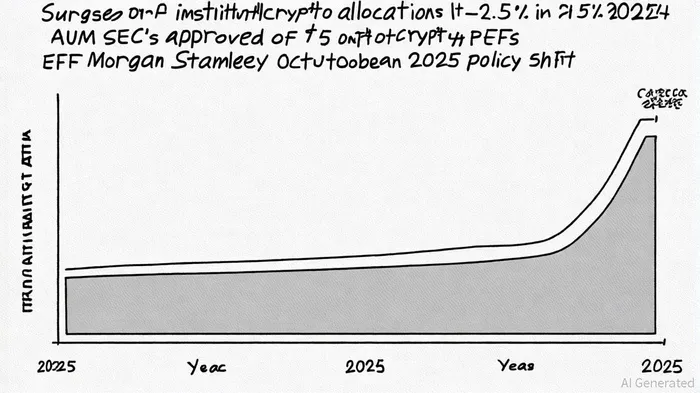
The expansion of crypto access by Morgan StanleyMS-- aligns with a surge in institutional interest. According to a 2025 survey by CoinbaseCOIN-- and EY-Parthenon of 350 institutional decision-makers, 83% plan to increase crypto holdings, with 59% targeting allocations exceeding 5% of assets under management (AUM), as reported by CoinReporter. This represents a doubling of institutional crypto allocations since 2024, driven by regulatory clarity, diversification benefits, and the maturation of crypto markets. For example, the U.S. Securities and Exchange Commission's (SEC) approval of spot crypto ETFs in late 2025 has normalized digital assets in institutional portfolios, while President Trump's executive order facilitating crypto in retirement accounts has further legitimized the asset class, according to FinancialContent.
Morgan Stanley's 2–4% allocation guidance, issued by its Global Investment Committee (GIC), underscores this trend. The firm now recommends crypto as a "speculative but increasingly popular" asset, with higher allocations for "opportunistic growth" portfolios and zero exposure for conservative "wealth preservation" strategies, according to InvestmentNews. This nuanced approach mirrors broader industry practices, where institutions balance crypto's high volatility with its potential to hedge against inflation and macroeconomic shocks.
Investor Behavior: From Speculation to Strategy
The democratization of crypto access is reshaping investor behavior. Previously, retail investors dominated crypto markets, but institutional participation has shifted the dynamic. Morgan Stanley's move to include crypto in retirement accounts-such as IRAs and 401(k)s-reflects a growing recognition of digital assets as long-term wealth-building tools. As noted by Hunter Horsley of Bitwise in Yahoo Finance, "This is the moment crypto transitions from a speculative corner of finance to a core asset class."
Data from the Coinbase/EY-Parthenon survey reported by CoinReporter reinforces this shift: 73% of institutions now hold altcoins like SolanaSOL-- and XRPXRP-- for DeFi and Web3 innovation, while 84% use stablecoins for yield generation and transactional efficiency. This diversification beyond BitcoinBTC-- signals a maturing market where institutions are no longer merely chasing price action but integrating crypto into broader financial ecosystems.
Asset Allocation Implications
Morgan Stanley's policy change has immediate and long-term implications for asset allocation. By recommending a 2–4% crypto allocation, the firm is effectively normalizing the asset class within traditional finance. This could unlock $40–80 billion in inflows into Bitcoin alone, given Morgan Stanley's $2 trillion in client assets, according to the FinancialContent article. Such institutional demand has already driven Bitcoin to an all-time high of $126,080 in October 2025, with analysts attributing the surge to the firm's endorsement as described in that FinancialContent piece.
However, risk management remains critical. Morgan Stanley's automated monitoring systems and 4% cap aim to mitigate overexposure, a concern also noted by CNBC. This cautious approach contrasts with the unregulated frenzy of 2021 but aligns with the measured integration of crypto into institutional portfolios. For example, 72% of institutions plan to engage in tokenization by 2026, a trend that could unlock trillions in additional demand by digitizing real-world assets, according to the CoinReporter coverage.
Market Impact and Future Outlook
Morgan Stanley's move is not an isolated event but part of a larger institutional wave. The firm's partnership with Zerohash to enable direct trading of Bitcoin, EthereumETH--, and Solana on its E-Trade platform in early 2026 will further integrate crypto into mainstream finance, as reported by FinancialContent. This follows similar moves by BlackRock and Fidelity, which now offer crypto ETFs and custody solutions.
Looking ahead, the industry faces challenges such as regulatory uncertainty and custody risks. Yet, the broader trend is clear: crypto is becoming a staple of institutional portfolios. As Mike Novogratz of Galaxy Digital notes in Yahoo Finance, "Morgan Stanley's decision is a green light for the rest of Wall Street to follow suit." With tokenization, stablecoin innovation, and regulatory frameworks like the EU's MiCA (Markets in Crypto-Assets) gaining traction, the next phase of crypto adoption will likely see even deeper integration into traditional finance.
Conclusion
Morgan Stanley's strategic expansion of crypto access is a pivotal moment in the evolution of institutional wealth management. By normalizing crypto allocations, embracing regulatory progress, and balancing risk with opportunity, the firm is setting a precedent for the industry. For investors, this signals a shift from speculative trading to strategic, long-term portfolio planning. As digital assets gain legitimacy, the lines between traditional and crypto finance will blur-reshaping investor behavior and asset allocation for years to come.





Comentarios
Aún no hay comentarios