
Morgan Stanley Removes Bitcoin ETF Restrictions and Signals Institutional Acceptance
Morgan Stanley's recent decision to remove restrictions on BitcoinBTC-- and EthereumETH-- ETFs marks a watershed moment in the cryptocurrency's journey from speculative curiosity to strategic asset class. By opening access to all clients-including those in retirement accounts-starting October 15, 2025, the firm has effectively signaled institutional confidence in crypto's role within diversified portfolios, according to Cointribune. This move, coupled with a regulatory environment under the Trump administration that now permits 401(k) accounts to include crypto investments, as reported by The Market Periodical, underscores a broader shift in how Wall Street views digital assets.
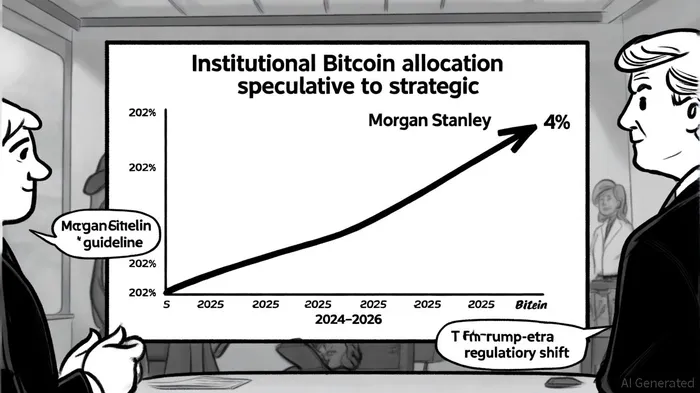
For years, Bitcoin was confined to the fringes of institutional investing, accessible only to high-net-worth clients with $1.5 million in assets and an aggressive risk profile, as Benzinga reported. Morgan Stanley's new policy eliminates these barriers, allowing even conservative investors to allocate a portion of their portfolios to crypto ETFs. The firm's investment committee has even provided specific guidelines, recommending a maximum 4% allocation for growth-oriented portfolios-a threshold that treats Bitcoin not as a speculative gamble but as a calibrated exposure, according to CNBC. This is not the behavior of a firm dismissing crypto as a fad; it is the language of institutionalization.
The implications are profound. By normalizing Bitcoin's inclusion in retirement accounts and taxable portfolios, Morgan StanleyMS-- is accelerating its integration into mainstream finance. This aligns with historical patterns of asset adoption: assets like gold or real estate were once considered niche or volatile but gained legitimacy as institutions established frameworks for their use. Similarly, Morgan Stanley's 4% guideline mirrors the way traditional asset allocators might treat commodities or emerging markets-high-risk, high-reward components of a diversified strategy.
Critics may argue that Bitcoin's volatility disqualifies it as a strategic asset. Yet volatility alone does not define an asset's utility. What matters is its role in a portfolio-specifically, its ability to hedge against inflation, diversify risk, or capture growth in new markets. Bitcoin's low correlation with equities and bonds makes it a compelling tool for these purposes, particularly in an era of monetary experimentation and geopolitical uncertainty, as BTCC explains. Morgan Stanley's decision implicitly acknowledges this, treating crypto as a complementary asset rather than a rival to traditional investments.
The firm's plans to expand direct crypto trading on its E-Trade platform in 2026-starting with Bitcoin, Ethereum, and Solana-further cement this shift, a development also noted by The Market Periodical. This move will democratize access to crypto, enabling retail investors to participate in markets previously reserved for specialists. The influx of new capital could amplify price swings, but it also signals a maturation of the ecosystem. As more institutions and individuals treat Bitcoin as a standard investment option, its price will increasingly reflect fundamentals rather than speculative hype.
Analysts suggest this institutional embrace could accelerate broader adoption while introducing new risks. "The removal of restrictions will likely increase market volatility due to the influx of new participants," one BTCC report notes. However, volatility is not inherently negative-it is a feature of any asset class undergoing rapid adoption. The key is whether institutions can manage risk effectively, a task Morgan Stanley's structured approach appears designed to address.
In conclusion, Morgan Stanley's policy change is more than a regulatory adjustment; it is a declaration that Bitcoin has earned a seat at the institutional table. By transforming crypto from a speculative outlier to a strategic allocation, the firm is reshaping the landscape of modern portfolio theory. For investors, this means reevaluating how they balance risk, return, and diversification in an era where digital assets are no longer a sideshow but a core component of financial strategy.





Comentarios
Aún no hay comentarios