
Morgan Stanley's 2026 Crypto Launch: A Pivotal Shift in Institutional Adoption
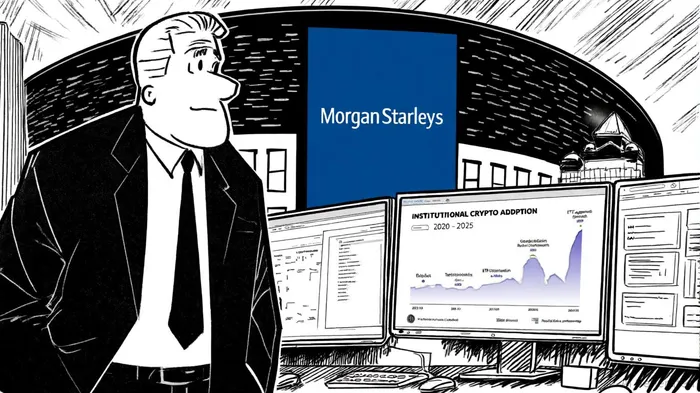
The financial world is on the cusp of a seismic shift. Morgan Stanley's decision to launch cryptocurrency trading on its ETrade platform in early 2026—offering direct access to BitcoinBTC--, EthereumETH--, and Solana—marks not just a strategic move for the bank but a watershed moment in the institutional adoption of digital assets. This initiative, powered by a partnership with Zerohash, a $1 billion crypto infrastructure provider, signals a broader acceptance of cryptocurrencies as a legitimate asset class within traditional finance. With 5.2 million ETrade users poised to trade digital assets alongside their conventional portfolios, Morgan StanleyMS-- is bridging the gap between Wall Street and the blockchain, a transition that could unlock $1.3 trillion in trading volume[1].
The Morgan Stanley Playbook: From ETFs to Wallets
Morgan Stanley's foray into crypto began cautiously in August 2024, when it allowed wealth advisers to recommend Bitcoin ETFs to clients[1]. Now, the bank is accelerating its digital asset strategy, with plans to develop a full wallet solution and integrate crypto into asset allocation frameworks. This evolution reflects a growing institutional recognition of cryptocurrencies as both a diversification tool and a hedge against macroeconomic volatility. By leveraging Zerohash's infrastructure for custody, liquidity, and settlement, Morgan Stanley is addressing critical pain points—such as security and regulatory compliance—that have historically hindered mainstream adoption[1].
The bank's timing is strategic. The regulatory landscape has shifted dramatically under President Donald Trump's administration, with the passage of the GENIUS Act providing a clearer legal framework for stablecoin issuance and digital asset innovation[1]. This legislative clarity, combined with the success of spot Bitcoin and Ethereum ETFs, has created a fertile ground for institutional participation. As stated by Jed Finn, head of wealth management at Morgan Stanley, this initiative is “the first phase of a broader digital asset strategy,” underscoring the bank's long-term commitment[1].
A Broader Institutional Convergence
Morgan Stanley's move is not an outlier but part of a larger institutional convergence. By 2025, 75% of financial institutions have acknowledged the necessity of advancing their digital asset activities to remain competitive[2]. This trend is driven by three key factors:
1. Regulatory Clarity: The Markets in Crypto-Assets (MiCA) framework in Europe and the U.S. GENIUS Act have reduced uncertainty, enabling banks to offer crypto services without fear of regulatory overreach[3].
2. Product Innovation: The launch of Bitcoin and Ethereum ETFs has created a liquid, regulated market, attracting $50 billion in institutional inflows for top Bitcoin ETFs in their first year[4].
3. Tokenization: Financial institutions are tokenizing real-world assets (RWAs), such as gold and real estate, to enhance liquidity. For example, JPMorgan Chase's pilot of a deposit token (JPMD) on the Base blockchain demonstrates how blockchain can streamline cross-border payments[5].
The Ripple Effect: From Banks to SMBs
The institutional embrace of crypto is cascading into broader economic sectors. Small and medium-sized businesses (SMBs) are increasingly adopting stablecoins for cross-border payments and remittances, with usage doubling from 17% in 2024 to 34% in 2025[6]. Meanwhile, fintechs like Klarna and Avalon Labs are integrating crypto into their platforms, signaling a shift toward embedded finance. Morgan Stanley's E*Trade launch could further accelerate this trend by normalizing crypto as a “traditional” asset, much like stocks or bonds.
Risks and Realities
Despite the momentum, challenges persist. Regulatory fragmentation, security risks, and market volatility remain hurdles. However, the collaboration between traditional banks and crypto-native firms—such as Morgan Stanley and Zerohash—demonstrates a growing willingness to mitigate these risks through innovation. As noted in a report by Techopedia, 76% of institutions plan to invest in tokenized assets by 2026, indicating that the industry is past the tipping point[7].
Conclusion: A New Era of Finance
Morgan Stanley's 2026 crypto trading launch is more than a product—it's a harbinger of a new financial era. By democratizing access to digital assets for millions of retail investors and institutionalizing crypto within asset allocation models, the bank is accelerating the transition from speculative niche to mainstream asset class. As the lines between traditional finance and blockchain blurBLUR--, one thing is clear: the future of finance is digital, and institutions that adapt will lead the charge.





Comentarios
Aún no hay comentarios