
J.P. Morgan's JP Coin on Canton Network: A New Era in Institutional Digital Assets?
In the ever-evolving landscape of institutional finance, J.P. Morgan's decision to expand its JPM Coin (JPMD) to the Canton Network marks a pivotal moment. This move, announced in late 2025, is not merely a technical upgrade but a strategic leap toward redefining how traditional financial systems interact with blockchain technology. By anchoring its USD-denominated deposit token to a privacy-preserving, institutional-grade blockchain, J.P. Morgan is signaling a broader shift in the industry's approach to digital assets. Let's dissect the implications.
Institutional Adoption: Bridging the Gap Between Legacy Systems and Blockchain
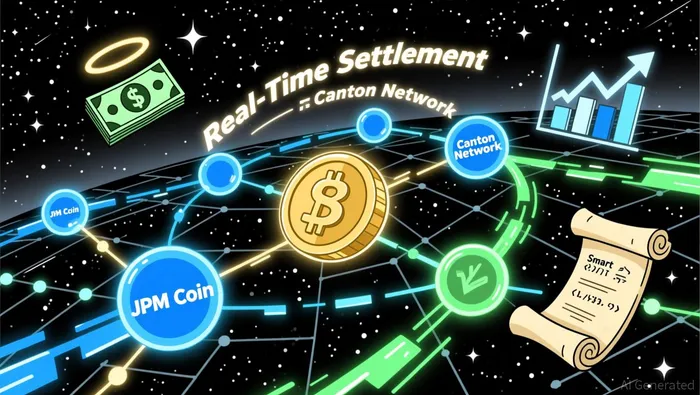
J.P. Morgan's JPM Coin has long been a regulated alternative to stablecoins, designed for institutional clients. Now, by integrating it with the Canton Network-a public, permissionless Layer 1 blockchain-J.P. Morgan is addressing two critical pain points: privacy and compliance. The Canton Network's architecture, engineered for institutional-grade transactions, enables synchronized settlement across asset classes, including cash, securities, and smart contracts. This is a game-changer for institutions that have historically been wary of blockchain's transparency, which often conflicts with their need for confidentiality.
The Canton Network's institutional adoption is further validated by its partnership with the Depository Trust & Clearing Corporation (DTCC) to tokenize U.S. Treasuries. This collaboration, supported by the SEC's no-action letter, demonstrates how real-world assets (RWAs) can be tokenized while maintaining legal and regulatory alignment. For J.P. Morgan, this means JPM Coin can now serve as a bridge between traditional finance and blockchain-based systems, enabling near real-time settlement and reducing counterparty risk.
Privacy-Driven Innovation: Zero-Knowledge Proofs and Institutional Trust
Privacy has been a thorn in the side of blockchain adoption for institutions. Public blockchains like EthereumETH-- or BitcoinBTC-- offer transparency but lack the confidentiality required for sensitive financial transactions. The Canton Network, however, leverages privacy-preserving technologies such as zero-knowledge proofs (ZKPs) and advanced encryption to ensure that transaction details remain confidential while still being verifiable. This dual-layer approach allows institutions to comply with regulatory requirements without exposing proprietary data.
For example, the Canton Network's CIP-56 token standard ensures compliance and privacy simultaneously, enabling seamless interoperability between applications. This is critical for use cases like tokenized cash management and real-time collateral mobility, where institutions need to maintain control over their data. J.P. Morgan's integration with Canton also includes collaboration with RedStone, a trusted oracle provider, to ensure reliable price feeds for tokenized assets while preserving confidentiality.
Strategic Implications: A New Infrastructure for Global Finance
The phased rollout of JPM Coin on Canton in 2026 is not just about J.P. Morgan-it's about setting a precedent for the entire industry. By demonstrating that regulated digital money can move on blockchain infrastructure while meeting institutional requirements, J.P. Morgan is accelerating the adoption of tokenized assets. The Canton Network's ability to handle $6T+ in on-chain assets and $280Bn in daily U.S. Treasury repo trades underscores its scalability and institutional readiness.
Moreover, the recent on-chain financing of U.S. Treasuries against USDCUSDC-- by a consortium including Bank of America, CircleCRCL--, and Tradeweb highlights the practicality of these systems. This transaction, executed on a Saturday, showcased a 24/7 capital market infrastructure-a feat impossible with legacy systems. Such innovations are not just incremental; they represent a fundamental reimagining of how global finance operates.
The Bigger Picture: Privacy as the New Competitive Advantage
As the financial sector grapples with the rise of decentralized finance (DeFi), privacy-preserving blockchains like Canton are emerging as the backbone of institutional-grade digital assets. J.P. Morgan's move signals that privacy is no longer a nice-to-have but a core requirement for institutional adoption. The 25% surge in Canton Coin's value on Christmas Eve 2025-a direct result of institutional demand-further validates this trend.
For investors, the strategic implications are clear: institutions are no longer on the sidelines. They are building infrastructure that prioritizes privacy, compliance, and scalability. J.P. Morgan's partnership with Canton is a masterstroke in this regard, positioning the firm at the forefront of a blockchain-driven financial revolution.
Conclusion
J.P. Morgan's JP Coin on the Canton Network is more than a product launch-it's a declaration of intent. By leveraging privacy-preserving blockchain technology, the firm is addressing the core challenges that have long hindered institutional adoption. As the Canton Network continues to scale and integrate with real-world assets, the stage is set for a new era in institutional digital assets. For investors, this is not just a story about JPM Coin or Canton; it's a glimpse into the future of finance.





Comentarios
Aún no hay comentarios