
MoonLake Immunotherapeutics and the De-Risking of Sonelokimab: A Catalyst-Driven Acquisition Play in Immunology
The biotech sector has long been a theater of high-stakes innovation, where regulatory milestones and clinical data can redefine a company's valuation overnight. MoonLakeMLTX-- Immunotherapeutics, a mid-cap player in the immunology space, is poised to capitalize on this dynamic with its lead asset, Sonelokimab (SLK), a Nanobody® targeting IL-17A and IL-17F. The drug's unique mechanism, robust clinical data, and recent regulatory clarity have positioned MoonLake as a compelling acquisition target, with its de-risked pipeline and strategic positioning in high-growth inflammatory disease markets offering a textbook case of regulatory-driven value creation.
Strategic Value Creation: From Nanobody Innovation to Clinical Proof
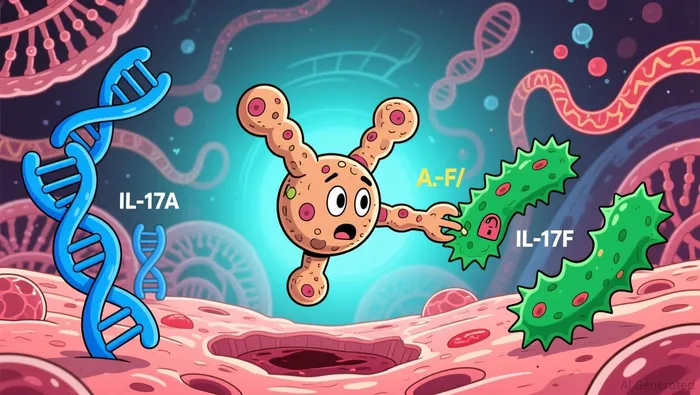
Sonelokimab's mechanism of action distinguishes it from conventional IL-17 inhibitors. By blocking IL-17A/A, IL-17A/F, and IL-17F/F dimers, SLK addresses a broader spectrum of inflammatory pathways than existing therapies, which typically target only IL-17A according to Nature. This differentiation is critical in diseases like hidradenitis suppurativa (HS) and psoriatic arthritis (PsA), where IL-17F has been increasingly implicated in disease pathology. The Nanobody platform itself-smaller in size (~40 kDa) and with enhanced tissue penetration-further amplifies SLK's therapeutic potential, particularly in inflamed or edematous tissues as detailed in Nature.
Clinical validation has followed swiftly. In HS, the MIRA, VELA-1, and VELA-2 trials collectively enrolled over 1,000 patients and demonstrated statistically significant improvements in HiSCR75 response rates, with 43% in MIRA and 35–36% in VELA-1 and VELA-2 according to Dermatology Times. These results, coupled with a favorable safety profile, led the FDA to confirm in a Type B meeting that the data package is sufficient for a Biologics License Application (BLA) submission in HS without additional trials as announced by MoonLake. This regulatory endorsement not only accelerates the BLA timeline (targeting Q3 2026) but also eliminates the need for costly Phase 3 trials, directly reducing development risk.
Regulatory Milestones as Valuation Catalysts
The FDA's feedback has redefined MoonLake's risk profile. Prior to the Type B meeting, the company faced uncertainty over whether its data would meet regulatory standards, particularly in PsA, where VELA-2's p-value (0.033) was less robust than VELA-1's (p < 0.001). The agency's decision to accept the combined dataset for HS, however, has created a floor for valuation by signaling that the "science works" as reported by MoonLake. This clarity has reignited acquisition speculation, with major pharma players like Merck, Sanofi, and Roche now viewed as potential suitors.
Financially, MoonLake is well-positioned to leverage this momentum. As of September 2025, the company holds $380.5 million in cash and equivalents, providing runway through mid-2027 according to Q3 2025 financial report. This liquidity allows it to advance additional trials, including the IZAR-1 and IZAR-2 Phase 3 studies in PsA, with readouts expected in Q2 2026. A positive IZAR-1 result could push the company's valuation toward $8–10 billion, a multiple reflective of its de-risked asset and potential as a standalone commercial entity or acquisition target as stated in financial report.
Market Dynamics and Competitive Landscape
The markets for HS and PsA are expanding rapidly, driven by biologic adoption and biosimilar competition. The global PsA treatment market reached $10.91 billion in 2025 and is projected to grow at a 9.44% CAGR through 2035, with biologic DMARDs dominating 50–52% of the market according to Towards Healthcare. Sonelokimab's potential to outperform existing IL-17 inhibitors-such as secukinumab and ixekizumab-on metrics like dosing frequency and tissue penetration could carve out a significant niche.
In HS, the market is similarly poised for growth, with a 5.1% CAGR expected through 2033. While adalimumab and bimekizumab currently dominate, SLK's Nanobody platform offers a compelling alternative, particularly for patients who fail to respond to existing therapies as detailed in SkyQuest. The drug's 64% mean reduction in PPPASI in the LEDA trial for palmoplantar pustulosis (PPP) further underscores its versatility across inflammatory indications according to MoonLake.
Acquisition Logic: A Pharma Industry Imperative
The biopharma industry's appetite for late-stage assets with clear regulatory pathways makes MoonLake an attractive acquisition candidate. With a BLA submission in HS on the horizon and PsA trials advancing, the company's risk profile aligns with big pharma's preference for de-risked assets. According to a report by Bloomberg, Merck and Roche have both expressed interest in expanding their immunology portfolios, with SLK's mechanism offering a complementary addition to their existing IL-17 and IL-23 inhibitor pipelines as reported by MoonLake.
Moreover, the regulatory acceptance of Nanobody technology-still a relatively novel platform-could position SLK as a first-mover advantage in a category with long-term growth potential. The FDA's willingness to accept MoonLake's data package sets a precedent for future Nanobody developers, enhancing the strategic value of the technology itself.
Conclusion: A Catalyst-Driven Re-Rating
MoonLake Immunotherapeutics exemplifies the power of regulatory milestones in driving valuation re-ratings. By transforming Sonelokimab from a high-risk clinical asset into a de-risked, FDA-sanctioned BLA candidate, the company has created a compelling narrative for both investors and acquirers. With a robust financial position, a clear regulatory path, and a growing market opportunity, MoonLake is no longer a speculative play-it is a catalyst-driven acquisition story. As 2026 unfolds, the upcoming BLA submission and IZAR trial readouts will serve as the ultimate arbitrage between current valuation and intrinsic value.





Comentarios
Aún no hay comentarios