
MoonFox Data: Li Auto's BEV Transition Under Pressure Amid Capacity and Competitive Headwinds
Li Auto's once-dominant position is crumbling. The company's third-quarter results delivered a stark reversal, with revenue falling 36.2% year-over-year to RMB 27.4 billion and vehicle sales down 37.4%. This plunge ended an 11-quarter streak of profitability, swinging the company to a net loss of RMB 625 million. The decline is severe and accelerating, with monthly sales having dropped from a peak of over 50,000 units to around 30,000, and fourth-quarter guidance pointing to another steep year-over-year decline.
This performance collapse is not happening in a vacuum. It is the direct result of a structural shift in the broader Chinese EV market, which is consolidating into a few powerful players. The sector is projected to reach $377.9 billion in revenue for 2025, with BYD capturing 34.1% market share through vertical integration and innovation. Against this backdrop, Li Auto's core strength-a moat built on extended-range electric vehicles (EREVs)-is eroding. Competitors have rapidly replicated its "fridge + TV + big sofa" family-oriented formula, turning its product lineup into a liability rather than an advantage.
The immediate operational constraint is a brutal reality of stock competition. Li Auto's family-oriented models, the L6, L7, L8, L9, and MPV model "MEGA", are now facing intense price wars and a flood of new rivals. The company's relatively limited product lineup is struggling to keep pace, while its pure electric i series has launched too late to stem the tide. This has created a painful pivot: Li AutoLI-- must now transition to pure electric vehicles (BEVs) to survive, but its product pipeline is insufficient and its production capacity is bottlenecked. The result is a company caught between a fading EREV advantage and an underdeveloped BEV future, all while the market's scale and intensity grow.
BEV Transition Challenges: Capacity Constraints and Rising Costs
The pivot to pure electric vehicles is proving to be a costly and logistically strained endeavor. Li Auto's third-quarter results show the financial punishment of this transition, with the company swinging to a net loss of RMB 625 million after 11 consecutive profitable quarters. While the recall of 11,400 MEGA vehicles contributed to the loss, the broader context is one of heavy investment required to build a new BEV platform and catch up in a market where rivals have already established significant advantages.
The most acute constraint is production capacity. Orders for the new i6 and i8 models have surged, but supply cannot keep pace. Despite having high orders for the i6, only a fraction of the company's Q3 deliveries were attributed to its pure electric lineup. This bottleneck is stark: with orders exceeding 100,000 units, yet only 18% of deliveries coming from these models, the company is unable to convert demand into revenue. This supply chain friction is a direct hit to growth and cash flow, forcing Li Auto to rely more heavily on discounting its older, slower-selling L-series vehicles.
This operational squeeze is pressuring the company's financials from both sides. On one side, the need to clear inventory through discounts weighs on the top line. On the other, the investment required to develop and ramp BEV production is a new cost center. While Li Auto's gross profit margin remains relatively stable at a healthy level of 19-20%, this stability is under threat. The weakening leverage from declining sales volume, combined with rising R&D and production costs for the new platform, creates a clear margin pressure point. The company is effectively paying to build its future while its current business erodes.
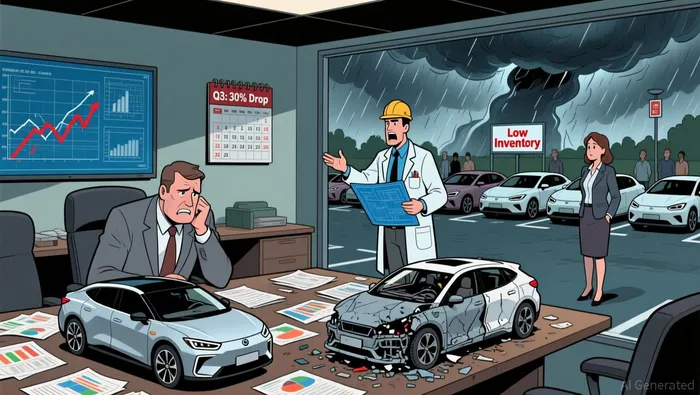
The bottom line is a capital-intensive transition hampered by physical bottlenecks. Li Auto is caught between a fading EREV advantage and an under-delivered BEV promise, with its production lines unable to scale fast enough to meet demand or offset the sales slump. This dual pressure-on cash flow from the loss and on operational capacity from the supply chain-is the defining challenge of its pivot.
Competitive Landscape: EREV Share Shrinks, BEV Rivals Advance
The competitive dynamics are shifting decisively against Li Auto's traditional playbook. Its core product category, extended-range electric vehicles (EREVs), is no longer a differentiator but a shrinking niche. Market data shows the category's share has fallen to just 7.5% in October 2025. This structural decline is the direct result of rivals rapidly replicating Li Auto's family-oriented formula, turning its product advantage into a crowded battlefield of stock competition.
The pressure is coming from multiple fronts. In the EREV segment, new entrants like AITO and Deepal are gaining ground, capturing the market share Li Auto is losing. Simultaneously, in the pure BEV segment where Li Auto is now scrambling to compete, established leaders are advancing with competitive models and expanding global footprints. Tesla's recent entry into India and Xpeng's expansion into Central Europe are clear signals that the global race is intensifying, with Chinese EVs leveraging their technological and cost advantages to push beyond domestic borders.
This global expansion is a strategic necessity for Li Auto, but it is a capital-intensive effort with no immediate payoff. The company is entering new markets in Central Asia and Africa, including Egypt, Kazakhstan, and Azerbaijan. While this move aims to offset weakness in the saturated domestic market, it represents a significant outlay of resources for a brand that is still building its BEV credibility. The expansion offers no revenue relief in the near term and adds another layer of complexity to an already strained operational and financial situation.
The bottom line is a company facing a two-pronged competitive assault. Its historical moat is eroding as its core product category shrinks, while rivals in both its legacy and new battlegrounds are gaining momentum. Li Auto's pivot to BEVs is not just a product transition; it is a desperate attempt to re-enter a market where the rules have changed, and the leaders are already in place.
Valuation Outlook: Deep Discount, High Execution Risk
The market has delivered a brutal verdict on Li Auto's trajectory. The stock trades at a deep discount, with a Price-to-Sales ratio of 0.91 and an even steeper Enterprise Value-to-Sales ratio of 0.21. This reflects severe skepticism about the company's ability to navigate its current crisis. The valuation compresses further when viewed against the broader market, where the stock has fallen 47.11% over the past 120 days and remains near its 52-week low of $16.11. In essence, investors are pricing in a company that is not just struggling, but one whose fundamental business model is under existential pressure.
This discount is the market's acknowledgment of a single, overwhelming risk: the execution of the BEV transition. The investment case hinges entirely on Li Auto successfully building a new, competitive BEV platform and capturing meaningful market share. The evidence points to a high bar. The company's pure electric i series has launched too late to stem the tide, and its production capacity is bottlenecked, unable to convert high order demand into deliveries. The primary risk is not a lack of ambition, but a failure to gain BEV market share against entrenched rivals. If the i6 and i8 cannot ramp quickly enough to offset the decline in its core EREV models, the company's revenue will continue to fall, and the valuation discount will likely widen.
The catalyst for a reversal is a clear, profitable product roadmap for 2026. The watchpoints are concrete and immediate. First, the BEV production ramp-up must accelerate to meet the surge in orders for the i6. Second, the company must demonstrate it can compete on pricing without destroying margins, a challenge given the intensifying stock competition in its legacy segment. Third, the pace of EREV market share erosion must slow, or the core business will continue to bleed. These are not abstract concerns; they are the daily operational hurdles that will determine whether the current valuation is a temporary mispricing or a permanent re-rating.
The bottom line is a high-risk, high-reward setup. The valuation offers a margin of safety for those who believe Li Auto can execute its pivot, but the evidence suggests the execution is fraught with difficulty. For now, the market is pricing in the most likely outcome: a painful transition that will test the company's capital and resolve.





Comentarios
Aún no hay comentarios