
MoonBull's Presale Momentum and Its Implications for DeFi Growth
The DeFi landscape in 2025 is witnessing a paradigm shift, driven by projects that blend high-yield incentives with community-centric tokenomics. Among these, MoonBull ($MOBU) has emerged as a standout case study, with its presale raising over $142,000 by Stage 3 and attracting more than 400 early participants, as reported in a GlobeNewswire release. This momentum, coupled with a 95% staking APY and a referral program incentivizing exponential growth, positions MoonBull as a compelling indicator of how early-stage DeFi projects can leverage tokenomics to drive adoption and value creation.
Structured Presale Dynamics and ROI Potential
MoonBull's presale is divided into 23 stages, each increasing the token price by 27.40%, culminating in a final listing price of $0.00616-a 1,492% increase from Stage 3's $0.00004057. Early investors who participated at Stage 3 have already achieved a 62.28% ROI, with a $100 investment potentially yielding over $19,340.66 at listing, according to that GlobeNewswire release. This structured price escalation mirrors strategies seen in successful DeFi launchpads like MEXC, where average peak ROIs of 10.83x were reported for early-stage projects in 2025 in an MEXC research. However, MoonBull's deflationary mechanisms-such as a 2% auto-burn per transaction and a dynamic trading tax-add a layer of scarcity not commonly seen in traditional meme coins, aligning with the tokenomics of projects like EthenaENA-- (ENA), which uses synthetic assets to drive demand per a MarketCapOf list.
High-Yield Staking and Referral-Driven Growth
The project's 95% APY staking program is among the most aggressive in DeFi, outpacing offerings from established platforms like Convex FinanceCVX-- (30% APY) and Yearn.finance (15% APY) in a TradingOnRamp roundup. This yield is backed by a 14.68 million MOBU staking pool, ensuring sustained reward distribution. Meanwhile, the referral program-offering 15% extra tokens to invitees and 15% of an invitee's purchase to referrers-creates a flywheel effect. The program is supported by $8.05 billion MOBU tokens, with top referrers earning USDC bonuses of up to 10%, as noted in the GlobeNewswire release. Such incentives rival those of platforms like Lido, where liquid staking derivatives (stETH) enable cross-DeFi liquidity, according to DeFi market statistics, but MoonBull's community-driven approach emphasizes viral growth over institutional adoption.
Tokenomics and Distribution: A Balanced Approach
MoonBull's tokenomics allocate 35% of its 1 billion supply to a capped whitelist, offering early adopters discounts, airdrops, and governance rights. The public sale accounts for 25%, while 30% is reserved for community participation (e.g., staking rewards, contests), and 10% for team and liquidity pools with a 12-month lock-up, per the GlobeNewswire release. This distribution contrasts with projects like AaveAAVE-- (AAVE), where governance tokens are more widely dispersed but yield lower APYs, based on the same DeFi market statistics. The inclusion of auto-burn mechanics and a dynamic tax further differentiates MoonBull, creating a model where token value retention is prioritized alongside growth.
Comparative Analysis: MoonBull vs. Leading DeFi Projects
To contextualize MoonBull's potential, consider the performance of 2025's top DeFi projects:
- Aave (AAVE): TVL of $11.2 billion, 30% staking APY (DeFi market statistics).
- Lido (LDO): TVL of $33.2 billion, liquid staking focus (DeFi market statistics).
- Hyperliquid (HYPE): $2.559 billion TVL, gas-free trading (GlobeNewswire release).
While these projects excel in liquidity and institutional adoption, they lack MoonBull's hyper-aggressive ROI structure and community-centric incentives. For instance, MEXC's launchpad projects achieved average ROIs of 10.83x in 2025 per the MEXC research, but MoonBull's presale ROI of 1,492% by listing suggests a more explosive trajectory. However, this comes with risks: high APYs often correlate with volatility, as seen in platforms like Maxi Doge (242% APY) referenced in the TradingOnRamp roundup, which face sustainability challenges.
Implications for DeFi Growth
MoonBull's success underscores a broader trend: early-stage DeFi projects are increasingly prioritizing holder participation and viral incentives to drive adoption. This aligns with 2025's DeFi evolution, where cross-chain interoperability and real-world asset (RWA) integration have expanded use cases, as summarized in DeFi market statistics. Projects that combine high APYs with deflationary mechanics-like MoonBull's auto-burn-may set new benchmarks for token utility and scarcity.
However, the model's sustainability hinges on execution. For example, while MoonBull's referral program could accelerate user acquisition, it must avoid the pitfalls of "pump-and-dump" dynamics seen in meme coins. Similarly, the 95% APY staking pool must remain adequately funded to avoid dilution.
Conclusion
MoonBull's presale momentum and tokenomics reflect a strategic alignment with 2025's DeFi priorities: high-yield incentives, community-driven growth, and deflationary scarcity. While its metrics outpace many peers, investors must weigh the risks of volatility against the potential for explosive ROI. As DeFi matures, projects like MoonBull may redefine how early-stage tokens balance innovation with sustainability-a critical consideration for investors navigating the sector's next phase.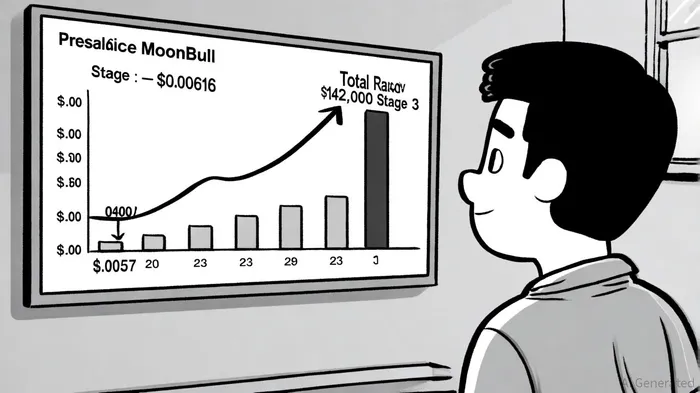






Comentarios
Aún no hay comentarios