
MoonBull ($MOBU): The Meme Coin with Institutional-Grade Governance and 9,256% ROI Potential in 2025
Institutional-Grade Governance: The New Standard for Meme Coins
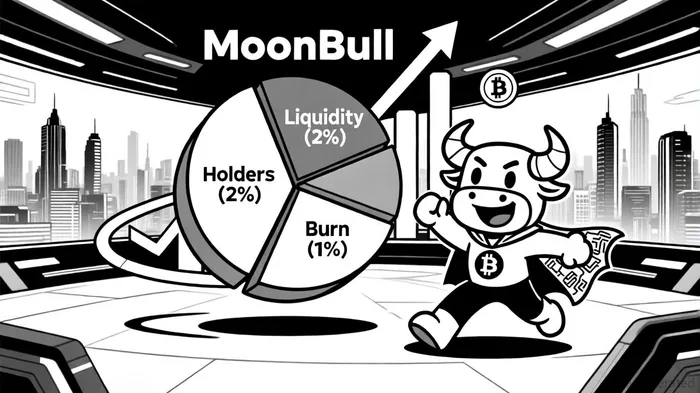
MoonBull's success hinges on its "Mobunomics" framework, a governance structure designed to align community interests with long-term value creation. Unlike traditional presales, where control is centralized, $MOBU's triple burn mechanism ensures every transaction contributes to the ecosystem: 2% of each trade is redistributed to holders, 2% is added to liquidity pools, and 1% is permanently burned, as noted in a FinanceFeeds roundup. This creates a self-sustaining flywheel that rewards participation while reducing supply over time.
The project's 23-stage presale further reinforces this model. With a fixed token supply of 73.2 billion and a 95% APY staking reward starting in Phase 10, MoonBull incentivizes early adoption while maintaining scarcity, according to Digital Journal coverage. Whitelisted users gain exclusive access to staking tiers and roadmap insights, leveraging psychological triggers like urgency and exclusivity to drive demand, as a FinanceFeeds article reports. This structured approach contrasts sharply with traditional presales, which often lack clear governance or tokenomics, leaving investors exposed to volatility and rug pulls, as outlined in a LinkedIn analysis.
ROI Potential: From Meme to Market Dominance
MoonBull's ROI projections are nothing short of extraordinary. At its current Stage 5 price of $0.00006584, early participants have already achieved 163.36% ROI. With a projected listing price of $0.00616, the token offers over 9,256% upside-a figure that dwarfs traditional presales, which rarely exceed 100% ROI, as Blockonomi reports. This potential is amplified by automated transaction burns and a 23-stage presale structure that creates controlled scarcity, as Digital Journal reported.
The project's 95% APY staking model, combined with referral bonuses and a 23-stage presale, creates a compounding effect that rewards long-term holders, as FinanceFeeds previously noted. For context, traditional presales often lack such incentives, relying instead on hype and short-term trading. Projects like BullZilla ($BZIL) and La Culex ($LCX) further validate this trend, with ROI projections of 2,639.81% and 333% respectively, driven by similar community-driven mechanics, as a Coindoo report notes.
Why Community-Driven Meme Coins Outperform
The key to MoonBull's success lies in its community-centric design. Traditional presales often prioritize ROI without fostering engagement, leading to fragmented ecosystems. In contrast, MoonBull's governance model ensures holders have a voice in protocol decisions, from liquidity allocation to marketing strategies, as FinanceFeeds observed. This aligns with broader trends in the meme coin space, where projects like Shiba InuSHIB-- (SHIB) and PEPEPEPE-- have leveraged community-driven initiatives to sustain relevance, according to a LinkedIn analysis.
Institutional validation is also growing. As of 2025, over 800,000 new meme tokens are launched monthly, but only those with transparent governance and active communities survive, according to CoinLaw statistics. MoonBull's 3,300+ holders and 1,500+ liquidity contributors exemplify this shift, creating a network effect that drives adoption, as Blockonomi reports. Meanwhile, traditional presales remain vulnerable to rug pulls and regulatory scrutiny, as highlighted by the SEC's February 2025 advisory on meme coin volatility.
Conclusion: The Future of Meme Coins Is Institutional
MoonBull ($MOBU) represents a paradigm shift in the crypto space. By combining meme-driven culture with institutional-grade governance, it offers a blueprint for sustainable growth. With 9,256% ROI potential and a governance model that rewards participation, $MOBU is not just a meme coin-it's a financial instrument built for the long term. As the market continues to evolve, projects that prioritize community engagement and structured tokenomics will outperform traditional presales, redefining what it means to invest in the digital age.






Comentarios
Aún no hay comentarios