
MoonBull and BlockDAG: Why These Projects Outperform Cardano and Stellar in 2025's Crypto Recovery
MoonBull: Meme Meets Utility in a High-Growth Presale
MoonBull's presale has surged into Stage 6, raising over $600,000 and attracting 2,000+ token holders. The project's tokenomics blend memeMEME-- coin virality with deflationary mechanics: 2% of every transaction is redistributed to holders, 1% is burned to reduce supply, and staking rewards further incentivize long-term participation. These features create a self-sustaining ecosystem that drives liquidity and scarcity.
The ROI potential is staggering. At its current presale price of $0.00008388, MoonBull's projected listing price of $0.00616 implies a 9,256% return for early investors. This is notNOT-- just speculative hype-it's a calculated strategy to align token holder interests with project growth. Additionally, governance rights tied to each $MOBU token empower the community to shape the project's future, fostering organic adoption.
In contrast, Cardano and Stellar lack such dynamic utility. ADA's 3.2% 24-hour gain and XLM's stable $0.33 price are encouraging but pale against the explosive momentum of presale-stage projects. Both projects remain constrained by their foundational architectures, with Cardano's proof-of-stake model and Stellar's cross-border payment focus failing to address the scalability and transaction cost issues that newer protocols like BlockDAG are solving.
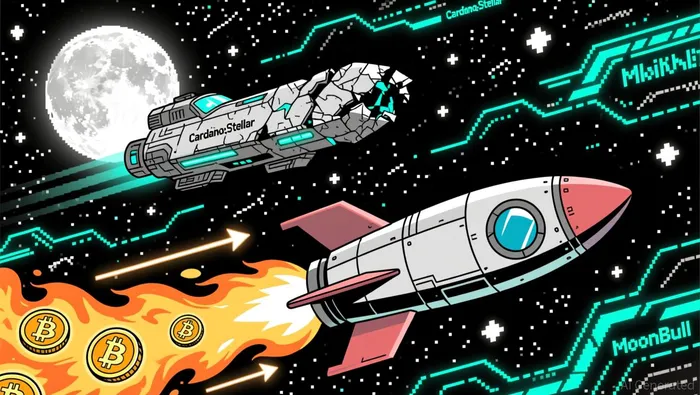
BlockDAG: A $430M Bet on Scalability and ROI
BlockDAG's presale has shattered records, raising over $430 million across 31 batches and selling 27.1 billion tokens to 312,000+ holders. At $0.0015 per token, investors are locking in a projected 3,233% ROI if the token lists at $0.05. This level of capitalization is rare for a presale-stage project and signals strong institutional and retail confidence.
Technologically, BlockDAG's hybrid DAG + Proof-of-Work architecture is a game-changer. The project's testnet already processes 1,400 transactions per second, with EVM compatibility ensuring seamless integration with Ethereum-based dApps. This scalability edge positions BlockDAG as a viable Layer-1 alternative to Cardano and Stellar, which struggle with throughput limitations and high fees.
Moreover, BlockDAG's 3.5 million X1 miners create a decentralized, community-driven network that rivals the security of Bitcoin's proof-of-work model. Upcoming events like the Binance AMA and GENESIS DAY are expected to catalyze further adoption, particularly as the project nears its mainnet launch.
Cardano and Stellar: Stagnation Amid Market Uncertainty
While Cardano and Stellar have maintained steady growth, their 2025 trajectories are clouded by unresolved technical challenges. ADA's price decline of nearly 3% in recent weeks reflects investor skepticism about its roadmap delays, while Stellar's focus on cross-border payments has failed to generate the same level of innovation as projects like BlockDAG.
Both projects also face adoption hurdles. Cardano's on-chain activity and large wallet movements suggest some institutional interest, but its proof-of-stake model lacks the energy efficiency and transaction speed of DAG-based systems. Stellar's regulatory compatibility is a strength, but it cannot offset the lack of a compelling narrative to drive mass adoption.
Conclusion: The Future Belongs to Utility-Driven Protocols
MoonBull and BlockDAG exemplify the next wave of crypto innovation: projects that combine viral appeal with real-world utility and scalable infrastructure. Their presale traction and ROI projections far outpace the cautious progress of Cardano and Stellar, which are increasingly seen as relics of a bygone era.
For investors seeking exposure to 2025's crypto recovery, the choice is clear. MoonBull's deflationary tokenomics and community governance, coupled with BlockDAG's $430M presale and DAG-based scalability, offer a compelling case for long-term value creation. As the market continues to favor projects that prioritize innovation over tradition, these two standouts are poised to redefine the industry's trajectory.






Comentarios
Aún no hay comentarios