
MoonBull as a 2025 Altcoin Outperformer in a Consolidating Crypto Market
The 2025 cryptocurrency market is at a pivotal inflection point. Bitcoin's consolidation phase and Ethereum's unresolved scalability challenges have created a vacuum for altcoins with robust tokenomics and institutional-grade infrastructure. Amid this landscape, MoonBull ($MOBU) emerges as a compelling strategic allocation, leveraging Ethereum's ecosystem while addressing its limitations through deflationary mechanics, high-yield staking, and community-driven growth.
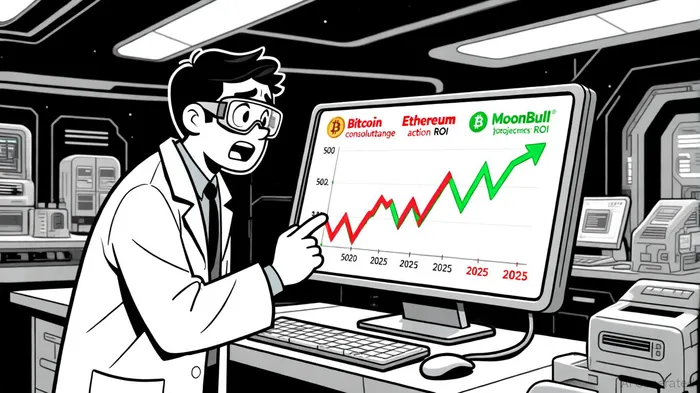
Bitcoin's Consolidation: A Catalyst for Altcoin Outperformance
Bitcoin has entered a consolidation phase, trading between $84,000 and $85,000 as of October 2025, with analysts projecting a potential rally to $150,000 by year-end, according to a Coinpedia forecast. However, this period of stagnation-historically observed during summer months-has seen institutional inactivity and retail overexposure erode momentum, according to an OKX analysis. For investors seeking yield during this pause, altcoins have historically outperformed. In 2025, the Altcoin Market Cap (excluding BitcoinBTC-- and Ethereum) surged to $1.18 trillion, driven by corporate and institutional allocations into projects with utility and scalability, as detailed in a TalkMarkets report.
MoonBull's presale model is uniquely positioned to capitalize on this dynamic. At Stage 4, the token price of $0.00005168 offers a projected 11,800% ROI if it reaches the listing price of $0.00616, according to a GlobeNewswire release. A $100 investment at this stage could yield $11,919.50, dwarfing Bitcoin's projected 73% return from its current consolidation range to $150,000. This ROI is amplified by MoonBull's 95% APY staking program, which commenced at Stage 10 and is backed by a 14.68 billion MOBU token pool, according to a CoinLineup piece.
Ethereum's Technical Hurdles and MoonBull's Strategic Response
Ethereum faces persistent scalability challenges, with Layer 1 processing averaging 14 transactions per second (TPS) compared to Solana's 4,000+ TPS, as noted in a LinkedIn analysis. Despite upgrades like Dencun (proto-danksharding) and Pectra (single-slot finality), Ethereum's reliance on Layer 2 solutions has fragmented its fee burn mechanism and introduced centralization risks, a point raised in a BeInCrypto article. Meanwhile, Ethereum's open interest in futures contracts ($25 billion) reflects indecision among traders, exacerbating volatility, according to a Metacint outlook.
MoonBull addresses these gaps by operating on Ethereum's ERC-20 standard while integrating Layer 2 solutions like ArbitrumARB-- and Base. Its tokenomics include auto-liquidity injections (2%), token reflections (2%), and a 1% burn on every trade, creating a deflationary flywheel, as described in a Coindoo profile. These mechanisms reduce slippage and enhance long-term value retention, countering Ethereum's scalability bottlenecks. Additionally, MoonBull's 30% liquidity pool allocation ensures stability, contrasting with Ethereum's fragmented Layer 2 ecosystem, an argument laid out in an OKX explainer.
Institutional Adoption and Risk-Reward Dynamics
Institutional adoption of Bitcoin has surged, with ETF holdings reaching 410k BTC in Q3 2025, according to a BitcoinStrategy report. However, Ethereum's ETF inflows ($33 billion) outpaced Bitcoin's ($1.17 billion) in Q3, signaling a shift in institutional interest toward Ethereum's tokenization and Layer 2 innovations, as observed in a Stockpil analysis. MoonBull, however, offers a superior risk-reward profile. While Ethereum's price targets ($5,000–$6,500) are ambitious, its technical hurdles and competition from SolanaSOL-- and AlgorandALGO-- pose risks, per a CoinCentral forecast.
MoonBull's structured presale across 23 stages, coupled with a 15% referral system and USDCUSDC-- bonuses for top referrers, creates a self-sustaining ecosystem, as noted in a GlobeNewswire release. This compares favorably to other altcoins like RIO and OCTA, which lack MoonBull's deflationary mechanics and institutional-grade smart contract audits, according to a CryptoNewsLand article. Furthermore, MoonBull's governance model allows token holders to vote on key decisions, aligning with institutional demands for transparency and community-driven governance, a detail highlighted in a Bitget report.
Strategic Allocation in a Maturing Market
As Bitcoin consolidates and EthereumETH-- grapples with scalability, MoonBull's tokenomics and Ethereum-based infrastructure position it as a high-conviction play. Its 11,800% ROI projection, 95% APY staking, and deflationary supply model create a compelling case for investors seeking asymmetric returns. With Ethereum's Fusaka upgrade (December 2025) and Bitcoin's potential breakout in Q4, MoonBull's structured presale and community incentives make it a strategic allocation in a maturing crypto landscape, according to a Coinetech analysis.






Comentarios
Aún no hay comentarios