
Monthly Income Generation in Equity Markets: Evaluating the Consistency and Sustainability of Sound Equity Dividend Income ETF's $0.0390 Distribution
The Allure of Monthly Income in Equity Markets
Investors seeking regular income often turn to dividend-paying equities, but consistency and sustainability remain critical hurdles. The Sound Equity Dividend Income ETF (DIVY) promises monthly distributions, aiming to double the yield of the S&P 500. However, its $0.0390 per-share payout—declared on September 15, 2025—requires scrutiny. This analysis evaluates whether DIVY's dividend strategy aligns with its stated goals and whether its financial underpinnings support long-term viability.
Evaluating Dividend Consistency: A Mixed Record
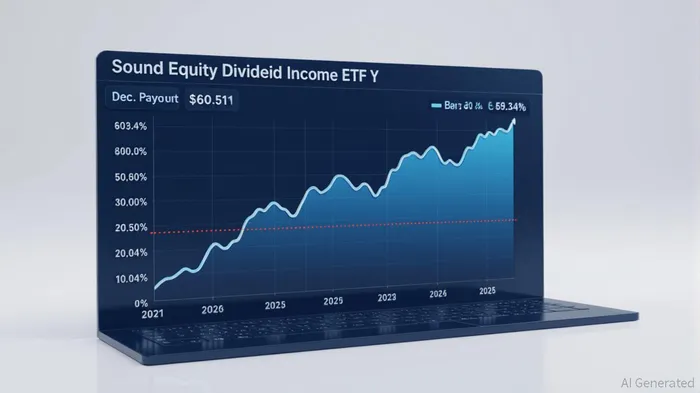
DIVY began distributing dividends in 2021, with a median of four years of consecutive payments across all ETFs. However, the fund has maintained only three years of uninterrupted payouts, placing it 25% below the median[1]. While the ETF has delivered 106 dividend payments since March 2021, the amounts have fluctuated dramatically. For instance, the December 2024 payout surged by 620.51% compared to the prior period[2], while January 2024 saw a 69.34% decline[2]. These swings suggest a lack of stability in the fund's distribution model.
Despite these irregularities, recent months have shown consistency, with $0.0390 per share paid regularly[1]. This pattern reflects the fund's strategy of targeting steady income but raises questions about its ability to maintain such predictability amid market volatility.
Sustainability: A Portfolio Under Scrutiny
DIVY's sustainability hinges on its top holdings, which include Omnicom GroupOMC--, LyondellBasellLYB--, and AbbVieABBV--. These companies collectively represent 18.75% of the fund's assets[3], making their financial health pivotal.
LyondellBasell's Risks: The chemical giant's dividend sustainability is under threat. As of H1 2025, LyondellBasell's payout ratio reached 403%, driven by a diluted EPS of just $0.34[4]. Worse, its operating free cash flow turned negative ($625 million), and cash reserves have dwindled from $3.38 billion to $1.7 billion[4]. These metrics signal a high risk of dividend cuts, despite the company's stated commitment to maintaining payouts.
AbbVie's Resilience: In contrast, AbbVie's 3.35% yield appears more secure. While its TTM payout ratio is elevated at 266.46%, strong free cash flow and a 3.71% revenue increase in 2024 ($56.33 billion) provide a buffer[5]. Strategic investments in immunology and oncology also position the company for long-term growth, though its debt levels remain a concern[5].
Omnicom's Strength: Omnicom's Q2 2025 results highlight robust revenue growth (+4.2% YoY) and a $3.3 billion cash reserve[6]. Despite a 13.9% decline in operating income due to acquisition costs, the company's adjusted EBITA margin of 15.3% and share repurchase program ($600 million planned for 2025) underscore its commitment to shareholder returns[6].
The ETF's Structural Challenges
DIVY's concentrated portfolio (36 stocks) amplifies exposure to individual holdings' risks. For example, LyondellBasell's struggles could disproportionately impact the fund's ability to meet its $0.0390 target. Additionally, the ETF's 0.45% expense ratio exceeds the FactSetFDS-- segment average of 0.34%, potentially eroding returns[7]. While its 6.34% 30-Day SEC Yield is attractive, this metric does not account for the volatility in underlying holdings.
Conclusion: A High-Yield Gamble?
DIVY's $0.0390 monthly distribution offers an appealing yield for income-focused investors, but its sustainability is far from guaranteed. The fund's reliance on a handful of high-yield stocks—some of which exhibit concerning payout ratios—introduces significant risk. While OmnicomOMC-- and AbbVie provide a degree of stability, LyondellBasell's financial trajectory raises red flags. Investors should weigh these factors against their risk tolerance and consider diversifying their income portfolios to mitigate exposure to concentrated, high-yield ETFs like DIVY.







Comentarios
Aún no hay comentarios