
Mono Protocol's Unified Balance System: A Game-Changer in Multi-Chain Accessibility
The DeFi landscape in 2025 is no longer defined by single-chain dominance but by the relentless pursuit of interoperability. As blockchain ecosystems fragment across chains like EthereumETH--, SolanaSOL--, and Base, users and developers face a critical challenge: how to manage assets and liquidity seamlessly without sacrificing efficiency or security. Enter Mono Protocol's Unified Balance System, a chain-abstraction solution that promises to redefine multi-chain accessibility. For investors, this innovation isn't just a technical breakthrough-it's a utility-driven presale opportunity with the potential to outperform speculative assets in a maturing market.
The Problem: Fragmentation in a Multi-Chain World
The rise of multi-chain DeFi has unlocked unprecedented liquidity and use cases but at a cost. Users must juggle multiple wallets, manually bridge tokens, and track balances across disparate networks. This complexity creates friction, stifling adoption and increasing transaction costs. According to a report, "the need to overcome fragmentation and access new liquidity pools" has become a defining priority for DeFi protocols in 2025. Projects like Curve and AaveAAVE-- are expanding to Solana and Base, but the lack of a unified interface remains a bottleneck.
Mono Protocol's Solution: Unified Balance System
Mono Protocol addresses this pain point with its Unified Balance System, a chain-abstraction layer that consolidates per-token balances across chains into a single interface. Users no longer need to manually bridge assets or manage multiple addresses; instead, they interact with a unified account that abstracts chain-specific complexities. This system leverages integrations with WalletConnect, ChainlinkLINK--, and LI.FI to ensure secure, cross-chain execution according to MEXC analysis.
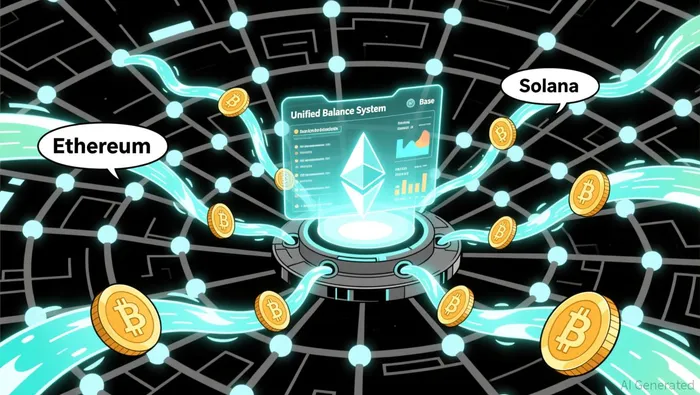
The technical implications are profound. By eliminating the need for intermediaries like bridges, Mono reduces transaction costs and execution times. For developers, it opens access to a broader pool of liquidity and users without requiring chain-specific optimizations. For investors, the system's utility is clear: it solves a real-world problem with a scalable, interoperable solution.
Investment Potential: Presale Metrics and Market Position
Mono Protocol's presale, currently in Stage 19, has already raised $3.71 million toward a $3.80 million target, with a token price of $0.0550 according to CoinCentral. The projected launch price of $0.500 implies a potential return of 1,011% for early participants-a figure that, while ambitious, is grounded in the project's growing traction.
What sets Mono apart from speculative presales is its utility-driven model. The token isn't just a governance asset; it's integral to the Unified Balance System's staking mechanisms and Rewards Hub, which incentivizes community participation. This creates a flywheel effect: as more users adopt the system, token demand increases, reinforcing its value proposition.
Third-party analyses further validate this potential. A 2025 report by MEXC highlights Mono Protocol as a "catching the eye of smart investors" due to its structured roadmap and transparent communication. Meanwhile, CoinCentral notes that its chain-abstraction model aligns with the broader trend of multi-chain adoption, positioning it as a "leading entry in the crypto presale market".
Broader Market Trends: Why Utility Matters
The DeFi TVL surpassed $126 billion in July 2025, a 45% increase since April 2025, signaling a shift from hype to substance. Regulatory clarity, such as the U.S. signing of the GENIUS Act, is also fostering institutional adoption. In this environment, projects that prioritize utility over speculation-like Mono Protocol-are better positioned to thrive.
Consider the competition: Stabull Finance and Symbiosis Finance are making strides in cross-chain stablecoin trading and real-world asset tokenization according to Antier Solutions. However, their focus remains niche. Mono Protocol's Unified Balance System offers a generalized solution applicable to any multi-chain use case, from lending to NFT trading. This versatility is a key differentiator.
Risks and Considerations
No investment is without risk. The success of Mono Protocol hinges on its ability to execute its roadmap and attract critical mass of users. While the presale has raised significant funds, the project must demonstrate real-world adoption post-launch. Additionally, regulatory shifts could impact cross-chain operations, though the GENIUS Act's emphasis on innovation suggests a favorable environment.
For investors, the key is to evaluate whether the Unified Balance System's utility justifies its risk profile. Given the current data-$3.71 million raised, a 1,011% projected return, and third-party validation-Mono Protocol appears to strike a balance between innovation and practicality.
Conclusion: A Utility-Driven Bet on the Future of DeFi
In a market increasingly defined by utility, Mono Protocol's Unified Balance System represents more than a technical novelty-it's a foundational layer for the next phase of blockchain adoption. By solving the fragmentation problem at its core, the project aligns with the broader trajectory of DeFi: interoperability, scalability, and user-centric design.
For investors seeking exposure to multi-chain ecosystems, the presale offers a compelling entry point. With a token price of $0.0550 and a structured development roadmap, early participation could yield substantial returns while supporting a protocol poised to become a DeFi standard.
As the saying goes in crypto: "Utility is king." Mono Protocol's Unified Balance System isn't just a game-changer-it's a glimpse into the future of decentralized finance.






Comentarios
Aún no hay comentarios