
Mono Protocol's MEV-Safe Cross-Chain Swaps: A Catalyst for DeFi's Next Evolution
The DeFi landscape is at a crossroads. As blockchain ecosystems proliferate, cross-chain interactions have become both a necessity and a vulnerability. MEV (Maximum Extractable Value) attacks—front-running, sandwich attacks, and arbitrage exploitation—have turned cross-chain swaps into high-stakes games of timing and trust. Enter Mono Protocol, a chain abstraction solution that claims to redefine cross-chain efficiency by embedding MEV-safe technology into its core. With a recent $2M private round[1], the protocol is positioning itself as a critical infrastructure layer for a future where liquidity is unified, trustless, and MEV-resistant.
The Problem: Cross-Chain MEV as a Systemic Bottleneck
Cross-chain MEV is not just a technical challenge—it's a systemic bottleneck. Traditional bridges and multi-chain swaps suffer from latency, high fees, and value erosion due to MEV actors exploiting price discrepancies across networks[3]. For example, a user swapping ETH for USDCUSDC-- on EthereumETH-- might face front-running on ArbitrumARB-- or SolanaSOL--, where arbitrage bots profit at their expense. According to a report by Invezz, these issues have stifled adoption, particularly among retail users who lack the tools to navigate fragmented ecosystems[1].
Mono's Solution: MEV-Resistant Infrastructure at Scale
Mono Protocol addresses these pain points through three pillars:
1. Liquidity Lock Technology: By aggregating tokens across chains into a single account, Mono eliminates the need for users to wait for bridge settlements. Transactions finalize instantly with cryptographic guarantees, reducing exposure to MEV attacks[1].
2. Intelligent Routing: The protocol's MEV-resistant systems dynamically route swaps through the most secure and cost-effective paths, shielding users from manipulation[1].
3. Developer-Friendly APIs: By abstracting chain-specific complexities, Mono enables developers to build cross-chain applications without manually stitching together multiple blockchains[1].
The $2M raise[1] is a pivotal catalyst here. The funding accelerates the development of a unified execution environment, which could lower the barrier to entry for both users and developers. For instance, automated yield optimization and real-time portfolio tracking—features highlighted in the protocol's roadmap—require robust infrastructure that only significant capital can scale[1].
Industry Validation and Competitive Positioning
Mono's approach is not without competition. Platforms like CoWSwap and Rango Exchange offer MEV-protected swaps, but they operate within single-chain or limited cross-chain contexts[3]. Meanwhile, SKALESKL-- Labs' FAIR blockchain—a MEV-resistant Layer 1 with native AI optimization—targets a different niche[2]. What sets Mono apart is its focus on chain abstraction, a concept gaining traction as users demand seamless, wallet-agnostic experiences.
Academic and industry efforts to mitigate MEV, such as Ethereum's Order Flow Auctions and Flashbots, highlight the urgency of the problem[4]. Mono's technical response—embedding MEV resistance at the execution layer—aligns with these trends while addressing cross-chain specificities. The protocol's ability to secure $2M in a private round[1] suggests strong institutional confidence, particularly in its potential to serve as a foundational layer for AI-driven DeFi protocols.
The $2M Raise: Fueling Scalable Liquidity Infrastructure
The $2M raise[1] is more than a funding milestone—it's a strategic move to build scalable, trustless liquidity infrastructure. Here's how the capital could be deployed:
- Liquidity Pool Expansion: Increasing the depth of cross-chain pools to reduce slippage and MEV opportunities.
- Validator Partnerships: Collaborating with entities like VodafoneVOD-- (a founding validator of FAIR[2]) to enhance security and finality.
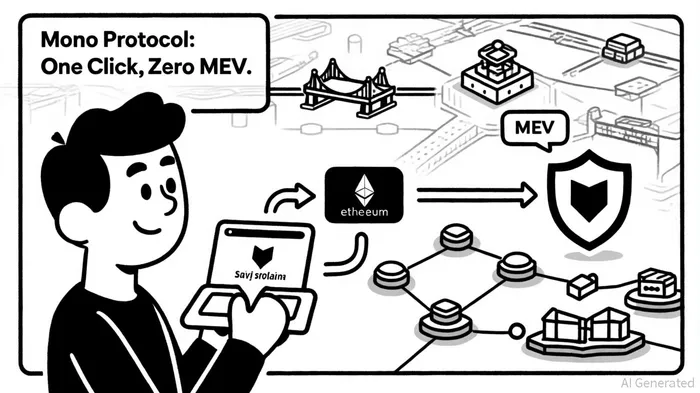
- User Onboarding: Simplifying cross-chain interactions through a single-click interface, which could attract retail and institutional users alike[1].
A data visualization could illustrate the potential impact of this funding. For example:
The Bigger Picture: DeFi Efficiency in a Multi-Chain World
Mono's success hinges on its ability to abstract complexity without compromising security. If the protocol can achieve its vision, it would not only protect users from MEV but also reduce the friction that has historically hindered cross-chain adoption. This aligns with broader industry shifts toward privacy-preserving technologies and Layer 2 solutions, which are expected to further reduce MEV exposure[4].
However, challenges remain. The protocol must navigate regulatory scrutiny around cross-chain transactions and ensure its MEV-resistant systems can scale without compromising speed. Additionally, competition from established players like UniswapUNI-- and emerging AI-focused blockchains could test Mono's market position.
Conclusion: A High-Stakes Bet on Chain Abstraction
Mono Protocol's $2M raise[1] is a bold bet on the future of DeFi. By embedding MEV-safe technology into cross-chain swaps, the protocol aims to create a world where liquidity is unified, trustless, and accessible to all. While the road ahead is fraught with technical and regulatory hurdles, the growing demand for MEV protection and chain abstraction suggests that Mono's approach is not just innovative—it's necessary.
For investors, the key question is whether the protocol can execute on its vision. If it does, the $2M raise could be the sparkSPK-- that ignites a new era of DeFi efficiency.






Comentarios
Aún no hay comentarios