
U.S. Monetary Policy Vulnerability to Political Influence in 2026: A Test of Central Bank Independence
The independence of central banks has long been a cornerstone of modern economic governance, ensuring that monetary policy is guided by data and long-term stability rather than short-term political expediency. However, the U.S. Federal Reserve's autonomy faces renewed scrutiny in 2026, as historical patterns of political pressure-particularly under the Trump administration-intersect with evolving leadership dynamics. This analysis examines how Trump-era rhetoric and Kevin Hassett's comments signal a potential shift in the Fed's independence, with critical implications for investors navigating an increasingly uncertain economic landscape.
Trump's Rhetoric: A Pattern of Pressure
President Donald Trump's public criticism of the Federal Reserve has been both consistent and unambiguous. In 2025, he decried the Fed's quarter-point rate cut to 3.6% as "insufficient," arguing that a reduction to 1% or lower would stimulate economic growth. His frustration extended beyond words: he threatened to replace Fed officials, including voting member Lisa Cook, with allies who would support his agenda. Such actions underscore a broader strategy to politicize monetary policy, leveraging appointments and public statements to align the Fed with his economic priorities.
Trump's push for aggressive rate cuts is driven by a desire to reduce borrowing costs for the federal government and offset the drag from his administration's trade and immigration policies according to analysis. Yet, as economists warn, this approach risks exacerbating inflation and destabilizing markets. The Fed's reluctance to comply reflects its commitment to data-driven decision-making, even as political pressures mount according to research. 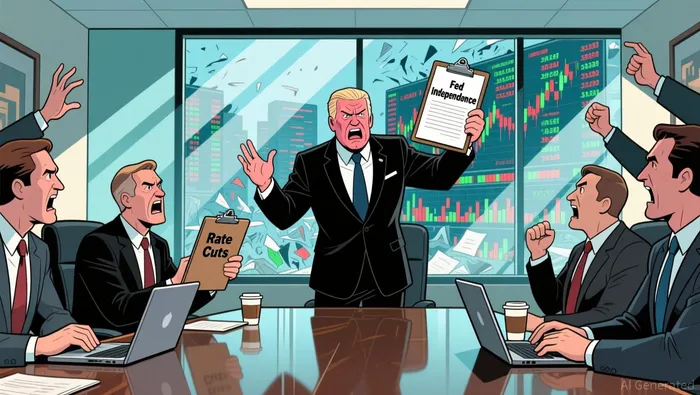
Hassett's Balancing Act: Independence vs. Influence
Kevin Hassett, a leading candidate for the next Fed chair, has navigated this tension with a nuanced stance. While emphasizing the Fed's need for independence, he has also acknowledged the inevitability of political engagement. In late 2025, Hassett stated that he would convey Trump's views on interest rates to the Fed but stressed that these opinions "could be rejected if they were not based on sound data." This position aligns with his broader advocacy for transparency in central banking, including support for reforms like the 2015 FORM Act, which seeks to demystify the Fed's decision-making process.
Hassett's comments reflect a pragmatic approach to central bank independence. He has repeatedly asserted that the president's voice would carry "no weight" in Fed decisions if he were chair according to MarketWatch, yet he has also framed the Fed as a "committee-driven institution" where collective deliberation-not unilateral authority-guides policy according to Fortune. This duality highlights a critical vulnerability: while the Fed's formal independence remains intact, the informal influence of political leaders like Trump could still shape its operational environment.
Implications for 2026: A Delicate Equilibrium
As 2026 unfolds, the interplay between Trump's rhetoric and Hassett's potential leadership will test the Fed's ability to resist political interference. The administration's push for rate cuts, coupled with Trump's history of threatening to replace dissenting officials, raises concerns about the erosion of institutional safeguards. At the same time, Hassett's emphasis on transparency and data-driven policy offers a counterweight, suggesting that the Fed may adapt to political pressures without fully succumbing to them according to Cato Institute analysis.
For investors, this dynamic creates a dual risk. First, if the Fed yields to political demands, it could trigger inflationary surges and market volatility, undermining long-term growth. Second, if it resists but fails to communicate effectively, it risks losing public and market confidence-a scenario that could amplify uncertainty in asset prices.
Investment Considerations: Hedging Against Policy Uncertainty
Given these risks, investors should prioritize strategies that hedge against policy volatility. Defensive sectors such as utilities and consumer staples may offer stability in a high-inflation environment. Additionally, allocations to inflation-protected securities (TIPS) and short-duration bonds could mitigate interest rate risks. Equities in companies with strong pricing power may also perform well if the Fed's accommodative stance supports economic growth.
However, the key challenge lies in balancing these hedges with exposure to growth opportunities. A diversified portfolio that incorporates both defensive and cyclical assets will be essential for navigating the unpredictable interplay between political influence and monetary policy.
Conclusion
The U.S. Federal Reserve's independence remains a critical but fragile asset in 2026. While Trump's rhetoric and Hassett's comments highlight the tension between political influence and institutional autonomy, the Fed's ability to maintain its data-driven approach will determine the trajectory of the economy. For investors, the lesson is clear: in an era of heightened policy uncertainty, adaptability and diversification are not just advantages-they are necessities.







Comentarios
Aún no hay comentarios