
Monero (XMR) as the New Privacy Benchmark Amid Zcash's Leadership Crisis
The privacy coin sector has long been a battleground for ideological and technical innovation, but 2025-2026 marked a pivotal shift in capital reallocation dynamics. At the center of this transformation lies Zcash's (ZEC) leadership crisis, which exposed governance vulnerabilities and catalyzed a surge in investor interest toward MoneroXMR-- (XMR). As Zcash's governance turmoil unfolded, Monero's decentralized model and consistent on-chain activity positioned it as the new benchmark for privacy-focused assets, reshaping the sector's competitive landscape.
Zcash's Governance Crisis: A Catalyst for Capital Flight
In January 2026, the resignation of Zcash's entire Electric Coin Company (ECC) team, including CEO Josh Swihart, triggered a governance crisis that sent shockwaves through the privacy coin market. The team cited "constructive discharge" due to changes in employment terms that allegedly hindered their mission-driven work. This mass exodus led to a 16.7% drop in ZEC's price within days, while on-chain data revealed a 7% spike in Zcash exchange balances, signaling heightened selling pressure.
The root of the dispute lay in diverging visions for Zcash's development funding model. Swihart advocated for ending direct protocol funding to decentralize the ecosystem further, while the Bootstrap board, including Zcash founder Zooko Wilcox, defended the existing structure. This schism underscored a critical risk for open-source projects: governance models that prioritize institutional control over community-driven development can erode trust and destabilize long-term value.
Monero's Resurgence: Stability in a Volatile Sector
While ZcashZEC-- reeled from internal conflict, Monero capitalized on the vacuum. By early 2026, XMR had reclaimed its position as the largest privacy coin by market capitalization, trading near $460-a level just 13.5% below its all-time high. This resurgence was fueled by three key factors:
- Decentralized Governance: Unlike Zcash's corporate structure, Monero relies on a decentralized community of developers and volunteers, reducing governance risks and fostering trust.
- Consistent On-Chain Demand: Monero's transaction volumes remained stable over three years, contrasting with Zcash and DashDASH--, which saw Q4 2025 spikes followed by sharp declines.
- Regulatory Resilience: As the EU's DAC8 directive mandated stricter transaction reporting, Monero's mandatory privacy features-unlike Zcash's selective disclosure via viewing keys-positioned it as a harder-to-regulate alternative.
Capital flows further validated this shift. Monero's Chaikin Money Flow (CMF) indicator spiked, reflecting inflows as investors sought privacy exposure without governance risks. Meanwhile, Zcash's developer activity plummeted to 2021 levels despite a 15-fold market cap increase in late 2025, highlighting a disconnect between valuation and development fundamentals.
Capital Reallocation: Metrics and Market Share Shifts
Quantitative data paints a stark picture of capital reallocation. Between Q4 2025 and Q1 2026, Zcash's price fell 16.7% while Monero rose 5%. Trading volume metrics reinforced this trend: Zcash and Dash saw Q4 2025 surges followed by sharp declines, whereas Monero's volumes remained stable. This divergence suggests that investors are prioritizing projects with proven utility and governance resilience over short-term hype.
Regulatory tailwinds also amplified Monero's appeal. With DAC8 and similar frameworks increasing scrutiny on transaction transparency, privacy coins offering mandatory anonymity-like XMR-have become more attractive to users seeking to circumvent reporting requirements. However, this advantage comes with risks: Monero's strong privacy features could attract legal challenges, particularly in jurisdictions prioritizing anti-money laundering (AML) compliance.
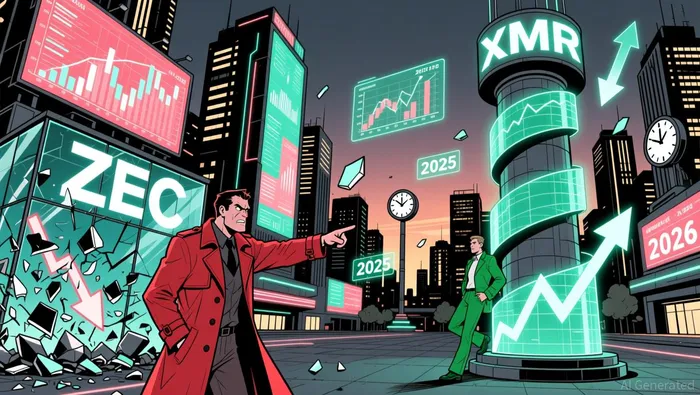
The Privacy Coin Sector's New Equilibrium
Zcash's crisis has accelerated a broader reallocation of capital within the privacy sector. While Zcash's foundational technologies, such as zk-SNARKs, remain influential, its governance model now faces existential questions. In contrast, Monero's decentralized ethos and technical consistency have solidified its role as the sector's new benchmark.
For investors, this shift underscores a critical lesson: in the privacy coin space, governance structure and development continuity are as vital as technological innovation. Zcash's struggles highlight the fragility of projects reliant on centralized leadership, while Monero's resilience demonstrates the value of community-driven models.
As 2026 unfolds, the privacy coin sector will likely see further consolidation. Projects unable to adapt to regulatory pressures or governance scrutiny may struggle to retain market share. For now, Monero's ascent reflects a market recalibration-one where privacy is not just a feature, but a governance imperative.







Comentarios
Aún no hay comentarios