
Monero (XMR) Price Breakout Potential and Privacy-Driven Crypto Demand: Investment Implications of Institutional Adoption and Regulatory Diversification
The Privacy Paradox: Monero's Resilience Amid Regulatory Headwinds
Monero (XMR) has long been a symbol of financial privacy in the crypto space, but its journey in 2025 has been defined by a delicate balancing act between institutional skepticism and surging demand for anonymity. As global regulators tighten their grip on digital assets, Monero's market position-holding a 58% share of the privacy coin market capitalization at $4.3 billion as of July 2025-reflects both its enduring appeal and the challenges of navigating a fragmented regulatory landscape, according to an OnChain Standard analysis.
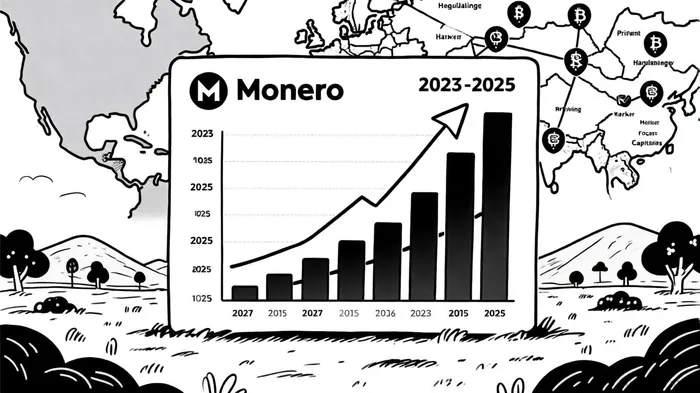
The European Union's Markets in Crypto-Assets (MiCA) regulation, which prohibits trading of crypto assets with built-in anonymization features unless transaction histories can be identified, has been a pivotal force. This has led to delistings on major exchanges like Binance, Kraken, and OKX in key jurisdictions, pushing trading activity to less-regulated platforms such as Poloniex and Yobit, according to a Brave New Coin report. Despite these hurdles, Monero's price has shown resilience, trading near $327 in mid-2025-a 58% year-over-year gain-suggesting that demand for privacy-driven assets remains robust, as the Dataconomy report finds.
Institutional Caution and Strategic Adaptation
Institutional investors, historically wary of privacy coins due to compliance risks, have adopted a cautious yet calculated approach. According to a CoinLaw report, 74% of surveyed blockchain companies cited compliance with the FATF Travel Rule as a major challenge when working with privacy coins. However, Monero's unique value proposition-untraceable transactions via ring signatures, stealth addresses, and RingCT-has attracted niche institutional interest, particularly in decentralized finance (DeFi) and decentralized exchanges (DEXs) where privacy is a non-negotiable requirement, according to The Standard report.
One notable strategy involves dollar-cost averaging to mitigate volatility, with institutional portfolios allocating small percentages (median: 10% of net income) to XMR as a "digital gold" hedge, per an OnTheNode analysis. Additionally, the shift to decentralized and peer-to-peer platforms has enabled institutions to bypass centralized exchange restrictions while maintaining exposure to Monero's ecosystem. For example, platforms like Haveno and Farcaster have seen increased activity, offering trustless trading environments that align with institutional risk management frameworks, as noted in a Cointelegraph piece.
Regulatory Diversification: A Double-Edged Sword
The global regulatory landscape for privacy coins is starkly divergent. While the EU and U.S. have imposed stringent measures-such as the U.S. Financial Crimes Enforcement Network's (FinCEN) proposed $500 transaction reporting rule-jurisdictions like Switzerland and Liechtenstein have adopted more balanced approaches, permitting privacy coin use within regulated sandbox environments, according to a Crystal Intelligence report. This divergence creates both opportunities and risks for investors.
In Asia-Pacific, where privacy coins account for 29% of crypto trading activity, countries like South Korea and Japan have restricted institutional trading of privacy coins, yet retail adoption persists, per a TMR analysis. Conversely, in the Middle East, the UAE's Dubai Virtual Assets Regulatory Authority (VARA) has issued 36 full licenses, fostering innovation while maintaining compliance standards, as reported by Cointelegraph. These regional contrasts highlight the importance of regulatory diversification in institutional strategies, as investors must navigate a patchwork of policies to optimize risk-adjusted returns.
Technological Resilience and Market Positioning
Monero's survival in 2025 hinges on its ability to adapt technologically. The implementation of Full-Chain Membership Proofs (FCMP++) in 2025 has enhanced privacy while improving scalability, addressing concerns from both users and compliance-focused stakeholders, as noted by OnChain Standard. Additionally, the Cuprate node upgrade has streamlined transaction processing, making Monero more accessible to mainstream users. These advancements position XMR as a viable alternative to transparent blockchains, particularly in sectors where financial anonymity is critical-such as cross-border remittances and privacy-sensitive commerce.
Despite regulatory pressures, Monero's market capitalization has remained within the top 30 cryptocurrencies, with a price range of $236–$327 as of mid-2025, according to OnTheNode. This resilience underscores the growing demand for privacy-driven assets, even as traditional financial systems increasingly marginalize them. Analysts suggest that if regulatory frameworks in key markets ease-particularly in the U.S. and EU-Monero could stabilize at higher price points, driven by its role as a "hedge against financial surveillance," according to a Medium article.
Investment Implications: Balancing Risk and Reward
For institutional investors, Monero presents a high-differentiation, high-risk asset that requires tailored compliance strategies. The key to unlocking its potential lies in leveraging decentralized infrastructure and cross-chain atomic swaps to maintain liquidity while adhering to evolving regulatory standards, as discussed in a DataBird article. However, the reputational risks associated with Monero's historical ties to darknet markets remain a barrier to broader adoption, according to a ShortsellingEX analysis.
In conclusion, Monero's price breakout potential is inextricably linked to its ability to navigate regulatory diversification and technological innovation. While institutional adoption remains limited, the growing demand for privacy-centric solutions-coupled with Monero's robust community and decentralized infrastructure-suggests that XMR will continue to play a pivotal role in the crypto ecosystem. For investors willing to navigate the complexities of regulatory fragmentation, Monero offers a compelling case study in the intersection of privacy, compliance, and market resilience.







Comentarios
Aún no hay comentarios