
Monero's Ongoing Hardware Wallet Integration and Security Upgrades: A Deep Dive into Technical Resilience and Adoption Potential
Monero (XMR) has long been a cornerstone of the privacy-centric cryptocurrency ecosystem, distinguished by its commitment to default transaction anonymity through ring signatures, stealth addresses, and confidential amounts. As the crypto landscape evolves in 2025, Monero's recent v0.18.4.5 update-dubbed "Fluorine Fermi"-has further solidified its technical resilience and user adoption potential. This release, which addresses critical Ledger hardware wallet compatibility issues, introduces support for the Ledger Nano Gen5, and enhances cross-platform usability, underscores Monero's adaptability in a rapidly shifting market.
Ledger Crash Fixes and Gen5 Integration: A Privacy-First Security Boost
The v0.18.4.5 update resolves a critical bug that caused the Ledger MoneroXMR-- app to crash, a fix that directly addresses a pain point for users relying on hardware wallets for secure key management. More significantly, the update adds support for the Ledger Nano Gen5, a hardware wallet launched in October 2025 with a certified secure E Ink touchscreen and advanced connectivity options like Bluetooth and NFC. This integration is not merely a technical upgrade but a strategic move to align Monero with the latest advancements in hardware wallet security. The Gen5's Secure Element chip and tamper-resistant design provide an additional layer of protection for Monero users, who prioritize privacy not only in transaction data but also in key storage.
For developers, the integration process involves building the Monero GUI from source using Docker, a method that ensures reproducibility and transparency in the software supply chain. This approach aligns with Monero's ethos of decentralization and open-source collaboration, as it allows the community to verify and audit the codebase independently. 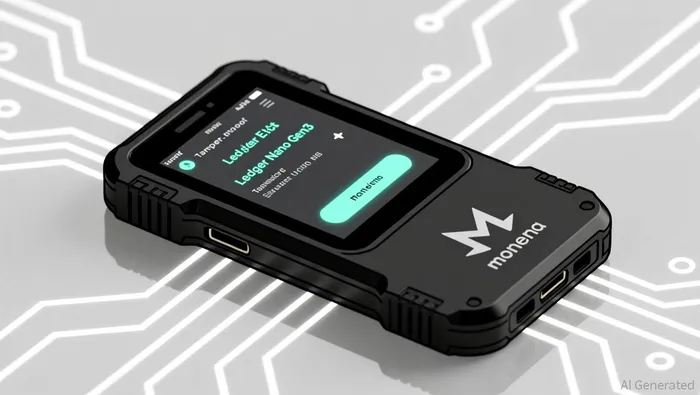 . The inclusion of Gen5 support also reflects Monero's proactive stance in staying ahead of hardware wallet innovation, a critical factor in retaining its position as the leading privacy-focused cryptocurrency.
Cross-Platform Improvements and Institutional Relevance
Beyond hardware wallet integration, the v0.18.4.5 update enhances macOS dark mode compatibility and updates P2Pool to version 4.13, improving the user experience for a broader audience. These cross-platform refinements are part of a larger trend in Monero's development roadmap: making privacy-centric tools more accessible without compromising security. The Cuprate node implementation, introduced in Q4 2025, further amplifies this effort by reducing blockchain sync times by over 700%, enabling full nodes to run on consumer-grade hardware within 16 hours. Such optimizations are crucial for fostering a more decentralized network, as they lower the barrier to entry for node operators and validators.
Institutional interest in Monero, while historically limited compared to BitcoinBTC-- or EthereumETH--, is gaining traction as privacy becomes a business imperative. The upcoming FCMP++ (Full-Chain Membership Proofs) upgrade, slated for Q1 2026, promises to mathematically prove untraceability, moving beyond probabilistic obfuscation and addressing a key concern for institutional investors seeking verifiable privacy guarantees. Monero's decentralized funding model, supported by a transparent Community Crowdfunding System (CCS), also strengthens institutional trust by ensuring that development remains community-driven rather than influenced by centralized entities.
User Adoption and the Privacy-Centric Ecosystem
The integration of Monero with the Ledger Nano Gen5 is poised to drive user adoption by combining robust privacy features with user-friendly hardware. The Gen5's affordability and intuitive interface make it an attractive option for both new and existing users, particularly in jurisdictions where privacy is a regulatory or social necessity. For example, Monero's adoption in regions with strict capital controls-such as Southeast Asia and Latin America- has already demonstrated its utility for private remittances. The Gen5's enhanced security features further reduce the risk of key exposure, a critical consideration for users who store significant value in XMRXMR--.
Retail adoption is also being bolstered by Monero's growing merchant ecosystem, with over 1,000 businesses now accepting XMR for goods and services. The Ledger Wallet Provider library, which enables direct browser sessions with Ledger signers, simplifies transaction execution for non-technical users while maintaining the privacy benefits of hardware wallets. This seamless integration between hardware wallets and dApps is a key differentiator for Monero in a market where usability often trumps privacy.
Challenges and the Road Ahead
Despite these advancements, Monero faces challenges, including regulatory scrutiny and competition from emerging privacy technologies. The EU's MiCA regulation and U.S. SEC guidance, while still in flux, could impose restrictions on privacy coins, potentially limiting their adoption in institutional portfolios. Additionally, the shift to FCMP++ has sparked debates about block size limitations and the potential emergence of a "fee market," which could price out smaller users. However, Monero's semi-monopolistic position in the privacy niche-coupled with its active community and decentralized governance-positions it to navigate these challenges effectively.
Conclusion: A Privacy-First Asset for the Long Term
Monero's v0.18.4.5 update exemplifies its commitment to technical resilience and user-centric innovation. By addressing Ledger compatibility issues, integrating the Gen5 hardware wallet, and enhancing cross-platform usability, the project reinforces its role as the gold standard for privacy in the crypto space. For investors, these upgrades signal a maturing ecosystem that balances cutting-edge security with accessibility, a combination that is increasingly attractive to both retail and institutional stakeholders. As the demand for privacy grows in response to global surveillance and regulatory pressures, Monero's ongoing integration with advanced hardware wallets and its focus on decentralized governance will likely ensure its relevance-and value-for years to come.






Comentarios
Aún no hay comentarios