
Monero vs. Gold and Treasury Bonds: A 2025 Analysis of Digital Privacy Coins as Macro Hedges
In 2025, the global financial landscape has witnessed a seismic shift in the dynamics of safe-haven assets. Traditional pillars like gold and U.S. Treasury bonds, long revered for their macroeconomic hedging properties, now coexist with a new contender: privacy-focused cryptocurrencies like Monero (XMR). This article dissects how these assets have fared against inflation, geopolitical risks, and fiscal uncertainty, offering a nuanced perspective on their roles in modern portfolios.
Gold's Resurgence as a Macro Hedge
Gold has reasserted itself as the dominant safe-haven asset in 2025, surging to record highs above $4,000 per ounce. This performance defies historical norms, as gold's traditional inverse relationship with U.S. Treasury yields has collapsed. According to a Deriv Blog report, investors are increasingly favoring gold over Treasuries amid concerns about U.S. fiscal credibility and inflationary pressures. Central banks, particularly in China, India, and Turkey, have accelerated gold purchases to diversify reserves away from the dollar, further cementing its role as a geopolitical hedge, the report adds.
Gold's appeal lies in its uncorrelated nature and its ability to preserve value during periods of currency devaluation. For instance, during the 2024–2025 inflationary spike, gold outperformed Treasury Inflation-Protected Securities (TIPS), which, while offering real returns, typically deliver lower yields compared to other fixed-income instruments, according to an Investopedia analysis.
The Diminishing Role of Treasury Bonds
U.S. Treasury bonds, once a cornerstone of risk-averse portfolios, have lost luster. As noted by an Euronews report, real yields on long-duration bonds remain negative or barely positive due to inflation persisting above central bank targets. The U.S. Treasury market, grappling with maturing debt and fiscal deficits, has become increasingly volatile. For example, 10-year Treasury yields stabilized around 4.1% in 2025, but their effectiveness as a hedge against inflation has waned.
While TIPS still provide a guaranteed real return, their low interest rates and susceptibility to inflation erosion make them less attractive in a high-debt environment. Capital Considered highlights that investors are now viewing Treasuries as risk assets rather than safe havens, a stark departure from historical norms.
Monero's Unique Position in the Digital Privacy Space
Monero, a privacy-centric cryptocurrency, occupies a distinct niche in the macroeconomic hedging debate. Unlike gold or Treasuries, Monero's value proposition hinges on its cryptographic features-ring signatures, stealth addresses, and bulletproofs-which ensure untraceable transactions, according to a Finance Monthly article. This privacy layer makes it an attractive option for individuals seeking to obscure financial activities amid rising surveillance and geopolitical tensions.
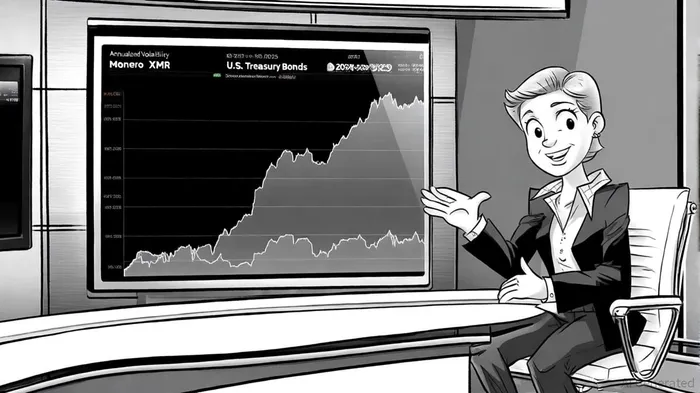
However, Monero's effectiveness as a macroeconomic hedge remains contentious. From 2020 to 2025, XMR exhibited extreme volatility, with daily price swings exceeding 7% during events like 51% hashrate scares, as detailed in a ShortsellingEX report. For instance, in May 2025, a $330.7 million BitcoinBTC-- laundering event through Monero exchanges triggered a 50% price spike, illustrating how illicit flows can distort its valuation, according to a Coin Republic report. Such volatility contrasts sharply with gold's stability and Treasuries' predictability.
Monero's supply model-growing at a low annual inflation rate of ~0.87%-positions it as a potential anti-inflationary asset. Yet, its adoption is hindered by regulatory scrutiny. Delistings on major exchanges and potential bans in the EU underscore the risks of its anonymity features.
Comparative Analysis: Effectiveness as a Hedge
When evaluating hedging effectiveness, gold and Treasuries outperform Monero in several dimensions:
1. Inflation Protection: Gold's historical performance during the 1970s and 2024–2025 inflationary periods demonstrates its resilience, as noted in the ShortsellingEX report. TIPS, while less dynamic, offer federally guaranteed real returns per the Investopedia analysis. Monero's inflation hedge is speculative, with no empirical evidence of its efficacy during major macroeconomic shocks.
2. Geopolitical Risk Mitigation: Gold's surge in 2025 reflects its role as a store of value during geopolitical fragmentation, a point highlighted in the Deriv Blog report. Monero's privacy features make it a tool for cross-border transactions in unstable regions, but its price is more susceptible to regulatory and liquidity shocks, as covered by the Coin Republic report.
3. Portfolio Diversification: Gold and Treasuries provide low-correlation diversification, whereas Monero's high volatility increases portfolio risk, a concern raised in the ShortsellingEX report.
Conclusion
In 2025, gold remains the gold standard (pun intended) for macroeconomic hedging, while U.S. Treasury bonds struggle to retain their relevance in a high-inflation, high-debt world. Monero, despite its innovative privacy features, lacks the stability and regulatory clarity to compete as a mainstream hedge. However, its unique role in obscuring financial activities during geopolitical crises suggests it could complement traditional assets in niche scenarios. Investors seeking diversification must weigh Monero's volatility and regulatory risks against its potential as a digital privacy tool.






Comentarios
Aún no hay comentarios