
Monero's Emergence as the Leading Privacy Coin and Its Case for a Top 10 Crypto Ranking
The cryptocurrency landscape in 2025 is witnessing a seismic shift in investment narratives, with privacy coins emerging as a critical asset class amid escalating regulatory scrutiny and institutional demand for cryptographic anonymity. MoneroXMR-- (XMR), long regarded as the gold standard of privacy-focused cryptocurrencies, has solidified its position as a top contender for a Top 10 crypto ranking. This analysis examines Monero's technological resilience, adoption trends, and governance risks, while contextualizing its role in a broader privacy-centric investment narrative.
The Investment Narrative Shift: Privacy as a Structural Requirement
The fourth quarter of 2025 has seen privacy coins outperform major cryptocurrencies like BitcoinBTC-- and EthereumETH--, even as the broader market faces downturns. According to a report by Grayscale, privacy tokens such as ZcashZEC-- (ZEC), Monero (XMR), and DashDASH-- (DASH) have attracted significant institutional interest, driven by the growing recognition of privacy as a structural requirement in blockchain integration. This shift is underscored by the EU's DAC8 directive and evolving compliance frameworks, which have heightened demand for privacy-preserving technologies.
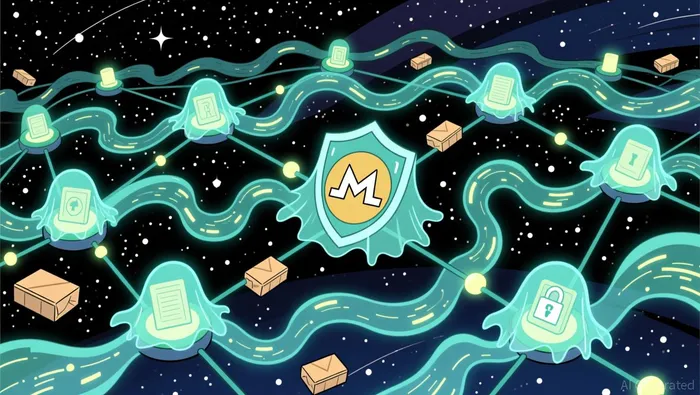
Monero's market capitalization of approximately $8.3 billion in late 2025-a-figure that rivals Zcash's $6.5 billion valuation-reflects its dominance in this niche. Analysts argue that Monero's privacy-by-default model, which employs ring signatures, stealth addresses, and RingCT, positions it as a foundational layer for digital sovereignty in an era of pervasive surveillance. Unlike Zcash, which relies on optional shielded transactions, Monero's fungibility is inherent, ensuring that all transactions are untraceable by design.
Technological Advancements: Strengthening Monero's Privacy Edge
Monero's technological roadmap in late 2025 has further cemented its leadership. The Fluorine Fermi upgrade, introduced in October 2025, enhanced peer selection algorithms to mitigate risks from spy nodes, reducing the likelihood of users connecting to suspicious nodes within the same IP subnet. This update was followed by the announcement of the upcoming "Seraphis" upgrade, which will introduce a new transaction protocol to expand anonymity sets exponentially. By allowing users to hide transactions among millions of potential decoys, Seraphis aims to render statistical analysis obsolete.
Additionally, the development of the OSPEAD decoy selection algorithm-a mechanism to ensure the age distribution of decoy inputs matches real spends- has bolstered Monero's resistance to statistical tracing attacks. These advancements, coupled with the Bulletproofs+ protocol and view tags, have improved transaction efficiency and wallet synchronization, addressing scalability concerns without compromising privacy.
Adoption Trends and Competitive Challenges
Monero's adoption in late 2025 has been marked by both progress and turbulence. While the cryptocurrency's price surged to $430–$440 in December 2025, its network faced a 51% attack orchestrated by Qubic, leading to chain reorganizations and sparking debates about decentralization. The community responded by shifting to P2Pool and implementing emergency measures to mitigate reorg risks. Despite these challenges, Monero's on-chain transaction volume remains robust, with over 9.09 million transactions recorded between 2021 and 2022.
Competition from Zcash and Solana's GhostwareOS has intensified, with Zcash briefly surpassing Monero in market capitalization after a 248% price surge in October 2025. However, Zcash's governance turmoil-marked by team resignations and internal disputes- has reinforced Monero's reputation as a stable alternative. Meanwhile, Solana's modular privacy solutions, while innovative, lack the fungibility and privacy-by-default model that define Monero's core value proposition.
Governance Risks and Regulatory Pressures
Monero's decentralized governance model, which operates through a community-driven development process rather than a formal company, presents both strengths and vulnerabilities. While this model ensures resistance to centralized control, it also complicates regulatory compliance, particularly in jurisdictions like South Korea, where expanded AML rules now require oversight of crypto transfers under $680. Analysts caution that Monero's privacy-by-default approach may clash with evolving compliance frameworks, potentially leading to exchange delistings and liquidity constraints.
However, the project's resilience is evident in its ability to adapt. For instance, the shift to P2Pool following the Qubic attack demonstrated the community's capacity to respond to security threats without compromising decentralization. Moreover, Monero's focus on usability and liquidity-through upgrades like FCMP++ and Cuprate- signals a strategic effort to balance privacy with real-world adoption.
Monero's Case for a Top 10 Crypto Ranking
Monero's trajectory in 2025 underscores its potential to break into the Top 10 cryptocurrencies by market capitalization. Its technological innovations, such as Seraphis and OSPEAD, position it as a leader in privacy-centric blockchain development. Furthermore, the growing institutional demand for cryptographic privacy- evidenced by Zcash's Shield Pool reaching 5 million ZEC locked-suggests that privacy coins will remain a cornerstone of the crypto ecosystem.
Critically, Monero's governance model, while unconventional, aligns with the decentralized ethos of blockchain. As regulatory pressures mount, its ability to maintain privacy-by-default while addressing scalability and liquidity concerns will determine its long-term success. For investors, Monero represents a high-conviction play on the structural demand for privacy in an increasingly surveilled digital economy.
Conclusion
Monero's emergence as the leading privacy coin in 2025 is a testament to its technological ingenuity and community-driven ethos. While governance risks and regulatory challenges persist, the project's strategic upgrades and adoption trends position it as a strong candidate for a Top 10 crypto ranking. As the investment narrative shifts toward privacy as a structural requirement, Monero's unique value proposition-fungibility, decentralization, and untraceable transactions-ensures its relevance in an evolving market.






Comentarios
Aún no hay comentarios