
Mondi Group: Navigating Sustainability-Driven Demand in Packaging Amid Near-Term Challenges
Strategic Alignment with Circular Economy and Market Trends
Mondi's sustainability initiatives are anchored in its Mondi Action Plan 2030 (MAP2030), which emphasizes circularity-a model where materials are reused, recycled, or composted to minimize waste. By 2025, the company aims to ensure that 100% of its packaging and paper portfolio is reusable, recyclable, or compostable. As of 2024, 87% of Mondi's revenue already derives from circular solutions, reflecting significant progress. This focus aligns with the broader eco-friendly packaging market, which is projected to grow at a compound annual growth rate (CAGR) of 8.4%, expanding from $260.72 billion in 2025 to $359.49 billion by 2029. Key drivers include rising consumer awareness, e-commerce expansion, and innovations in plant-based and biodegradable materials.
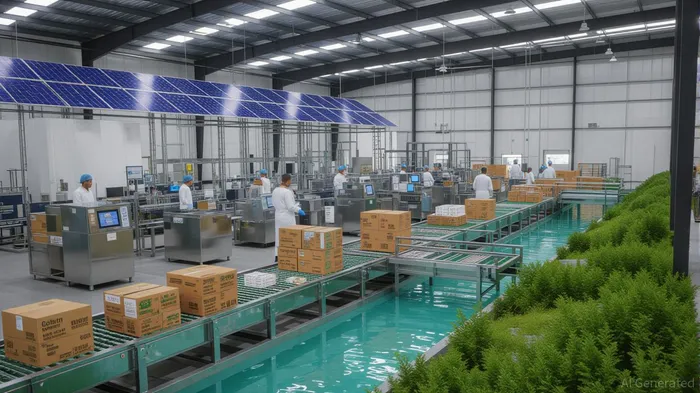 Mondi's emphasis on flexible packaging innovations-such as lightweight, recyclable materials-positions it to capitalize on these trends. For instance, its 2023 financial performance underscored the commercial viability of sustainability, with 85% of revenue tied to circular solutions and €1,312 million in cash generated from operations. These figures suggest that Mondi's environmental commitments are not merely aspirational but are increasingly translating into revenue streams.
Near-Term Financial Pressures and Operational Realities
Despite these strengths, Mondi faces near-term headwinds. The Q3 2025 trading update revealed an underlying EBITDA of €223 million, a figure consistent with the first half of 2025 (€564 million for H1 2025) but reflective of softer market conditions. Declining paper selling prices and subdued demand have pressured volumes, even as the company continues to reduce Scope 1 and 2 greenhouse gas emissions by 31% compared to 2019 levels. This duality-advancing sustainability while navigating economic challenges-highlights the complexity of balancing long-term environmental goals with short-term profitability.
Mondi's response has centered on operational efficiency and cost controls. For example, the company has prioritized investments in high-margin circular solutions while managing costs in lower-growth segments. This approach aims to mitigate the impact of market volatility and preserve cash flow, which is critical for funding future sustainability projects. However, investors must weigh whether these measures are sufficient to sustain momentum in a competitive landscape where rivals like AmcorAMCR-- and Tetra Laval are also advancing eco-friendly offerings.
Investment Implications and Strategic Outlook
For investors, Mondi's trajectory presents both opportunities and risks. On the positive side, its alignment with the $359.49 billion eco-friendly packaging market by 2029 suggests long-term growth potential, particularly as regulatory frameworks tighten and consumer preferences evolve. The company's progress in circular solutions-already accounting for 87% of revenue in 2024-underscores its ability to adapt to these shifts.
Yet, near-term financial performance remains a concern. The Q3 2025 results indicate that Mondi's sustainability-driven strategy has not yet fully offset declining demand in core markets. This raises questions about the pace of market adoption for sustainable packaging and the company's ability to maintain profitability amid macroeconomic headwinds. Investors should monitor key metrics, such as the proportion of revenue from circular solutions and EBITDA margins, to assess whether Mondi can bridge the gap between its environmental ambitions and financial outcomes.
Conclusion
Mondi Group's sustainability initiatives are a testament to its commitment to the circular economy, a strategy that aligns with the accelerating global demand for eco-friendly packaging. While the company has made measurable progress-both in environmental performance and revenue diversification-near-term financial challenges underscore the need for disciplined execution. For investors, the key lies in evaluating whether Mondi's operational efficiency measures and innovation pipeline can sustain its competitive edge as the market evolves. In a world where sustainability is increasingly inseparable from profitability, Mondi's ability to navigate these dual imperatives will define its long-term success.





Comentarios
Aún no hay comentarios