
Molina Healthcare's Earnings Outlook: Navigating Policy Shifts and Margin Pressures in 2025
The healthcare landscape in 2025 has been reshaped by sweeping policy changes, particularly the enactment of H.R. 1, which has introduced significant financial and operational challenges for Medicaid managed care organizations (MCOs) like Molina HealthcareMOH--. As the company prepares to report its earnings, investors must assess whether MolinaMOH-- can sustain its margins and scale its operations amid these headwinds.
Policy Shifts and Financial Pressures
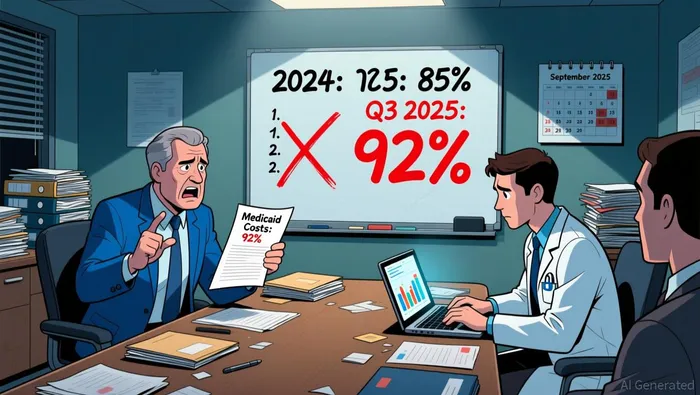
H.R. 1, signed into law in 2025, is projected to reduce federal Medicaid spending by $915 billion over the next decade, with the Congressional Budget Office estimating that 7.5 million more Americans could become uninsured by 2034. For Molina, a company heavily reliant on Medicaid and Affordable Care Act (ACA) markets, the law's provisions-such as 6-month redeterminations, provider taxes, and state-directed payments (SDPs)-are set to intensify cost pressures. By Q3 2025, Molina's Medicaid medical cost ratio had already surged to 92%, reflecting the strain of rising medical expenses and regulatory complexity.
The Centers for Medicare & Medicaid Services (CMS) further complicated the environment by rescinding prior guidance on health-related social needs (HRSN) coverage, now requiring case-by-case reviews. This shift limits Molina's ability to proactively address social determinants of health, a strategy previously used to manage costs and improve outcomes. Meanwhile, CMS's new SDP rules mandate that states tie these payments to measurable quality goals, adding administrative burdens for MCOs.
Cost Management and Operational Efficiency
 Molina has responded to these challenges with disciplined cost management. In 2024, its general and administrative (G&A) expenses totaled 6.7% of revenue, a figure the company has emphasized as a testament to operational efficiency. However, the path forward remains fraught. For 2025, Molina revised its earnings guidance downward, projecting adjusted earnings per share (EPS) of $21.50 to $22.50-well below its initial forecast of at least $24.50-due to a "temporary dislocation between premium rates and medical cost trends." The company now anticipates a consolidated pre-tax margin of just under 4%, the low end of its long-term target range.
To offset these pressures, Molina has invested in scalability initiatives, including $1.00 per diluted share in implementation costs for new Medicaid and Medicare Duals contracts. These investments signal a strategic focus on growth, albeit at the expense of near-term profitability.
Strategic Adjustments for Scalability
Molina's approach to scaling under policy uncertainty has centered on two pillars: market rationalization and targeted expansion. In the ACA market, the company raised premiums by 30% for 2026 plans, and exited underperforming markets, reducing its county footprint by 20%. This move reflects a recognition of the ACA's deteriorating risk pool, where higher-acuity enrollees have driven up costs.
In Medicaid, Molina has doubled down on Dual Special Needs Plans (D-SNPs), a segment where it aims to grow its presence by 23% in 2025. This aligns with a CMS rule streamlining enrollment for dual-eligible beneficiaries, which automatically enrolls Medicaid recipients in D-SNPs through their healthcare providers. The company has also filed competitive Medicare Advantage (MA) bids, targeting dual-eligible populations to balance cost and growth.
Challenges and the Road Ahead
Despite these efforts, Molina faces persistent headwinds. Retroactive rate cuts in states like California, have added financial strain, prompting the company to engage in ongoing discussions with state officials to advocate for stable payment structures. While leadership remains cautiously optimistic about future Medicaid rate adjustments- citing off-cycle increases observed in Q3 2025-the path to margin stabilization is unclear.
The company's long-term outlook hinges on its ability to execute strategic M&A and secure favorable rate negotiations. However, with H.R. 1's effects unfolding over the next decade, investors must weigh the risks of prolonged margin compression against the potential for growth in D-SNPs and MA.
Conclusion
Molina Healthcare's 2025 earnings report will serve as a critical barometer of its resilience in a transformed regulatory environment. While the company has demonstrated agility in managing costs and pursuing scalable opportunities, the cumulative impact of H.R. 1 and CMS policy shifts cannot be overstated. For now, Molina's ability to sustain margins appears contingent on short-term rate adjustments and disciplined execution. Investors should monitor its progress in D-SNP expansion and ACA market rationalization, as these initiatives will determine whether the company can navigate 2025's turbulence and emerge as a durable player in the evolving managed care landscape.





Comentarios
Aún no hay comentarios