
Moderna's Long-Term Bet: Navigating Volatility in the mRNA Therapeutics Revolution
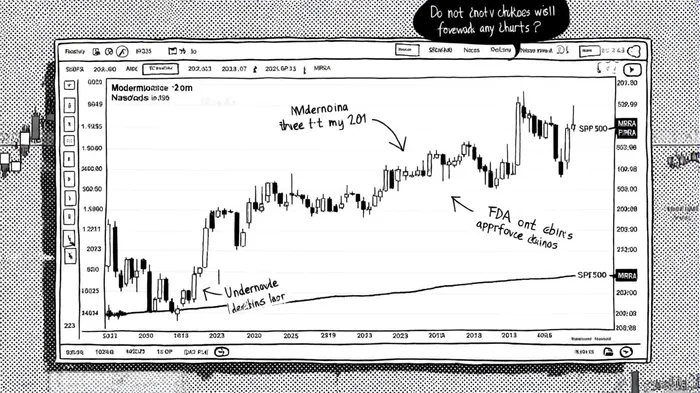
In the volatile world of biotech investing, ModernaMRNA-- (MRNA) has emerged as both a cautionary tale and a case study in resilience. Over the past two years, the company's stock has swung between outperforming major indices and collapsing under the weight of its own expectations. As of late 2025, Moderna's shares closed at $25.51 in one session, outpacing the S&P 500's 0.48% gain and the Nasdaq's 0.94% increase[1]. Yet, just weeks later, the stock plummeted by -7.4%, underperforming the broader market's modest declines[2]. These swings reflect a company in transition: one that must reconcile its post-pandemic identity with the realities of a maturing mRNAMRNA-- therapeutics market.
The Financial Reckoning
Moderna's financials tell a story of stark contrasts. While its early success with the Spikevax vaccine made it a household name, the company now faces a -63.57% total return over the past 12 months and a -38.79% drop year-to-date[3]. Earnings estimates for 2025 project a loss of -$9.7 per share, with revenue expected to fall to $1.92 billion—a 40.61% decline from 2024[1]. These figures underscore the challenges of transitioning from a one-product wonder to a diversified biotech leader.
The company's net profit margin of -94.31% and a return on equity (ROE) of -27.50%[4] highlight the urgency of cost-cutting measures. Moderna has announced $1 billion in 2025 expense reductions and an additional $500 million in 2026[2], signaling a painful but necessary recalibration. Yet, these cuts must not come at the expense of innovation—a delicate balance the company is still learning to strike.
Pipeline as a Lifeline
Moderna's long-term prospects hinge on its ability to diversify its pipeline. The company has 10 key programs in late-stage development, with up to three potential approvals expected in 2025[2]. Notable milestones include the FDA's review of its next-generation COVID-19 vaccine (mRNA-1283), with a PDUFA date of May 31, 2025[2], and positive Phase 3 data for its flu/COVID combination vaccine (mRNA-1083)[2]. In oncology, partnerships with MerckMRK-- and IBM—leveraging quantum computing to accelerate drug design[2]—signal a strategic pivot toward personalized therapies.
The rare disease segment also offers promise. Moderna's mRNA-3927 for propionic acidemia and mRNA-3705 for methylmalonic acidemia are advancing through clinical trials, with the latter set to begin a registrational study in early 2025[2]. These programs, while niche, could generate high-margin revenue and reinforce Moderna's reputation as an innovator in mRNA science.
Industry Tailwinds and Competitive Pressures
The global mRNA therapeutics market is projected to grow from $18.5 billion in 2023 to $40.3 billion by 2033, driven by applications in oncology, infectious diseases, and rare genetic disorders[2]. Moderna's leadership in this space is undeniable, but competition is intensifying. PfizerPFE-- and Alnylam PharmaceuticalsALNY-- are closing the gapGAP--, while CureVac's resurgence in personalized cancer vaccines adds to the pressure[3].
Despite these challenges, Moderna's platform remains a technological marvel. Its ability to rapidly design and scale mRNA-based solutions—from vaccines to therapeutics—positions it to capture a significant share of this expanding market. Analysts project a return to profitability by 2029[1], assuming successful regulatory approvals and sustained R&D investment.
The Investor Dilemma
For investors, Moderna presents a paradox: a company with a -63.57% total return over the past year but a $1.99 billion market opportunity by 2035[3]. The current consensus rating of “Hold” and an average price target of $43.50 (implying a 70.92% upside)[5] reflect this tension. While the near-term outlook is bleak, the long-term potential is tantalizing—provided Moderna can execute its strategic shift without sacrificing its scientific edge.
In the end, Moderna's story is one of reinvention. The company must prove that it can evolve from a pandemic-era hero to a sustainable biotech leader. For those willing to weather the volatility, the rewards could be substantial—but patience will be a virtue.





Comentarios
Aún no hay comentarios