
Mobix Labs' $100M Equity Financing and SPAC Merger: A Catalyst for Growth?
In the ever-evolving landscape of capital markets, Mobix LabsMOBX--, Inc. (NASDAQ: MOBX) has positioned itself as a case study in the strategic use of SPACs and equity financing to fuel aggressive expansion. The company's $100 million equity financing agreement with B. Riley Principal Capital II, LLC in 2024[2] and its 2022 merger with Chavant Capital Acquisition Corp.[1] represent pivotal moves in a broader strategy to consolidate market share across mission-critical industries. However, for investors, the question remains: Do these maneuvers signal a sustainable path to growth, or are they symptomatic of the broader challenges facing SPAC-backed firms in a post-2025 regulatory environment?
Strategic Implications: Flexibility and Diversification
Mobix's $100M financing agreement operates as a dynamic capital-raising tool, allowing the company to issue shares at its discretion based on market conditions[2]. This flexibility is critical for executing its merger-and-acquisition (M&A) strategy, as evidenced by its 2025 acquisition of Spacecraft Components Corp., a manufacturer of aerospace connectors[4]. By entering high-margin sectors like defense and transportation, MobixMOBX-- aims to diversify revenue streams and reduce reliance on its core operations. The acquisition of EMI Solutions, Inc. in 2022[5] further underscores a pattern of vertical integration, aligning with the company's vision to dominate niche markets.
The SPAC merger with Chavant Capital in 2022[1] provided Mobix with immediate public market access, bypassing the traditional IPO process. This move was timely, as 2025 saw a SPAC resurgence driven by regulatory reforms that enhanced transparency and investor protections[3]. However, the broader SPAC ecosystem remains fraught with challenges. While 53 SPACs raised $9.5 billion in H1 2025[3], de-SPAC activity remains subdued, with only 16 completed transactions year-to-date. This suggests lingering skepticism among investors, who now demand stronger governance and clearer value propositions from SPAC-backed firms.
Financial Implications: A Tale of Two Metrics
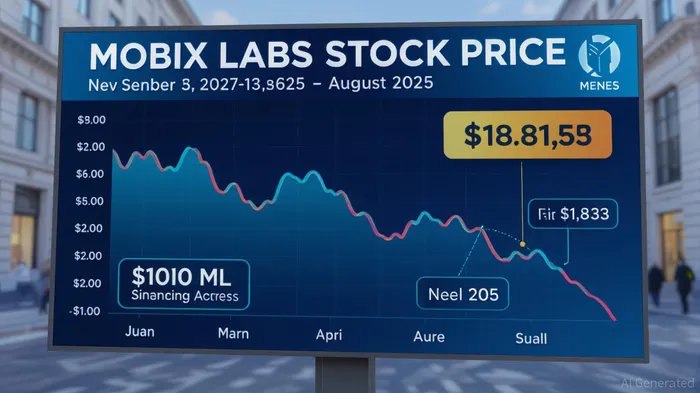
Mobix's financial performance post-SPAC merger tells a mixed story. As of June 2025, the company reported trailing twelve-month (TTM) revenue of $11 million[1], a modest increase from its unaudited 2023 revenue of $18.1 million for Spacecraft Components alone[4]. This discrepancy highlights the challenges of integrating acquired assets into a cohesive revenue model. Meanwhile, Mobix's stock price has halved since its post-SPAC peak of $2.66 in January 2024[4], closing at $1.18 as of August 2025[1]. The decline reflects broader market concerns about SPAC underperformance, with studies showing that SPACs underperform traditional IPOs by an average of 50% or more[6].
Despite these headwinds, Mobix's $100M financing agreement provides a buffer against liquidity constraints[2]. The put-like structure of the deal allows the company to set a minimum valuation floor, mitigating downside risk in volatile markets[3]. This is particularly relevant given the company's negative EBITDA and net income figures, which underscore its unprofitability[1]. For now, Mobix relies on strategic acquisitions and capital flexibility to stave off near-term financial pressure, but long-term profitability remains unproven.
Investor Considerations: Balancing Risk and Opportunity
For investors, Mobix's trajectory raises critical questions about risk tolerance and time horizons. The company's aggressive M&A strategy could unlock value if integrated successfully, particularly in high-growth sectors like aerospace and defense. However, execution risks are significant. The average SPAC-backed firm has lost 67% of its value since 2021[5], and Mobix's stock price trajectory aligns with this trend.
Regulatory tailwinds, such as stricter SEC disclosures and the rise of PIPE (Private Investment in Public Equity) financing[3], offer some optimism. Institutional backing through PIPEs has stabilized several SPAC transactions in 2025, and Mobix's recent sweetened offer to acquire PerasoPRSO-- with cash and stock[2] suggests it is leveraging these tools to attract credibility. Yet, with a market cap of $64.8 million[1] and 54.9 million shares outstanding, Mobix remains a high-volatility bet.
Conclusion: A Work in Progress
Mobix Labs' $100M equity financing and SPAC merger are undeniably strategic, providing the capital and public market visibility needed to pursue aggressive growth. However, the company's financial underperformance and the broader SPAC market's mixed outlook suggest that investors should approach with caution. While diversification into mission-critical industries and regulatory tailwinds offer upside potential, the path to profitability remains uncertain. For now, Mobix exemplifies the SPAC 2.0 ethos—prioritizing transparency and fundamentals—but its success will ultimately depend on its ability to execute on its M&A vision and deliver tangible shareholder value.







Comentarios
Aún no hay comentarios