
Mobileye's $900M Robotics Bet: A Strategic Pivot or a Costly Distraction?
Mobileye's $900 million acquisition of Mentee Robotics is a high-risk, high-reward strategic bet to leverage its automotive AI for the next frontier: humanoid robotics. The deal, announced at CES, frames this as the start of "Mobileye 3.0" to lead in "Physical Artificial Intelligence"-systems designed to understand context, infer intent, and act safely in the physical world. The core thesis is a convergence play, combining Mobileye's production expertise and autonomy stack with Mentee's breakthrough in simulation-first training for humanoid robots.
The price tag underscores the magnitude of this bet. MobileyeMBLY-- is paying a massive premium over Mentee's previous valuation. The startup was valued at roughly $162 million in a March funding round, meaning the $900 million deal implies a premium of over 450%. The consideration includes $612 million in cash and up to 26.2 million shares, with the transaction expected to close in the first quarter of 2026.
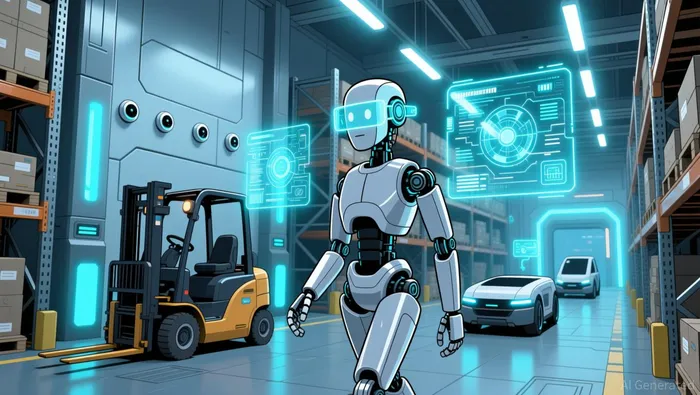
The market's initial reaction was positive but muted, reflecting the inherent uncertainty of the strategic pivot. Mobileye shares traded nearly 6% higher after hours on the news. This tepid pop suggests investors acknowledge the long-term vision but are cautious about the near-term costs and execution risks. The deal is expected to modestly increase Mobileye's operating expenses in 2026 by a low-single-digit percentage, a tangible headwind for an already capital-intensive transition.
CEO Amnon Shashua, who co-founded Mentee and recused himself from the board vote, is betting that the technological overlap between autonomous driving and robotics is a powerful moat. Mentee's approach, which aims to learn new skills from a single human demonstration, could accelerate deployment in warehouses and factories. First customer deployments are targeted for 2026, with commercial production for 2028. The strategic rationale is clear: by acquiring a platform with a strong AI foundation, Mobileye aims to leapfrog the competition in the humanoid robotics race, turning its automotive expertise into a new growth engine.
Financial Impact and Capital Allocation
The acquisition of Mentee Robotics is a significant capital commitment that will reshape Mobileye's near-term financial profile. The deal's structure is a blend of cash and stock, with Mobileye paying approximately $612 million in cash and up to 26.2 million shares of common stock. This stock component represents a material dilution for existing shareholders, as the issuance of new shares will reduce their ownership percentage. The transaction is expected to close in the first quarter of 2026, marking a decisive step into the company's "Mobileye 3.0" era focused on physical AI.
The immediate financial burden is a modest but tangible increase in operating expenses. The company has stated the acquisition will modestly increase Mobileye's operating expenses in 2026 by a low-single-digit percentage. This cost is the price of integrating a new, capital-intensive robotics business and accelerating its development. For a company that has historically focused on automotive ADAS, this shift signals a strategic pivot that will pressure near-term margins as it funds a longer-term bet on humanoid robotics.
This capital allocation decision is made against a backdrop of extreme valuation metrics. Mobileye trades at a forward P/E of -29.3 and a P/S ratio of 5.1. The negative earnings multiple reflects the company's current losses, while the elevated sales multiple indicates the market is pricing in very high future growth expectations. The $900 million bet on robotics is a direct wager that Mobileye can successfully monetize its AI expertise beyond the automotive sector, justifying its premium valuation. The success of this acquisition will be a critical test of whether the company can translate its massive automotive revenue pipeline-estimated at $24.5 billion over eight years-into a new, high-growth vertical.
Execution Risks and Market Realities
The acquisition of Mentee Robotics is a bold bet on a future that remains distant and unproven. The core risk is technological maturity. While Mentee has made progress in its four-year startup phase, its platform is still in development. The company's own roadmap shows a clear gap between promise and product: first on-site proof-of-concept deployments with customers are expected in 2026, with series production and commercialization targeted for 2028. This two-year lag means the technology must not only work in controlled demos but also scale to reliable, safe, and cost-effective commercial operation. The "few-shot generalization" and simulation-first training that form Mentee's AI moat are innovative, but they must prove their mettle in the chaotic real world before they can justify a $900 million price tag.
The competitive landscape is another formidable hurdle. Mentee is entering a market where giants are already deploying or pre-selling. Tesla, Figure AI, Agility Robotics and several Chinese startups are among the companies racing to develop two-legged robots. Agility Robotics' Digit is already working shifts in warehouses, albeit segregated from humans for safety. This first-mover advantage creates a significant barrier; Mentee must not only catch up but leapfrog competitors with a demonstrably better platform. The race is not just for technology but for early customer contracts and data, which are critical for refining AI models. Mobileye's autonomy stack provides a strategic foundation, but it does not guarantee a lead in the physical AI race.
Finally, the path to widespread adoption is blocked by high capital costs and unresolved societal concerns. Developing humanoid robots involves high capital costs associated with advanced sensors, actuators, AI software, and testing infrastructure. This limits the market to well-funded players and slows large-scale commercialization. More critically, safety and privacy are not secondary issues but primary adoption barriers. Robots operating in homes or alongside workers raise immediate concerns about operational safety, accidental malfunctions, and interaction risks with humans. The idea of a camera-equipped, internet-connected humanoid in a private space evokes a "stranger danger" unease. For the market to grow, companies must solve these problems while also driving down prices-a challenge given the expensive hardware and software stack. The $900 million deal is a down payment on a future that is still being built.
Catalysts, Scenarios, and What to Watch
The immediate catalyst for Mobileye is the successful close of its $900 million acquisition of Mentee Robotics in the first quarter of 2026. This deal marks the formal launch of "Mobileye 3.0," a strategic pivot into humanoid robotics. The transaction is expected to modestly increase operating expenses in 2026 by a low-single-digit percentage, but the real test is integration. Mentee will operate as an independent unit, yet the shared co-founder and chairman, Amnon Shashua, ensures a deep strategic and operational overlap. The success of this integration will determine whether the company can effectively manage two high-stakes, capital-intensive ventures in parallel.
The primary risk is that this robotics venture consumes disproportionate capital and management attention, diverting focus from the core automotive ADAS business. That business remains the cash engine, with a current revenue pipeline of $24.5 billion over the next eight years. This pipeline, which has grown more than 40% since early 2023, is driven by the adoption of next-generation chips like the EyeQ6H. Recent wins, including a deal for 9 million units from a "top 10 automaker," underscore the strength of this established market. The risk is that the ambitious robotics bet, while strategically aligned with the future of "Physical AI," creates a distraction that could slow execution or require capital that could otherwise be reinvested in the proven automotive growth engine.
The key watchpoint for investors is progress on proof-of-concept deployments in 2026 and updates on the path to 2028 commercialization. Mentee's roadmap targets first on-site proof-of-concept deployments with customers in 2026, with series production and commercialization aimed for 2028. The company's technology, which relies on simulation-first training and few-shot learning, is designed to accelerate this timeline. However, the robotics market is a crowded and costly race, with competitors like Tesla and Figure AI also targeting commercialization in the late 2020s. For Mobileye, the critical question is whether these early deployments demonstrate the promised technological leap and economic scalability, or if they reveal unforeseen engineering or cost hurdles that could delay the 2028 target. The coming year will be a litmus test for the company's ability to manage its dual-track future.





Comentarios
Aún no hay comentarios