
MLN: A High-Yield, Tax-Advantaged Play in the Long Municipal Bond Market
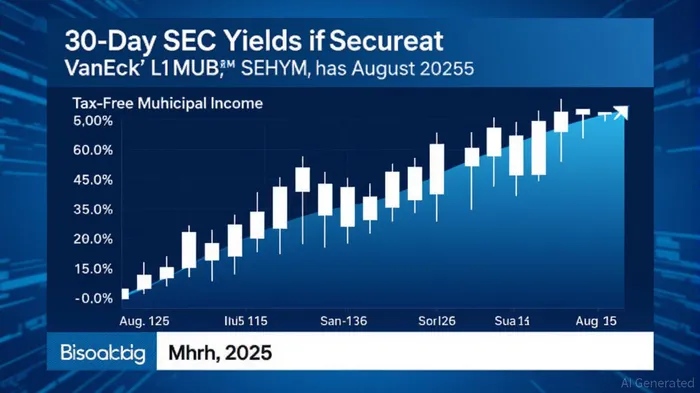
In a world where Treasury yields hover near historic lows and corporate bond spreads remain compressed, income-hungry investors are increasingly turning to the tax-advantaged universe of municipal bonds. Among the most compelling options is the VanEck Long Muni ETF (MLN), which has recently reported a 30-Day SEC Yield of 4.45% as of August 29, 2025 [2]. This figure not only outpaces the broader municipal bond market but also positions MLN as a standout play for those seeking to maximize after-tax returns in a low-yield environment.
The Tax-Advantaged Edge
MLN’s allure lies in its dual benefits: high yields and tax-free income. The fund invests in long-term U.S. municipal bonds, which are typically exempt from federal income taxes and often from state and local taxes as well, depending on the investor’s jurisdiction [3]. For high-tax-state residents, this can translate to a significant boost in real-world returns. For example, an investor in New York, where the state income tax rate is 8.82%, would see MLN’s 4.45% yield effectively become a 5.38% after-tax return—a stark contrast to taxable alternatives like the iShares Long-Term National Muni Bond ETF (LMUB), which yields 3.93% [1].
Yielding to the Competition
While other municipal bond ETFs like iShares’ SHYM (4.49%) and the iShares Short-Term National Muni Bond ETF (SUB, 2.36%) offer competitive yields, MLN’s 4.45% stands out for its balance of duration and income [2][3]. Unlike short-duration funds such as IBMN (2.15%), which are structured to liquidate by December 2025, MLN’s long-term focus allows it to capture higher-yielding bonds with maturities extending beyond 10 years [4]. This strategy aligns with the current market’s demand for duration, as investors bet on a prolonged period of low inflation and accommodative monetary policy.
Risks and Considerations
No investment is without its caveats. MLN’s long-duration profile makes it more sensitive to interest rate hikes, which could erode principal value in a rising-rate environment. However, with the Federal Reserve signaling a dovish stance for 2025, this risk appears muted for now. Additionally, while municipal bonds are generally considered low-risk, MLN’s portfolio includes a mix of general obligation and revenue bonds, some of which may carry credit risks, particularly in lower-rated states [3]. Investors should also note that while MLN is AMT-free, its tax advantages are contingent on the investor’s state of residence.
The Bottom Line
For investors prioritizing tax efficiency and income generation, MLN’s 4.45% yield represents a compelling opportunity. Its combination of high returns, tax-free status, and long-duration exposure makes it a standout in the municipal bond space. However, as with any fixed-income investment, due diligence is key. Investors should align their time horizons with MLN’s strategy and ensure their state residency qualifies them for the full tax benefits. In a world where every basis point matters, MLN’s yield could be the edge investors need to outperform the curve.
**Source:[1] MLN - VanEck Long Muni ETF | Holdings & Performance, [https://www.vaneck.com/us/en/investments/long-muni-etf-mln/][2] VanEck Vectors Long Municipal Index declares monthly ..., [https://seekingalpha.com/news/4490924-vaneck-vectors-long-municipal-index-etf-declares-monthly-distribution-of-00545][3] MLN - VanEck Long Muni ETF - Fact Sheet, [https://www.vaneck.com/us/en/mln/fact-sheet/][4] iShares® iBonds® Dec 2025 Term Muni Bond ETF, [https://www.ishares.com/us/products/282964/ishares-ibonds-dec-2025-term-muni-bond-etf]







Comentarios
Aún no hay comentarios