
MKS Instruments' Strategic Divestiture of Chemicals Unit: A Pivotal Step for Chip Sector Growth
MKS Instruments' decision to divest its $1 billion specialty chemicals unit marks a pivotal strategic realignment, prioritizing high-margin semiconductor enabling technologies amid evolving market dynamics. This move, announced to refocus operations on semiconductor manufacturing and advanced electronics packaging, underscores the company's commitment to capitalizing on the surging demand for memory chips, AI-driven advanced packaging, and next-generation electronics, according to MKS's Q1 2025 results. By shedding a non-core business, MKSMKSI-- aims to unlock financial flexibility, accelerate innovation in its core markets, and position itself as a critical enabler of the semiconductor industry's long-term growth trajectory, as discussed in the Q1 2025 earnings call highlights.
Reallocating Capital to High-Growth Semiconductor Segments
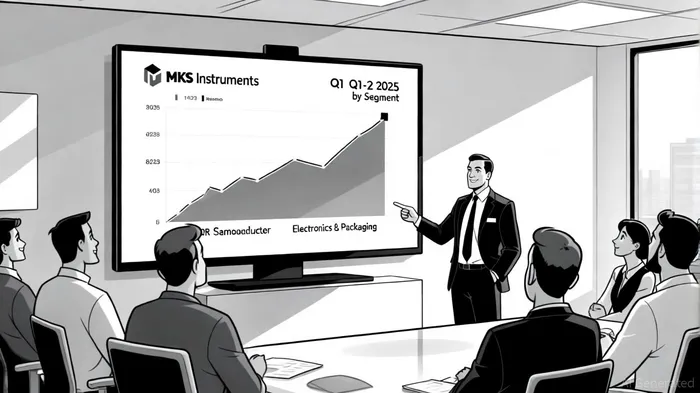
The divestiture aligns with a broader industry trend of companies streamlining operations to concentrate on high-growth areas. For MKS, this has translated into robust performance in its Semiconductor and Electronics & Packaging segments. In Q1 2025, the Semiconductor segment generated $413 million in revenue, reflecting an 18% year-over-year increase driven by recovery in NAND, DRAM, and logic applications, per MKS's Q1 2025 results. This momentum continued into Q2 2025, with Semiconductor revenue rising to $432 million, a 17% year-over-year gain, as shown in MKS's Q2 2025 slides. Similarly, the Electronics & Packaging segment saw revenue grow to $253 million in Q1 and $266 million in Q2, fueled by demand for AI-related advanced packaging and flexible PCB drilling, as detailed in MKS's Q2 2025 slides.
The financial discipline demonstrated by MKS is evident in its margin resilience. The company reported a non-GAAP gross margin of 47.4% in Q1 2025, with operating margins reaching 20.2%, according to MKS's Q1 2025 results. These figures highlight MKS's ability to maintain profitability despite macroeconomic headwinds, including trade policy uncertainties and margin compression in certain product lines, as noted in the Q1 2025 earnings call highlights.
Strategic Rationale and Industry Validation
MKS's pivot to semiconductor technologies is not merely a defensive maneuver but a proactive bet on sectors with durable growth potential. The company's leadership in RF power, vacuum solutions, and advanced packaging positions it to benefit from the AI and memory chip booms, a point underscored in MKS's Q2 2025 slides. Fitch Ratings has affirmed MKS's credit rating, citing its strong performance and favorable semiconductor market outlook through 2026. Analysts also note that MKS's global manufacturing capabilities and customer relationships provide a buffer against trade policy risks, enabling sustained investment in R&D and innovation, as described in MKS's Q1 2025 results.
The divestiture has also accelerated MKS's deleveraging efforts. In 2025, the company voluntarily prepaid $200 million in USD term loan B principal, reflecting a disciplined approach to balance sheet management, as reported in MKS's Q2 2025 slides. This financial prudence enhances credibility among investors, even as the stock price declined 1.78% in the past month, trading at $104.36 as of October 10, 2025, according to Beyond The Numbers. Analysts remain cautiously optimistic, with an average 12-month price target of $118.6, signaling confidence in the company's long-term growth prospects (Beyond The Numbers).
Risks and Market Realities
While the strategic shift is well-justified, challenges persist. Near-term gross margins may face pressure from new trade policies and tariffs, particularly in the vacuum segment, as discussed in the Q1 2025 earnings call highlights. Additionally, the absence of the chemicals unit's revenue stream necessitates rapid scaling of semiconductor operations to offset the loss. However, MKS's Q1 and Q2 results suggest this transition is already bearing fruit, with revenue from core segments outpacing historical growth rates, as reported in MKS's Q1 2025 results and MKS's Q2 2025 slides.
Conclusion: A Calculated Bet on the Future
MKS Instruments' divestiture of its chemicals unit is a calculated, forward-looking strategy to capitalize on the semiconductor industry's transformative phase. By reallocating capital to high-margin, high-growth technologies, the company is aligning itself with megatrends that will define the next decade of tech innovation. While short-term volatility and macroeconomic risks remain, the financial and operational discipline demonstrated by MKS-coupled with its technological leadership-positions it as a compelling long-term investment for those aligned with the semiconductor sector's trajectory.







Comentarios
Aún no hay comentarios