
Mixue's Leadership Shift: A Tactical Move to Strengthen Multi-Brand Global Execution?
The immediate event is a board meeting scheduled for today, March 24, 2026. Its agenda is routine: reviewing 2025 financial results and considering a dividend. Yet the timing is significant. This gathering occurs as Mixue navigates a critical strategic inflection point, shifting from breakneck domestic growth to a more deliberate, multi-brand global expansion.
The company's overseas footprint is vast, with over 4,800 international stores. But the pace of new store additions has moderated, stabilizing at around 800 annual net openings. This controlled growth marks the company's move into what it calls "Phase 3.0", a phase defined by operational discipline over raw volume. The leadership change, therefore, arrives at a tactical crossroads. The board must now oversee a more complex, multi-brand strategy abroad, where execution risks-like the internal competition from dense clustering seen in Indonesia-are higher.
At the helm is CEO Hongfu Zhang, a co-founder with an 8.25-year tenure and a 14.2% ownership stake worth billions. His compensation is heavily tied to performance, with 82.8% in bonuses and stock. Yet the broader management team is relatively new, with an average tenure of just 2.7 years. This creates a tension: a seasoned founder-CEO leading a team still finding its global rhythm.
The core question is whether this board meeting is a tactical move to strengthen oversight for the multi-brand strategy, or a symptom of deeper execution friction. The shift to Phase 3.0 demands a different kind of leadership-one focused on brand architecture, supply chain integration across diverse markets, and managing franchisee performance at scale. The board's review of 2025 results will be the first public test of whether the company's operational foundation is solid enough to support this next phase.
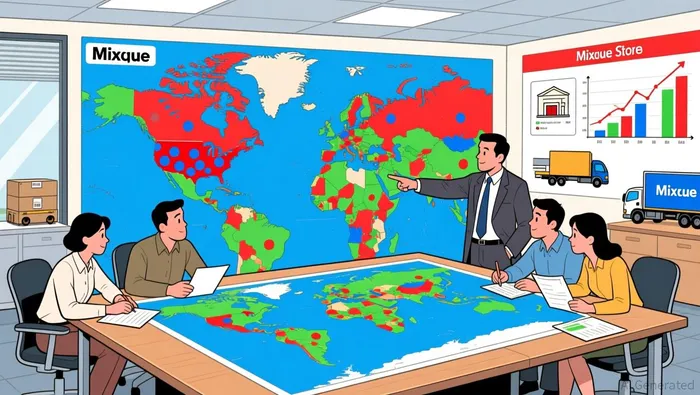
The Multi-Brand Execution Challenge: Scale vs. Friction
Mixue's global playbook is built on two powerful, yet conflicting, engines: extreme scale and ultra-low prices. The company's model is nearly 100% franchised, allowing it to deploy capital-light and achieve staggering reach-more than 53,000 stores worldwide. This is its primary advantage, creating a dominant footprint in key markets like Southeast Asia. Yet this same hyper-scale model, when applied to new and unfamiliar regions, introduces significant friction.
The core risk is consistency. A franchise system incentivized for rapid volume can struggle with quality control and brand experience in diverse cultural settings. This was evident in early overseas expansion, where relaxed site standards led to dense clustering and internal competition, directly harming store performance. In the US, where it's just beginning, the challenge is even starker. The brand's ultra-low prices and reliance on viral internet culture are potent tools for entry, but they may not be enough to build lasting emotional equity against entrenched QSR giants.
The supply chain is Mixue's other critical asset and vulnerability. Its massive scale in China provides immense leverage, but its heavy dependence on equipment and raw materials sourced from China creates a logistical and financial risk. As seen in Indonesia, this can lead to prolonged shortages during key demand periods, damaging revenue and franchisee trust. For the multi-brand strategy to work, Mixue must build more resilient, regionally adapted supply chains to protect margins and ensure product consistency.
The backdrop is a booming market. The global quick-service restaurant sector is projected to grow at a 9.14% CAGR, offering ample room for expansion. But the competition is fierce, with established players like McDonald's and Starbucks having decades of operational refinement. For Mixue, the multi-brand approach is a direct attempt to monetize its scale beyond the core low-cost offering. The question is whether its operational foundations-its franchise oversight, supply chain agility, and brand management-can evolve quickly enough to navigate this crowded, high-stakes landscape. The controlled growth of Phase 3.0 is a recognition that scale alone is not a moat.
Valuation and Catalysts: What to Watch for the Thesis
The immediate catalyst is the board meeting itself. The release of final 2025 financial results and the dividend decision will be the first concrete data point on the company's financial health as it enters Phase 3.0. A clean, profitable set of results would support the thesis of a mature, cash-generating machine. Any signs of margin pressure or slower-than-expected growth would raise immediate questions about the sustainability of its scale.
Beyond the numbers, the market's reaction to the leadership change will be a leading indicator. Is the shift seen as a proactive strengthening of oversight for a complex multi-brand strategy, or as a symptom of deeper operational friction? The board's composition-four executive directors and three independent non-executives-suggests a balance, but the real test is in the strategy that follows. Investors should watch for any explicit multi-brand strategy announcements from management, as this is the critical next step for unlocking value beyond the core brand.
The key operational watchpoints are the quality of new US store openings and the pace of operational improvements in Southeast Asia. The US launch is a high-stakes test. The company's ultra-low prices and viral marketing are tools, but the real metric will be unit economics and customer retention in a mature market. Early signs of franchisee dissatisfaction or poor performance in these initial locations would signal that the hyper-scale model struggles with quality control and brand consistency abroad.
In Southeast Asia, the focus must shift from raw store count growth to operational discipline. The company's move into Phase 3.0 is a direct response to challenges like the dense clustering and internal competition seen in Indonesia. Investors should monitor for evidence of improved site selection, stronger franchisee support, and more resilient supply chains. The goal is to convert its massive footprint into consistent, profitable operations rather than just volume.
The bottom line is that the valuation thesis hinges on execution. With a brand value of USD4.6 billion, Mixue is a global scale leader. But that value must be translated into sustainable profits and a clear path for its multi-brand ambitions. The coming quarters will provide the data to determine if the company's foundations are solid enough to support this next phase-or if the leadership change is merely a tactical adjustment to a more fundamental challenge.







Comentarios
Aún no hay comentarios