
Mitsui & Co's Coal Divestment: Strategic Alignment with Decarbonization and Capital Risks
Mitsui & Co's Coal Divestment: Strategic Alignment with Decarbonization and Capital Risks
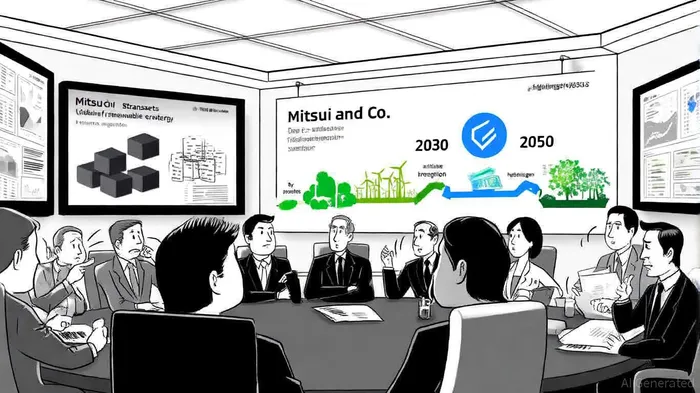
Mitsui & Co., a Japanese trading giant, has embarked on a sweeping transformation of its energy portfolio, aligning with global decarbonization goals while navigating significant risks to capital preservation. The company's decision to divest all stakes in coal-fired power plants by 2030, according to Business Times, reflects a strategic pivot toward cleaner energy sources, including liquefied natural gas (LNG), offshore wind, and hydrogen. This shift is part of Mitsui's broader net-zero emissions target by 2050, a commitment that places it at the forefront of Japan's corporate response to climate change. However, the path to decarbonization is fraught with challenges, from stranded assets to regulatory headwinds in Asia, where coal remains deeply entrenched in energy systems.
Strategic Alignment with Decarbonization Trends
Mitsui's coal divestment strategy is closely tied to global efforts to reduce carbon dioxide emissions. By 2024, the company had already sold its shares in PT Paiton Energy, an Indonesian coal-fired power plant, signaling its intent to exit the sector entirely by 2030, according to a Mitsui press release. This move aligns with the International Energy Agency's (IEA) net-zero roadmap, as Reuters reported, which calls for a 75% reduction in coal-fired power generation by 2030. Mitsui's pivot to gas-based power generation as a transitional fuel is a pragmatic response to the intermittency of renewables, a challenge that persists despite advances in battery storage, the Transition Pathway Initiative notes.
The company's renewable energy investments are equally ambitious. Mitsui has partnered with Mainstream Renewable Power to develop 25 gigawatts of renewable capacity over the next decade, aiming to increase its renewable energy share from 14% of total electricity generation in 2020 to 30% by 2030, according to NS Energy. These projects span offshore wind farms and hydrogen production, with Mitsui O.S.K. Lines pioneering offshore hydrogen extraction via the Winz Maru vessel, as Energy News describes. Such innovations underscore Mitsui's recognition that decarbonization requires not only phasing out coal but also building new infrastructure to support a low-carbon economy.
Risks to Capital Preservation
Despite its strategic clarity, Mitsui's transition exposes it to several risks. Stranded assets remain a critical concern. Early retirements of coal plants in regulated markets could leave undepreciated capital unrecovered, a risk exacerbated by inflexible power purchase agreements (PPAs) in countries like Malaysia, as a University of Michigan analysis explains. For instance, Indonesia's continued subsidies for coal and price controls complicate Mitsui's exit strategy, as the government's pledge to retire coal plants by 2040 lacks immediate enforcement mechanisms, Climate Finance Asia warns.
Regulatory and market volatility further amplify these risks. Stricter carbon pricing mechanisms, such as emissions trading schemes (ETS), could erode the profitability of Mitsui's remaining fossil fuel investments, as detailed on Mitsui's risk factors. Meanwhile, rapid technological advancements in renewables-such as next-generation solar modules and wind turbines-are accelerating the obsolescence of coal assets, according to WTW. Mitsui's reliance on LNG as a transitional fuel also faces scrutiny, as some climate advocates argue that gas infrastructure may itself become stranded if hydrogen and renewables scale faster than anticipated, as a systematic review finds.
Navigating Asia's Regulatory Challenges
Asia's energy transition is particularly complex for Mitsui. In Indonesia, coal subsidies and political resistance to early retirements create a policy environment that delays decarbonization, WRI reports. Similarly, Malaysia's high decommissioning costs and foreign investor contracts-often requiring compensation for early closures-pose financial barriers, as Nikkei reports. To address these challenges, Mitsui must engage in scenario planning and stress testing, as outlined in its risk management framework. The company's focus on hydrogen and ammonia production may offer a hedge against these uncertainties, given Japan's aggressive push for green hydrogen as a clean energy carrier, as noted by Mitsui Chemicals.
Conclusion: A Calculated but Risky Transition
Mitsui's coal divestment strategy is a bold alignment with global decarbonization trends, yet its success hinges on managing transition risks. While the company's investments in renewables and hydrogen position it to capitalize on the energy transition, the potential for stranded assets and regulatory delays in Asia cannot be ignored. Investors must weigh Mitsui's long-term vision against the short-term volatility of fossil fuel markets and the pace of technological change. For now, Mitsui's transition appears well-structured, but its ultimate success will depend on how swiftly the world moves away from coal-and how resilient its new energy ventures prove to be.







Comentarios
Aún no hay comentarios