
Mitsubishi Corp's Strategic Expansion into Resource Sectors via MCAR: Assessing Investment Implications in a Decarbonizing World
MCAR's Strategic Expansion: Agriculture and Biogas as Anchors
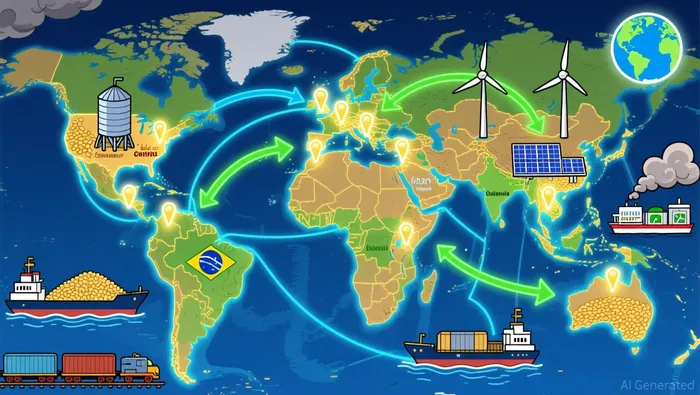
Mitsubishi's MCAR division has emerged as a linchpin in its resource strategy, with recent partnerships and investments underscoring its focus on food security and renewable energy. A landmark deal with Archer Daniels MidlandADM-- (ADM) to co-operate U.S. and Brazilian grain export hubs aims to boost annual grain handling capacity to 30 million tonnes by 2030, according to a Nikkei report Nikkei report. This move not only strengthens supply chain resilience but also aligns with growing demand for sustainable agricultural commodities.
Simultaneously, MC has entered the biogas sector through a minority stake in KIS Group's Indonesia operations, marking its first foray into renewable gas, as reported by the Business Standard Business Standard report. KIS Group's USD 1 billion investment plan for Southeast Asia and India by 2030, coupled with Mitsubishi's global network, positions the partnership to scale biogas, BioCNG, and BioLNG solutions, according to the Economic Times Economic Times report. These projects directly support MC's decarbonization targets, which include halving emissions by 2030 and achieving net-zero by 2050, as outlined in the company's materiality report Materiality report.
Decarbonization Alignment: Hydrogen, Minerals, and CCUS
Mitsubishi's decarbonization strategy extends beyond biogas. The company is doubling down on hydrogen and ammonia value chains, with partnerships like the ExxonMobil-led low-carbon hydrogen project and a U.S. clean ammonia initiative, as noted in the Materiality report Materiality report. These efforts are critical for industries reliant on hard-to-abate emissions, such as steel and aviation.
Critical minerals-copper, nickel, and lithium-are another focus area. MC's investments in Canada's Kalgoorlie Nickel Project and PAK Lithium Project, as detailed in the Materiality report Materiality report, align with the surge in demand for battery materials and renewable infrastructure. Meanwhile, carbon capture, utilization, and storage (CCUS) initiatives, including cross-business task forces and international feasibility studies, are part of the company's broader decarbonization efforts, as described in the Materiality report Materiality report.
Capital Allocation and Financial Realities
Despite these ambitious projects, Mitsubishi faces near-term financial challenges. A 42% drop in first-half net profit, driven by weak Australian coal operations and capital gains shortfalls, has raised questions about its ability to fund long-term transitions, as reported by Investing.com Investing.com report. However, the company has maintained its full-year profit forecast of 700 billion yen and plans to increase dividends in fiscal 2025, as noted in the same report Investing.com report.
The 1.2 trillion yen investment in decarbonization projects over three years, as stated in the Materiality report Materiality report, reflects a deliberate shift in capital allocation. While this underscores commitment to sustainability, it also highlights the trade-offs between short-term profitability and long-term strategic positioning. The divestment of its Usiminas stake for USD 7.4 million, as reported in a Steel Market Update Steel Market Update report, signals a reallocation of resources toward higher-impact sectors like biogas and hydrogen.
Investment Implications: Balancing Risks and Rewards
For investors, Mitsubishi's strategy presents a dual narrative. On one hand, its alignment with global decarbonization trends-particularly in agriculture, biogas, and critical minerals-positions it to benefit from policy tailwinds and ESG-driven capital flows. On the other, short-term financial volatility and execution risks in nascent ventures (e.g., biogas scalability, hydrogen cost competitiveness) could test its resilience.
The ADM partnership and KIS Group collaboration, as reported in the Nikkei and Business Standard reports Nikkei reportBusiness Standard report, are particularly noteworthy for their potential to generate recurring revenue streams and enhance market access. However, the success of these initiatives hinges on commodity price stability and regulatory support for renewable energy.
Conclusion
Mitsubishi Corporation's MCAR division is a testament to the company's adaptability in a decarbonizing world. By leveraging strategic partnerships, capitalizing on high-growth sectors, and realigning its corporate structure, MC is positioning itself to navigate the energy transition. While near-term financial pressures persist, the long-term value proposition-rooted in sustainability and resource innovation-remains compelling for investors willing to balance risk with transformative potential.





Comentarios
Aún no hay comentarios