
The Misalignment of U.S. Poverty Metrics and Its Investment Implications
The Flawed Metrics and Their Consequences
The current poverty line methodology fails to account for regional cost-of-living disparities and the rising costs of essential services like housing, healthcare, and childcare. For example, median mortgage payments in New Hampshire reached $4,000 per month in 2024, far exceeding the 2025 FPL for a family of four ($32,150) according to the Buffett Institute. Similarly, the average annual cost of infant care in a center is $15,570, consuming nearly 40% of a single parent's income as data shows. These gaps highlight how traditional income-based poverty metrics understate hardship, leading to inadequate resource allocation for programs like SNAP, which lifted 3 million people out of poverty in 2024 according to CBPP research.
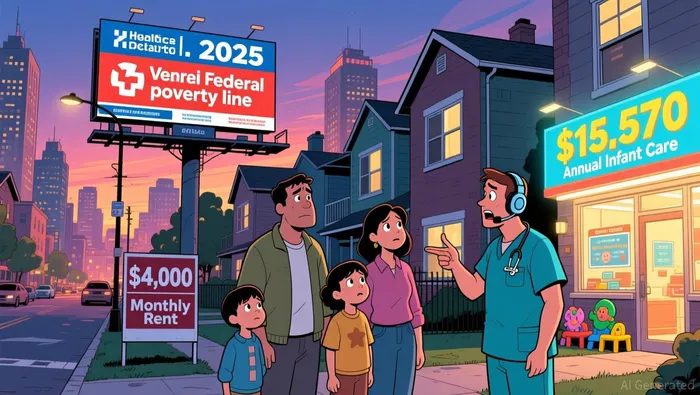
The misalignment also exacerbates labor market challenges. The federal minimum wage remains below the poverty line for a full-time worker, contributing to economic vulnerability as EPI reports. Meanwhile, Republican proposals to cut SNAP benefits, impose stricter work requirements, and reduce rental assistance could deepen poverty and hinder labor participation according to CBPP analysis. Conversely, the Poverty Line Act of 2025, introduced in February 2025, seeks to modernize the FPL by incorporating a 5-year rolling average of expenditures on food, housing, childcare, and healthcare, adjusted for regional variations as proposed by Congress. This recalibration could expand eligibility for federal programs and stabilize household budgets, indirectly supporting labor market participation.
Long-Term Economic Effects and Policy Recalibration
Redefining the poverty line has far-reaching implications for consumer spending and economic growth. Research by Sullivan, Meyer, and Han shows that consumption-based poverty measures-unlike income-based ones-declined from 33.8% in 1980 to 6.0% in 2022, reflecting the impact of anti-poverty programs and economic growth according to the University of North Dakota. The 2025 recalibration, which includes housing costs based on Fair Market Rents and childcare expenses, could further reduce consumption volatility. For instance, HUD's 2025 HOME Program reforms introduce tenancy addenda to protect tenants in affordable housing and prioritize energy-efficient construction, aligning with broader infrastructure goals as outlined in CRS reports.
However, political headwinds persist. House Republican agendas and Project 2025 propose cuts to Medicaid and social safety nets, which could reverse progress in poverty reduction according to CBPP analysis. Conversely, bipartisan efforts like the Child Care Infrastructure Act of 2025 aim to expand childcare access through federal grants and tax incentives, addressing a critical barrier to workforce participation as detailed by FFYF. These policy shifts create a dual dynamic: sectors tied to social infrastructure may see increased demand, while cuts to safety-net programs could strain labor markets and consumer spending.
Strategic Investment Opportunities in Social Infrastructure
The recalibration of poverty metrics and associated policy reforms are reshaping investment opportunities in healthcare, housing, and childcare. Key asset classes and sectors to consider include:
Healthcare Infrastructure:
The rising cost of healthcare, particularly for retirees, has spurred demand for innovative financial tools. Milliman's 2025 launch of the Healthcare Inflation Guard ETF (MHIG) and Healthcare Inflation Plus ETF (MHIP) targets this need, using a mix of health sector equities and bonds to hedge against healthcare inflation as reported by Morningstar. These ETFs align with the Poverty Line Act's focus on incorporating healthcare costs into poverty metrics, as the average 65-year-old couple retiring in 2025 faces $588,000 in medical expenses according to Milliman analysis.Affordable Housing and Real Estate:
HUD's 2025 HOME Program reforms and state-level initiatives like California's $414 million investment in 2,099 new affordable homes highlight growing demand for housing equity as reported by HCD. JPMorganChase's $40 million in philanthropic funding for housing supply expansion further underscores this trend as announced by JPMorgan Chase. Investors can target real estate investment trusts (REITs) focused on affordable housing or construction firms specializing in energy-efficient housing.Childcare Infrastructure:
The Child Care Infrastructure Act of 2025, which increases the child and dependent care tax credit and funds facility upgrades, creates opportunities for childcare providers and infrastructure developers as proposed by Congress. Public-private partnerships, such as Michigan's Tri-Share Childcare program and Texas's $84 million Child Care Expansion Initiative, demonstrate scalable models for investors as detailed by the U.S. Chamber Foundation. ETFs tracking education services or real estate development may benefit from these trends.Digital and Energy Infrastructure:
McKinsey estimates a $106 trillion global infrastructure investment need by 2040, with the U.S. focusing on digital and energy sectors according to McKinsey analysis. The One Big Beautiful Bill Act (OBBBA) of 2025, which includes tax cuts to boost consumer spending, further supports infrastructure growth as reported by CBREIM. Investors should consider ETFs or companies involved in renewable energy, smart grid technologies, and digital infrastructure.
Conclusion: Aligning Portfolios with Policy Shifts
The misalignment of U.S. poverty metrics has long distorted social spending and economic growth. However, the 2025 Poverty Line Act and related reforms present a unique opportunity for investors to align portfolios with sectors poised for expansion. By targeting healthcare infrastructure, affordable housing, childcare, and digital/energy infrastructure, investors can capitalize on policy-driven demand while supporting economic resilience. As the U.S. recalibrates its approach to poverty, strategic investments in these asset classes will not only yield financial returns but also contribute to a more equitable and sustainable economy.







Comentarios
Aún no hay comentarios