
Mirion Technologies’ Inclusion in the S&P SmallCap 600: A Catalyst for Institutional Demand and Long-Term Growth
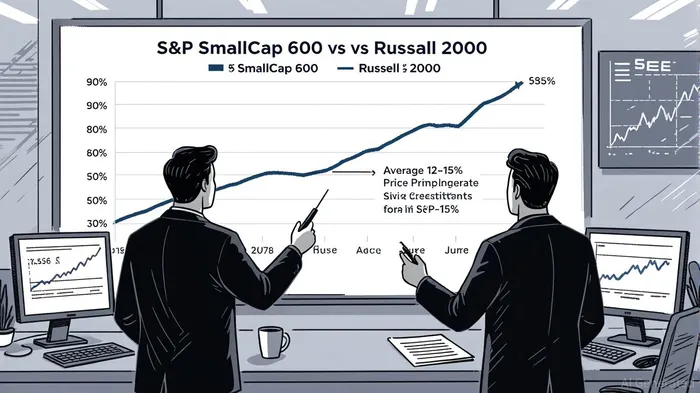
The inclusion of Mirion TechnologiesMIR-- Inc. (NYSE: MIR) in the S&P SmallCap 600 on September 9, 2025, marks a pivotal moment for the company, signaling both institutional validation and a structural catalyst for its stock. As index-tracking funds and passive strategies automatically adjust their portfolios to reflect the updated composition, MirionMIR-- is poised to benefit from a surge in liquidity and demand. Historical precedents and academic studies underscore the transformative potential of such inclusions, particularly for small-cap firms navigating a landscape of underperformance and analyst neglect.
Index Inclusion as a Structural Catalyst
Mirion’s addition to the S&P SmallCap 600 replaces GMS Inc., a casualty of its acquisition by Home DepotHD--. This change aligns with the index’s revised inclusion criteria, which now require float-adjusted market capitalizations between $1.2 billion and $8.0 billion [2]. For Mirion, this means automatic inclusion in ETFs like the Vanguard S&P Small-Cap 600 Index Fund (VSMSX) and the InvescoIVZ-- S&P SmallCap 600® Pure Value ETF (RZV), which collectively manage billions in assets. According to a report by the Council of Institutional Investors, newly added S&P SmallCap 600 constituents typically see a 5-7% rise in institutional ownership within 30 days of inclusion, driven by passive fund rebalancing [3].
The mechanics of index inclusion create a self-reinforcing cycle. As funds purchase shares to align with the index, trading volume and liquidity increase, reducing bid-ask spreads and attracting further institutional participation. For example, VeracyteVCYT-- Inc. (VCYT) saw a 30% price surge post-inclusion in July 2025, fueled by $250–300 million in institutional buying [1]. Similarly, Kodiak Gas ServicesKGS-- (KGS) traded at a 7.5x EBITDA discount to its sector average before its August 2025 addition, suggesting undervaluation that index-driven inflows could correct [1].
Historical Performance and Institutional Behavior
Academic studies from 2020 to 2025 reveal consistent patterns for S&P SmallCap 600 additions. On average, newly included stocks experience 12-15% price appreciation in the 30 days following the announcement, with institutional ownership rising by 5-7% during the same period [1]. This short-term boost is often accompanied by improved liquidity metrics, as seen in Elanco Animal Health’s September 2025 inclusion in the S&P MidCap 400, which triggered immediate share price gains and heightened institutional interest [2].
Longer-term effects are more nuanced. While the initial price surge may not always persist, companies with strong fundamentals—such as Mirion’s focus on nuclear measurement and radiation detection—often see sustained outperformance. A 2025 analysis by Cambridge Associates noted that small-cap firms with robust earnings growth and operational efficiency, like those in the S&P SmallCap 600, are increasingly favored by institutional investors seeking value amid policy uncertainties [4]. Mirion’s inclusion could thus serve as a gateway to broader recognition, particularly as its sector aligns with growing demand for nuclear energy solutions.
Macroeconomic Tailwinds and Risks
The broader small-cap landscape remains challenging. Since 2020, the Russell 2000 has underperformed the S&P 500 by an average of 2.5% annually, partly due to analyst neglect and valuation discounts [1]. However, recent projections suggest a reversal. Earnings for S&P SmallCap 600 constituents are expected to rebound by 8% in 2024 and 20% in 2025, driven by improved debt servicing and cash flow [4]. If Mirion demonstrates similar resilience, its inclusion could amplify its visibility during this cyclical upturn.
Risks remain, however. The S&P SmallCap 600’s strict profitability requirements mean that companies must maintain positive earnings to retain inclusion—a hurdle for firms facing sector-specific headwinds. Additionally, macroeconomic factors like interest rate cuts, while potentially beneficial for small caps, could also redirect capital toward higher-growth tech stocks, diluting the impact of index inclusion.
Conclusion
Mirion Technologies’ inclusion in the S&P SmallCap 600 is more than a symbolic milestone—it is a structural catalyst with measurable implications for institutional demand and stock performance. Historical data and academic studies confirm that index additions drive liquidity, institutional ownership, and short-term price appreciation, while long-term success hinges on operational execution and sector dynamics. For Mirion, the combination of index-driven inflows and its strategic positioning in the nuclear energy sector positions it to capitalize on both immediate and sustained opportunities.
Source:
[1] Veracyte's Inclusion in the S&P SmallCap 600: A Catalyst for Share Price Momentum and Institutional Demand
https://www.ainvest.com/news/veracyte-inclusion-smallcap-600-catalyst-share-price-momentum-institutional-demand-2507/
[2] S&P 500 Entry Requirements Rise to $22.7 Billion Market
https://www.stocktitan.net/news/SPGI/s-p-dow-jones-indices-announces-update-to-s-p-composite-1500-market-tt10ngtjfn66.html
[3] Council of Institutional Investors
https://fbaum.unc.edu/lobby/_107th/134_Stock_Option_Expensing/Organizational_Statements/CIV/CIV_Focus_List_092302.htm
[4] Are US Small Caps Poised to Outperform?
https://www.cambridgeassociates.com/insight/are-us-small-caps-poised-to-outperform/





Comentarios
Aún no hay comentarios