
MIRA Token Price Convergence: On-Chain vs. Off-Chain Arbitrage Opportunities in 2025
The MIRA token, a cornerstone of the AI verification revolution, presents a unique case study for analyzing price convergence between on-chain and off-chain arbitrage opportunities. As of September 2025, MIRA's price fluctuates between $1.26 and $1.49 across platforms[3], with analysts projecting a potential surge to $3.06 by year-end[2]. This volatility, driven by both technical and fundamental factors, creates fertile ground for arbitrage strategies. Below, we dissect the interplay between on-chain liquidity dynamics and off-chain utility-driven demand, offering insights for investors navigating this evolving landscape.
On-Chain Arbitrage: Liquidity, Leverage, and Airdrop Dynamics
Recent on-chain developments have amplified MIRA's volatility and arbitrage potential. Listings on exchanges like BinanceTR and OrangeX, coupled with 25x leverage options, have spurred a 24-hour trading volume spike to $1.26 billion[1]. However, this liquidity surge is double-edged: while it attracts traders, it also heightens short-term price swings. For instance, the #HodlerAirdrop—distributing tokens to BNBBNB-- holders with a 4% allocation cap—triggered a 7.70% price increase over seven days[2], yet a 16.7% drop in the preceding 24 hours[3].
Arbitrageurs exploiting these fluctuations must account for the token's 4.73 turnover ratio, which signals high trader churn and rapid absorption of airdropped tokens[1]. Additionally, the 191.24 million circulating supply (out of 1 billion total) and 81% locked supply create a delicate balance. If staking incentives weaken, the unlocked portion could flood markets, exacerbating inflation risks[1].
Off-Chain Arbitrage: Enterprise Adoption and Utility-Driven Demand
While on-chain activity drives short-term volatility, off-chain factors anchor MIRA's long-term value. The token's AI verification network is gaining traction in regulated sectors like healthcare and DeFi, where trust in AI-generated outputs is critical[1]. This enterprise adoption creates a deflationary tailwind: as institutions integrate MIRA's verification tools, token utility increases, potentially outpacing supply-side risks.
For example, healthcare providers adopting MIRA's network to validate AI diagnostics could lock in recurring demand, while DeFi platforms might use it to verify smart contract audits. Such use cases reduce reliance on speculative trading and align token value with real-world applications. Analysts project an average price of $1.53 by year-end[3], reflecting this utility-driven optimism.
Convergence and Risks: Bridging the On-Chain/Off-Chain Divide
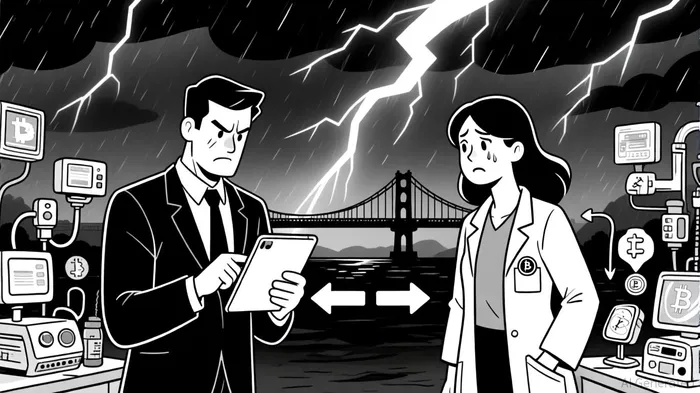
Price convergence between on-chain and off-chain markets hinges on balancing speculative flows with utility growth. Current data suggests a tug-of-war:
- Short-Term: Airdrop absorption and leverage-driven trading will dominate, with arbitrage opportunities arising from cross-exchange price discrepancies (e.g., $1.26 vs. $1.49[3]).
- Long-Term: Enterprise adoption could stabilize prices by shifting demand from traders to institutional users, reducing reliance on volatile on-chain activity.
However, risks persist. Post-airdrop sell-offs could trigger short-term dips, while weak staking incentives might unlock large portions of the 81% locked supply[1]. Investors must also monitor regulatory developments in AI verification, which could either accelerate or hinder MIRA's enterprise adoption.
Conclusion: Strategic Entry Points for Arbitrageurs
For on-chain arbitrageurs, the key lies in capitalizing on liquidity events and airdrop-driven volatility while hedging against post-event sell-offs. Off-chain investors, meanwhile, should focus on MIRA's enterprise partnerships and utility metrics, which signal a potential floor for price convergence. Given the projected $1.28–$3.06 range[3], a diversified strategy that balances speculative and fundamental factors may yield the highest returns.
As the AI verification market matures, MIRA's ability to bridge on-chain speculation with off-chain utility will determine its long-term trajectory. Investors who navigate this duality effectively may find themselves at the forefront of the next AI-driven financial revolution.







Comentarios
Aún no hay comentarios