
US Military Mini Shuttle Launches on Secret Mission with Classified Experiments
PorAinvest
viernes, 22 de agosto de 2025, 12:14 am ET1 min de lectura
BA--
The X-37B, a Boeing-built reusable space plane, will embark on its eighth flight, known as OTV-8. This mission aims to test two advanced technologies: a laser communications system and a quantum inertial sensor. The laser communications system aims to support heavier data loads and tougher security safeguards compared to traditional radio communications [1]. The quantum inertial sensor, on the other hand, is designed to measure the inertia of nearby atoms to help inform the space plane's navigational position without reliance on existing satellite infrastructure like GPS [1, 3].
The Falcon 9 booster supporting the USSF-36 launch, B1092, has previously launched several missions, including NROL-69, CRS-32, GPS III-7, and Starlink groups 12-13 and 10-34. It is expected to return to the Space Coast for recovery at SpaceX's Landing Zone-2, located at Cape Canaveral Space Force Station [1].
This mission is significant for both military and civilian spaceflight. For the US Space Force, it represents a step towards greater operational resilience, particularly in scenarios where GPS might be denied. For future space exploration, such as to the Moon, Mars, or even deep space, a quantum navigation system could serve as a reliable backup or even a primary system when signals from Earth are unavailable [3].
The X-37B's previous missions have lasted from months to years, with the vehicle spending more than 4,200 days in orbit across its past seven missions. The duration of this mission is not yet clear [2].
References:
[1] https://www.space.com/space-exploration/launches-spacecraft/watch-spacex-launch-us-space-forces-classified-x-37b-space-plane-august-21
[2] https://www.floridatoday.com/story/tech/science/space/2025/08/21/when-is-x-37b-liftoff-spacex-rocket-falcon-9-launch-space-force-plane-kennedy-space-florida/85738073007/
[3] https://www.livescience.com/technology/engineering/secretive-x37-b-space-plane-to-test-quantum-navigation-system-scientists-hope-it-will-one-day-replace-gps
A US military mini shuttle, the X-37B, launched by SpaceX on a secret mission from Cape Canaveral, Florida. The space plane will test laser communications and safe navigation without GPS. The Boeing-made reusable space plane is 29 feet long with a wingspan of almost 15 feet. The mission duration is not yet clear, with previous missions lasting from months to years.
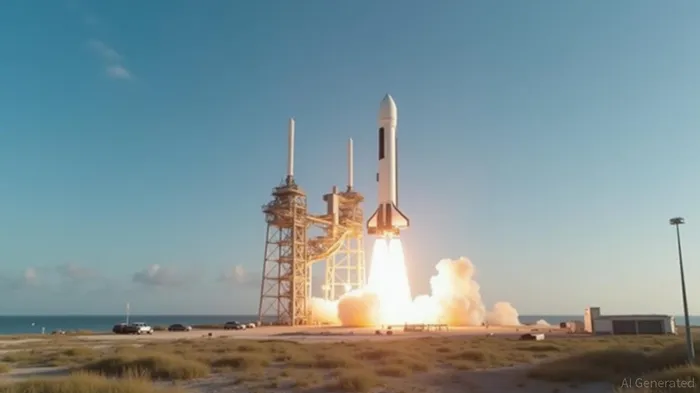
NASA's Kennedy Space Center, Florida - SpaceX is set to launch the U.S. Space Force's (USSF) X-37B space plane from Pad 39A at NASA's Kennedy Space Center (KSC) in Florida. The mission, designated USSF-36, will utilize a Falcon 9 rocket and is scheduled for August 21 at 11:50 p.m. EDT (0350 GMT, Aug. 22) [1].The X-37B, a Boeing-built reusable space plane, will embark on its eighth flight, known as OTV-8. This mission aims to test two advanced technologies: a laser communications system and a quantum inertial sensor. The laser communications system aims to support heavier data loads and tougher security safeguards compared to traditional radio communications [1]. The quantum inertial sensor, on the other hand, is designed to measure the inertia of nearby atoms to help inform the space plane's navigational position without reliance on existing satellite infrastructure like GPS [1, 3].
The Falcon 9 booster supporting the USSF-36 launch, B1092, has previously launched several missions, including NROL-69, CRS-32, GPS III-7, and Starlink groups 12-13 and 10-34. It is expected to return to the Space Coast for recovery at SpaceX's Landing Zone-2, located at Cape Canaveral Space Force Station [1].
This mission is significant for both military and civilian spaceflight. For the US Space Force, it represents a step towards greater operational resilience, particularly in scenarios where GPS might be denied. For future space exploration, such as to the Moon, Mars, or even deep space, a quantum navigation system could serve as a reliable backup or even a primary system when signals from Earth are unavailable [3].
The X-37B's previous missions have lasted from months to years, with the vehicle spending more than 4,200 days in orbit across its past seven missions. The duration of this mission is not yet clear [2].
References:
[1] https://www.space.com/space-exploration/launches-spacecraft/watch-spacex-launch-us-space-forces-classified-x-37b-space-plane-august-21
[2] https://www.floridatoday.com/story/tech/science/space/2025/08/21/when-is-x-37b-liftoff-spacex-rocket-falcon-9-launch-space-force-plane-kennedy-space-florida/85738073007/
[3] https://www.livescience.com/technology/engineering/secretive-x37-b-space-plane-to-test-quantum-navigation-system-scientists-hope-it-will-one-day-replace-gps
Divulgación editorial y transparencia de la IA: Ainvest News utiliza tecnología avanzada de Modelos de Lenguaje Largo (LLM) para sintetizar y analizar datos de mercado en tiempo real. Para garantizar los más altos estándares de integridad, cada artículo se somete a un riguroso proceso de verificación con participación humana.
Mientras la IA asiste en el procesamiento de datos y la redacción inicial, un miembro editorial profesional de Ainvest revisa, verifica y aprueba de forma independiente todo el contenido para garantizar su precisión y cumplimiento con los estándares editoriales de Ainvest Fintech Inc. Esta supervisión humana está diseñada para mitigar las alucinaciones de la IA y garantizar el contexto financiero.
Advertencia sobre inversiones: Este contenido se proporciona únicamente con fines informativos y no constituye asesoramiento profesional de inversión, legal o financiero. Los mercados conllevan riesgos inherentes. Se recomienda a los usuarios que realicen una investigación independiente o consulten a un asesor financiero certificado antes de tomar cualquier decisión. Ainvest Fintech Inc. se exime de toda responsabilidad por las acciones tomadas con base en esta información. ¿Encontró un error? Reportar un problema


SOBRE NOSOTROS
Nuestra historiaAutores de noticiasBase de conocimientosPolítica de privacidadTérmino de usoDescargo de responsabilidad de corretaje de tercerosTérminos de uso de AIMEDivulgaciones de riesgos de AInvest AICarrerasCONTÁCTENOS
Email: support@ainvest.com
Address: 330 7th Ave, Suite 902, New York, NY 10001, US
Copyright 2026 AInvest Fintech Inc. All rights reserved.


Comentarios
Aún no hay comentarios