
Middle East Tensions Fuel Defense and Energy Plays: A Strategic Investment Outlook
The Middle East remains a geopolitical tinderbox, with recent clashes between Israel and Iran, Gaza's collapsing ceasefire, and sectarian violence in Syria creating a volatile backdrop for investors. Yet, this instability is unlocking near-term opportunities in defense contractors and energy infrastructure stocks. As regional actors scramble to secure military advantages and energy supply chains, select companies are positioned to profit handsomely.
Defense Contractors: The Winners of Escalating Conflict
The Israel-Iran war of June 2025 and ongoing Gaza violence have reignited demand for advanced defense systems. Here's how key players are capitalizing:
RTX Corporation (RTX):
RTX's stock surged 1.74% on June 13 as its missile defense systems (e.g., Iron Dome) and $647M radar contract with the U.S. military gained urgency. Analysts project a 12-month price target of $155, implying a 7% upside.
RTX's diversified portfolio—including Collins Aerospace and Raytheon's AI-driven cybersecurity—makes it a core holding for defense exposure.Lockheed Martin (LMT):
LMT's F-35 jets and missile systems drove a 2.9% jump to $482.80 on June 13. With global defense spending projected to hit $2.5T by 2025, its $113B market cap reflects investor confidence in sustained demand.Northrop Grumman (NOC):
NOC's 2.18% rise to $507.94 stems from contracts for stealth drones and radar systems critical to Israel's air defense. Its $73B market cap and 1.86% dividend yield offer stability amid volatility.
Investment Thesis:
Defense stocks are benefiting from replenished weapons stocks sent to Ukraine and Israel, as well as U.S. budget hikes (FY2026 spending +4.7%). The S&P Aerospace & Defense Select Index's 24.3% YTD return underscores the sector's momentum.
Energy Infrastructure: Qatar's LNG Boom and Renewables Play
Escalating tensions have prioritized energy security, with Qatar's LNG expansion and renewables projects at the forefront:
Qatar LNG Dominance:
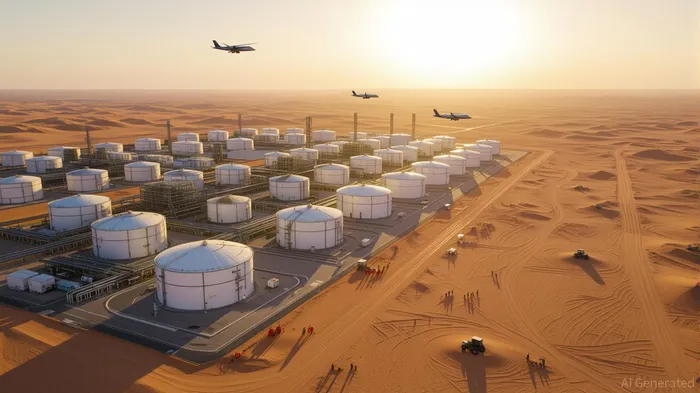
QatarEnergy's $54.5B North Field Expansion aims to boost LNG output to 126M metric tons by 2030, surpassing Russia as the world's top exporter. Partners like ExxonMobil (XOM) and ChevronCVX-- (CVX) stand to profit from joint ventures such as the $10B Golden Pass Terminal in Texas.
Renewables and Diversification:
Qatar's National Renewable Energy Strategy targets 18% renewables in its energy mix by 2030 and net-zero emissions by 2050. Companies like General Electric (GE) gain from supplying turbines for these projects.Strategic Corridors:
Neutral infrastructure like Turkey's TANAP pipeline and the Red Sea-Dead Sea canal project reduce reliance on conflict zones like the Strait of Hormuz.
Investment Opportunity:
Brent crude's five-month high ($73.72/barrel) reflects supply risks. Investors should pair energy exposure with Qatar LNG plays and renewables firms like NextEra EnergyNEE-- (NEE).
Risks and Mitigation Strategies
While opportunities abound, risks loom:
- Sanctions and Volatility: U.S. sanctions on Russia/North Korea could disrupt supply chains.
- AI Disruption: Startups like Anduril threaten traditional defense giants, though established firms are adapting.
- Ceasefire Uncertainty: A lasting Israel-Iran deal could reduce defense spending—monitor diplomatic developments closely.
Portfolio Play:
- Buy: RTX, LMT, QatarEnergy-linked XOM/CVX, and renewables like NEE.
- Avoid: Pure-play Russian equities or Ukraine-specific energy firms.
- Hedge: Use inverse ETFs (e.g., SQQQ) during escalation phases.
Conclusion: Position for Instability, Profit from Chaos
The Middle East's geopolitical quagmire is a tailwind for defense and energy stocks. Investors should prioritize:
1. Defense Contractors with missile, radar, and AI capabilities (RTX, NOC).
2. Energy Infrastructure in Qatar's LNG and renewables (XOM, GE).
3. Diversification to balance short-term gains with long-term risks.
The region's instability isn't ending soon. For those willing to navigate the chaos, these sectors offer unmatched growth potential in 2025 and beyond.





Comentarios
Aún no hay comentarios